
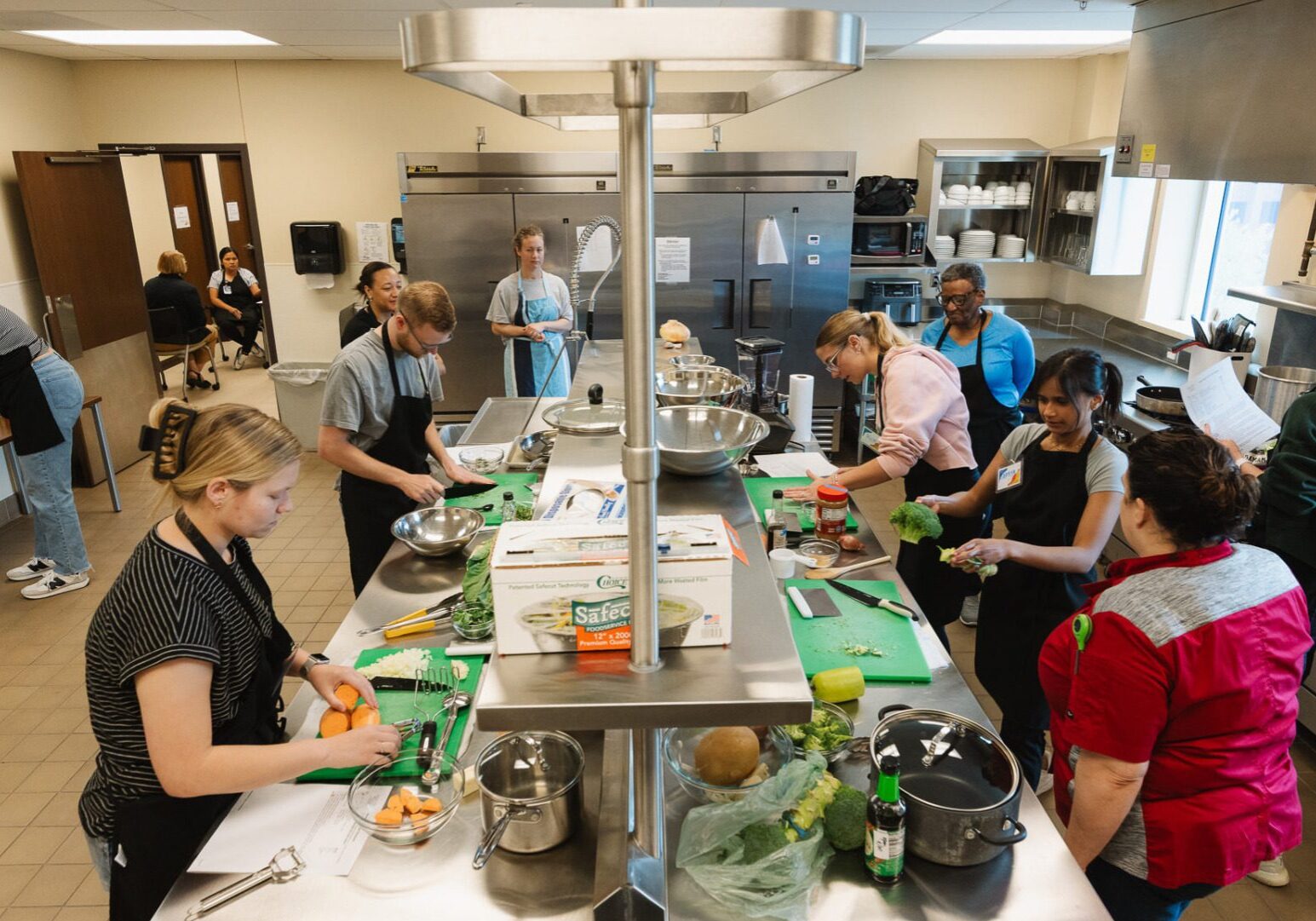
Chef Educator Rachel Ciordas deftly sliced collard greens into a ribbon-like chiffonade as students from the University of Kansas School of Medicine watched with a degree of awe typically reserved for an episode of the Food Network’s “Chopped.”
After Ciordas demonstrated how to peel, chop, or grate the raw ingredients, the future physicians donned aprons and broke into teams. Using tested recipes, they had one hour to cook two low-sodium meals.
The challenge was part of the American College of Culinary Medicine’s Health Meets Food, a hands-on elective for first- and second-year medical students. The curriculum gives students practical tools to treat chronic diet-related diseases, such as obesity, high blood pressure, diabetes, heart disease, and cancer.
Students can read about the low-sodium DASH diet, the predominantly plant-based Mediterranean Diet, and the “Big 9” food allergens. But they also learn to cook collards without bacon, substitute plain yogurt for butter or cream in mashed sweet potatoes, and taste unfamiliar ingredients, such as opo, a fiber-rich squash commonly used in Indian and Chinese cooking.
KU Med’s “farm-to-table-to-clinic” emphasis encourages the students to shop for in-season, locally grown produce and snip fresh basil for their personal use the next time they walk through one of the botanical gardens located on campus.
The students volunteer at Kanbe’s Markets, a Kansas City nonprofit that provides recovered produce in neighborhoods that lack grocery stores, to better the community. Volunteering also helps the students understand barriers, such as food waste and food insecurity, that block some patients from implementing healthier food and lifestyle choices.
Sydney Sample, a third-year medical student, stopped into the kitchen as the finished dishes — pork tenderloin with honey-mustard sauce, mashed sweet potatoes, collard greens, Asian peanut noodles, broccoli, and chocolate avocado mousse — were ready for tasting and review.
“You can think of food as fuel for the body,” Sample said, “but to see how intertwined, not only in each other’s lives and different cultures, but also how impactful food is from an environmental systemic level, is just eye-opening.”

KU Med introduced the Health Meets Food in December 2023, one of more than 60 academic medical institutions across the United States using the curriculum piloted at the Tulane University School of Medicine.
The nutrition information it is providing to its students is as relevant as ever, with budget proposals in Washington threatening to cut off millions of low-income households from food assistance that helps them afford groceries.
Meanwhile, in its 2025 Map the Meal Gap Report, Feeding America calculated that approximately 14% of all Kansans (410,760) are food insecure. The figures in Missouri are 15.4% and 951,330, respectively.
Researchers at the National Institutes of Health pointed to social and cultural trends over the past three decades for the rise in culinary medicine offerings: “Teaching kitchens are positioned at the intersection of culinary, lifestyle, integrative, and conventional medicine as approachable and accessible learning laboratories for behavior change.”
“I think over the last 10 years the data is really robust showing the improvements of chronic disease when these things are implemented for patients,” said David Dungan, a physician at Duly Health and Care in Chicago, who is a certified culinary medicine specialist through the American College of Culinary Medicine. “Covid accelerated this trend. … Patients who were not healthy in a metabolic sense did not do well. They got sick. They died.”
Most medical students receive the bare minimum when it comes to nutrition education, and the hours they put in tend to focus on macro and micronutrients, which does little to prepare them to have conversations about food and nutrition with their patients.
Kerri Dotson, a chef, registered dietitian, and vice president of the American College of Culinary Medicine, supports institutions as they implement a curriculum that encourages collaboration across medical disciplines.
“Our goal is to provide a point of entry for all levels, from the home cook with a lot of knowledge to those who the kitchen freaks them out,” Dotson said. “We’re teaching kitchen confidence: How to come home and walk into your kitchen not feeling anxious and put a meal on the table for your family in 30 to 45 minutes.”
Finding an Audience
Chef Educator Ciordas has been on both sides of the culinary medicine equation: When her son was diagnosed with celiac disease, she received a “mind-numbingly” thick binder of dietary restrictions.
“I hope we’re going to a place where doctors are including the food component in their thinking,” said Ciordas, who writes the subscription newsletter Next Level Gluten Free. “They can make lots of recommendations (based on textbooks), but this gives medical students some real-life experience.”
KU Med physicians Dr. Margaret Smith and Dr. Marissa Love helped introduce the curriculum.
Smith is an associate professor in the Department of Family and Community Health with a secondary appointment in Population Health, and Love is an assistant professor of Allergy, Clinical Immunology and Rheumatology.


Smith had spent most of her career focused on treating obesity. While GLP-1 drugs are helping patients lose weight, her training in culinary medicine has added a broader lifestyle component to counsel them on keeping the weight off.
“I would never say stop taking medications, but I think that we rely so much on those medications and not enough on those things that we can control to help our own health,” Smith said. “Once I had all these tools and knowledge, I was using it in the clinic with my patients, but I was looking for a way to bring it to a bigger audience.”
Love found herself running to the grocery store to familiarize herself with the wide array of alternative yogurts for her allergy patients. It wasn’t long before she understood firsthand that dietary recommendations alone were insufficient.
Some of her patients lacked the time to drive to more than one store in search of specialty items or could not afford the higher prices in the health food section of the supermarket.
“I got tired of telling my patients, ‘OK, you need to avoid X, Y and Z,’ … so we started talking about nutrition and meeting patients where they are at,” she said.


Notoriously rigorous schedules and tight household budgets can mean medical students face the same lifestyle and economic barriers their future patients will face.
“Sometimes at the end of the week, the students say, ‘Man, we ate really well this week!’ “ Love said. “I tell them, ‘Well, now you have the tools to try it out at home.’”
Growing up in a small town in central Kansas, Skyler Forge’s parents grew vegetables and tended wine grapes. He loves to bake, but he’d never taken a cooking class.
“Our education is standardized. We all learn the same general concepts,” Forge said. “The nutrition side can kind of be put on the back burner due to the amount of coursework.”
But Forge learned tips and tricks to cook vegetables from his time in the kitchen, and this summer he has volunteered to spearhead efforts in one of the campus botanical gardens.
Sample, of Jonesboro, Arkansas, had no gardening experience when she took a summer elective about growing and harvesting food. She called her time digging in the soil a “transformative experience” as well as the “mental health reset” she needed.

Recently, Sample has been tracking the sun to find the perfect spot to grow tomatoes on her apartment balcony, and she’s added the pork tenderloin with mustard sauce recipe she learned to make during her “Chopped” session into her regular dinner rotation.
Kailey Rawson, of Prairie Village, Kansas, signed up for the first culinary elective and has gone on to help start a lifestyle medicine interest group and taken a seat on the board of the campus food pantry. She also worked with Love on a research project to investigate nutrition barriers in minority neighborhoods that have historically experienced housing discrimination.
“It’s important for all physicians to understand the patient is a real person who has so much more going on than just a blood pressure reading. They need to get at the social determinants of health so they can treat the patient in a holistic manner,” Rawson said.
Into the Frying Pan
Cecilio Gonzalez gave his thumbs up to the sweet potato mashed potatoes.
“They’re doing a great job,” said Gonzalez, who is working on a master’s degree in dietetics. “Doctors can also give diet advice and recommend the DASH diet, but I think it’s important to know what that looks like by actually being in the kitchen.”
Love and Smith dream of adding a teaching kitchen on the main medical campus that would be open to students, physicians, and the public. Love also has plans to pair students with high-profile restaurant chefs to help cook at charitable events.
Smith rated the value of culinary medicine this way: “We don’t have to smoke, which is one of the things that causes us to have chronic disease. We don’t have to exercise, which is one of the things that prevents chronic disease. But everybody has to eat.”
Jill Silva is a James Beard award-winning food writer. She also works with local chefs, restaurants, farmers, and food artisans.
Reading these stories is free, but telling them is not. Start your monthly gift now to support Flatland’s community-focused reporting.

Related Stories

Nick’s Picks | Rally, Debate, Data Center and More …
Election season is in full swing, with the U.S. Senate race in Kansas taking center stage, including President Donald Trump holding a rally in Wichita.
Kansas City Cooks as Site for National Anti-ICE Dinner Series
Celebrated chefs from throughout the metro collaborated for three nights on dinners that raised money for a local immigrant-rights nonprofit.
Nick’s Picks | Top Cop, Mission Mall, Lucas’ Travels and More …
Nick Haines also has the lowdown on information for the upcoming election, the arrival of fall and Kansas City's Day of the Dead celebration.