
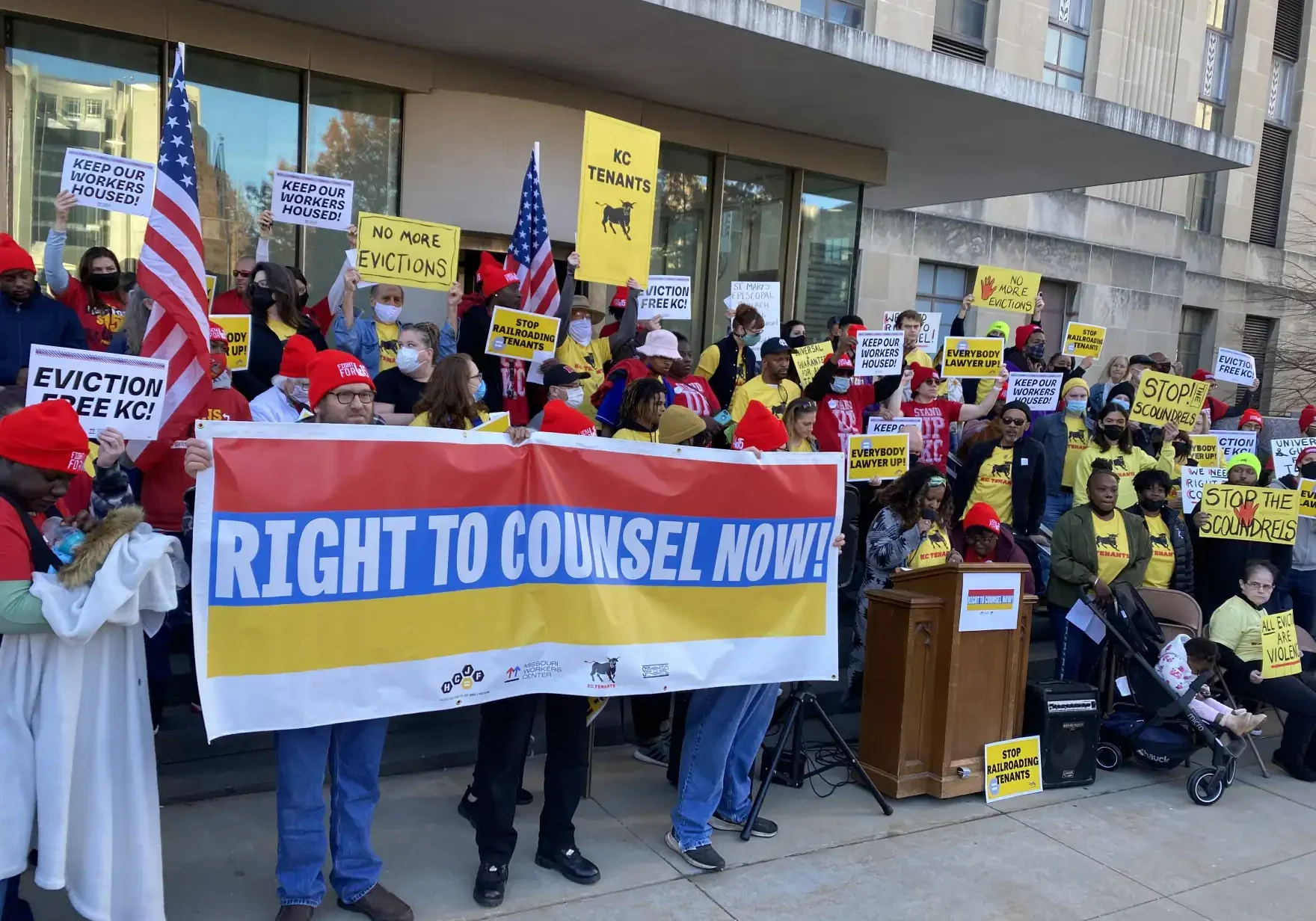
Kansas City Helping Renters Avoid Eviction
Washington University study finds low-income renters three times more likely to have eviction attorney through city's right-to-counsel program.
October 1, 2026 | Lyda Cosgrove | 7 min read
On any given Thursday, a small hallway in the Jackson County Courthouse crowds with tenants, landlords, and attorneys arriving for their scheduled hearings and trials.
The scene unfolds on Floor 7M, which is half the height of the building’s other levels, and is where Associate Circuit Judge Mary Weir recently worked through 55 eviction cases on her 11 a.m. docket.
Most cases would take under a minute. Weir asked each defendant if they had an attorney.
“You can try to represent yourself,” Weir warned one defendant. “But a lot of times people think they can do that, and it’s not easy once the other side starts making legal objections.”
She gestured to the stacks of gold and white flyers in front of the stand — one for rent assistance and one about Kansas City’s right-to-counsel program, which provides free legal representation to eligible tenants facing eviction.
As the court proceedings continued, Natalie Branch, supervising attorney for the eviction defense team at the Heartland Center for Jobs and Freedom, carried the same stack of flyers and approached tenants along the benches.
“Have you heard about the right to counsel program? You may be eligible for access to free legal representation,” she said, sitting with various tenants as they waited for their case to be called.
Branch is one of the many attorneys working through Kansas City’s right-to-counsel program, which the city began in 2022. The city contracts with the Heartland Center, Legal Aid of Western Missouri, and the University of Missouri-Kansas City School of Law to provide the legal representation.
The Numbers
Kansas City created the right-to-counsel program as part of a broader push to assist renters.
The City Council passed the Tenant Bill of Rights in 2019, pushed by groups that included the advocacy nonprofit KC Tenants. The city also hired its first-ever houseless prevention coordinator in 2002.
Eviction protections were a particular focus as pandemic-era protections expired.
New research from Washington University in St. Louis quantified the impact of the right-to-counsel program, finding, for instance, that the percentage of tenants with legal representation more than tripled from 6.4% to 20% between 2018 and 2024.
The study also found that, during the same period, judgments resulting in eviction dropped from 60.7% to 50.9%
Instead of going up against a landlord’s experienced attorney on their own, tenants have someone by their side to guide them through the complexities of court and evictions.
“When you have such an imbalance, such a high asymmetry in knowledge base, you know that the outcome is not going to be favorable to the tenants,” said Yi Wang, the lead author of the Washington University study. She is a postdoctoral researcher at the Bursky School of Public Health, where she studies housing instability and eviction as a public health issue.
Related Content
Leveling the Playing Field
That imbalance can begin even before a tenant steps into the courtroom.
Eviction hearings are typically scheduled during the workday, when tenants may be unable to take time off work. If a tenant does not appear, the case usually results in a default judgment for the landlord.
Wang’s study found these default judgments declined by about 8 percentage points to 37.5% —a direct result of the program’s initiative to keep tenants on track to meet their court dates and requirements.
“Before the program, it was pretty much an automatic pipeline for a landlord to get [an eviction] judgment when they were coming to court asking for one,” Branch said.
Evictions are often more complicated than simply unpaid rent.
Some tenants withhold payment due to neglected health and safety issues at their properties, like infestations or structural hazards. Others may have experienced a major life event, such as a job loss or medical setback.
For one Kansas City tenant, the right-to-counsel allowed her to remain in her home of six years.
The tenant, who asked to remain anonymous, suffered a heart attack, which forced her to miss work and fall behind on rent and bills while recovering.
After hearing about the program in her initial court hearing, she connected with an attorney at the Heartland Center who helped negotiate a payment plan, and she continued making payments from each paycheck until she caught up.
“Everybody’s one paycheck away from being evicted, and between rent and bills and life, I fell behind,” the tenant said. “Without an attorney, it feels like poor people are being punished for being poor. This program gives voice to the voiceless.”
Branch says tenants who attempt to represent themselves are often vulnerable to agreements with legal details and jargon they may not fully understand. The program helps tenants tell their stories, assert their rights and negotiate a new agreement, like a payment plan or extended move-out date.
“We help tell the human story, rather than it just being another number to the landlord,” Branch said.
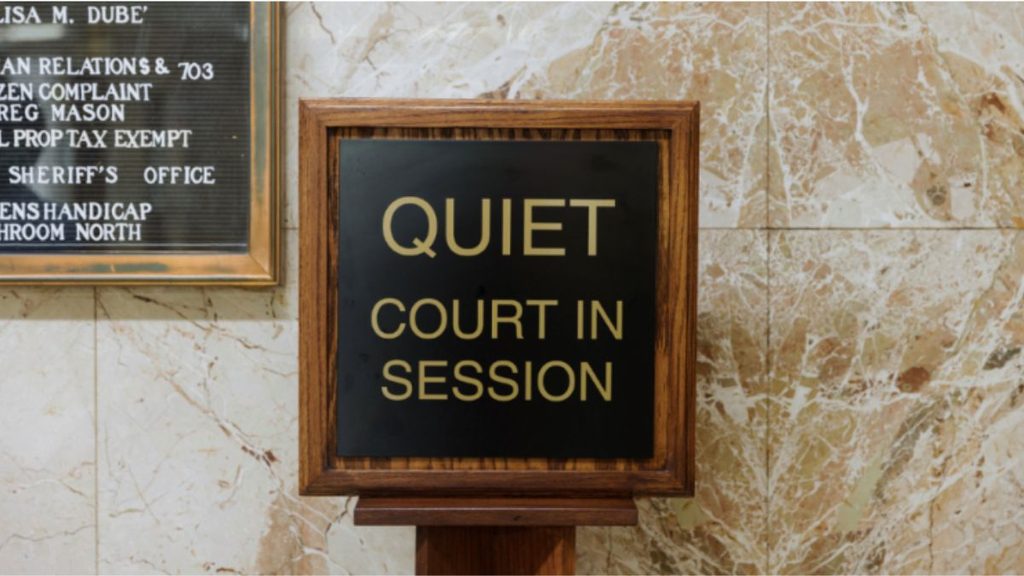
Wang’s findings still mean that 80% of tenants are still going through eviction court without attorneys.
The Heartland Center, for example, has received an average of 55 requests for legal representation per week in 2026, according to Branch. So far this year, they have had to decline 152 tenant requests. To Branch and Wang, the reason for this is simple: there are not enough lawyers to meet demand.
“There are tenants who are supposed to have a right to counsel but are getting declined and having to go through the eviction without that representation,” Branch said. “More attorneys would mean fewer declines, or, obviously, the goal is no declines, and more funding would allow us to do that.”
Initially launched with federal pandemic relief funds, Kansas City’s right to counsel program is now supported through the city’s budget, which has allocated $2.6 million annually for fiscal years 2026 and 2027.
“We know that Kansas City’s right to counsel program is really well funded compared to what we have here in St. Louis,” Wang said. “St. Louis passed a tenant counsel bill right after Kansas City, but our program was so poorly funded that you basically cannot see any visible improvement in the tenant legal representation.”
Ripple Effect
The Washington University study also looked beyond Kansas City, comparing its eviction outcomes with those in nearby Grandview and Raytown, two communities that were not covered by Kansas City’s right to counsel program.
Because tenants in all three communities move through the Jackson County court system, the comparison provided a way to account for broader changes affecting eviction cases across the area. Grandview and Raytown also saw declines in eviction judgments during the study period, though not as large as Kansas City’s.
Branch said the program has also had a noticeable effect on the court system itself. By regularly bringing tenants’ rights issues before judges, right-to-counsel attorneys have been able to educate the courts about tenant protections.
“It’s been really interesting to bring these issues to light and kind of help educate the courts,” Branch said. “After a while, the judges become familiar with those things, and the court is more likely to acknowledge it. We have seen shifts on several issues like that where the courts are more aware and receptive to enforcing the tenants’ rights.”
Kansas City’s right to counsel program may not be able to represent every tenant at risk of eviction, but its impact is evident, according to Gary Rhoades, executive director of the Heartland Center.
Heartland’s attorneys have seen how the program has had a broader ripple effect beyond the courtroom. Rhoades said preventing evictions can reduce the costs communities take on when families lose their homes — from shelter and housing assistance to increased health costs associated with eviction.
“These programs are such a good investment for our community,” Rhoades said. “When you have so many families avoiding eviction, that saves a community.”
Reading these stories is free, but telling them is not. Start your monthly gift now to support Flatland’s community-focused reporting.

Related Stories

Nick’s Picks | Obama Visits KC, Debates and Fall’s Arrival
Obama in KC With Election Day just six weeks away, some of the nation’s top political names are now rolling through Kansas City. Last week, Vice President JD Vance was in town. This week, it’s Barack Obama. The former president takes the stage Saturday at the Overland Park Convention Center for a leadership event hosted…

Preparations Aside, KC World Cup was Quiet for Hospitals, Police
Officials said months of planning will serve them well in the year's to come through improved collaboration.

Nick’s Picks | Veep, Gerrymandering, Football and More …
Vance Lands in KC Again … Vice President JD Vance will make two stops in the Kansas City area today, his second visit to the metro in less than four months. The White House says Vance will visit a federal law enforcement facility in Kansas City, Missouri, to highlight the Trump administration’s crackdown on fraud….