
Alzheimer’s Panelists Point To Progress In Diagnosis, Treatment
November 24, 2015 | Mike Sherry | 3 min read
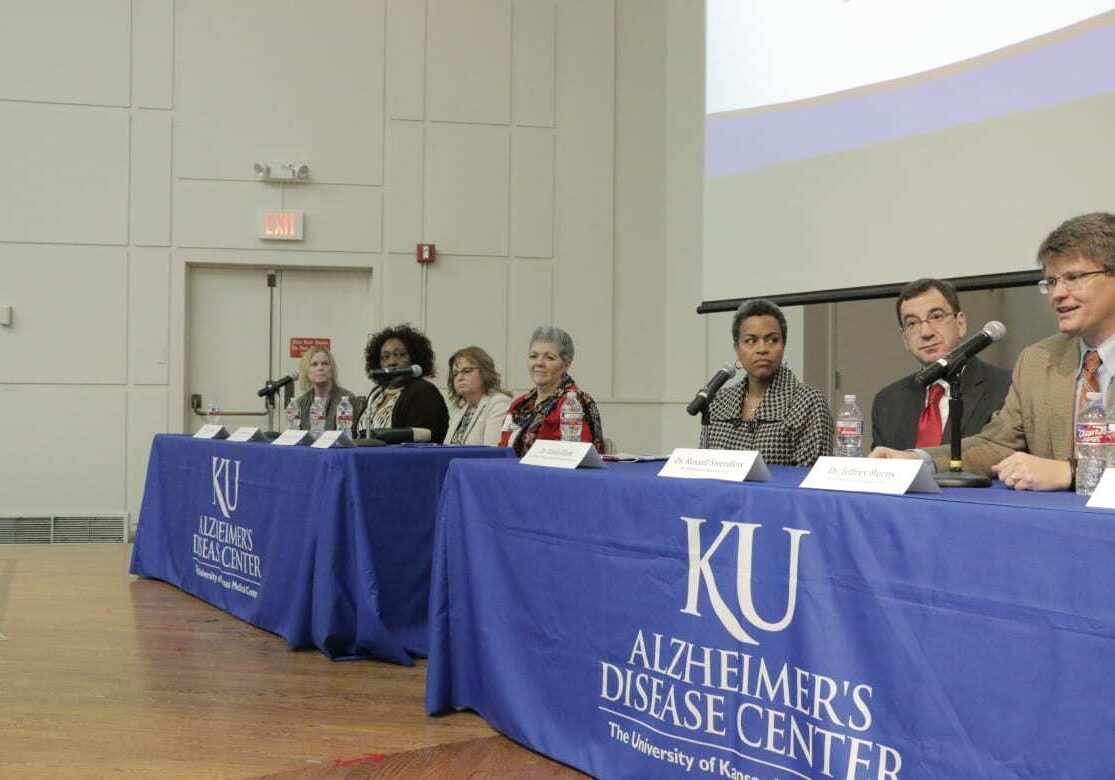
Two University of Kansas Medical Center researchers at the forefront of national efforts to treat Alzheimer’s disease said scientists are making strides toward reducing the prevalence of a condition that affects as many as 5.1 million Americans.
Key aims include early detection and halting the progression of the disease, said Dr. Jeffrey Burns, a leader of the KU Alzheimer’s Disease Center (KUADC).
“We think that day is coming,” said Burns, who spoke at a public forum on the KU Med campus Monday in Kansas City, Kansas. The KUADC co-sponsored the event with the U.S. Department of Health and Human Services (HHS).
The KU Alzheimer’s Disease Center is one of 29 federally designated centers, through the National Institute on Aging.
Burns and Dr. Russell Swerdlow, the director of the center, outlined some of the research at the center, which includes studies on how exercise can prevent or delay the onset of Alzheimer’s.
Some data suggest 75 minutes of moderate aerobic exercise a week can have a positive effect, Burns said.
Alzheimer’s researchers, he said, now have a diagnostic method in which a dye injected into the body can highlight the buildup in the brain of a protein linked to Alzheimer’s before any outward symptoms appear.
Swerdlow is researching the link between brain energy metabolism and Alzheimer’s. He’s also experimenting with stem cells in animal models to stimulate growth of brain cells.
The forum also featured a number of other panelists, including representatives from local service and advocacy organizations.
Other panelists suggested the need for greater focus on people with developmental disabilities and the need for innovative ways to assist people with Alzheimer’s disease and their families – such as establishing day programs for people not yet suffering from advanced forms of the disease.
Linda Elam, a deputy assistant secretary with HHS, said the U.S. health care bill for Alzheimer’s and related dementias is about $109 billion a year. In addition, she said, family caregivers collectively miss out on about $50 billion in wages because of their responsibilities.
“Even given that dismal background, we have reason to hope,” she said.
Elam pointed to the National Plan to Address Alzheimer’s Disease, established nearly five years ago with the enactment of the National Alzheimer’s Project Act. The aim of the plan is to:
- Coordinate Alzheimer’s disease research and services across all federal agencies.
- Accelerate the development of treatments that would prevent, halt or reverse the course of Alzheimer’s disease.
- Improve early diagnosis and coordination of care and treatment of Alzheimer’s disease.
- Decrease disparities in Alzheimer’s disease for ethnic and racial minority populations that are at higher risk for the condition.
- Coordinate with international bodies to fight Alzheimer’s disease globally.
The goal is to find a way to prevent and effectively treat Alzheimer’s by 2025.
“Will we make it by 2025? I’m not sure,” Elam said. “But we are driving very hard toward it.”
Reading these stories is free, but telling them is not. Start your monthly gift now to support Flatland’s community-focused reporting.

Related Stories

Kansas City Helping Renters Avoid Eviction
On any given Thursday, a small hallway in the Jackson County Courthouse crowds with tenants, landlords, and attorneys arriving for their scheduled hearings and trials. The scene unfolds on Floor 7M, which is half the height of the building’s other levels, and is where Associate Circuit Judge Mary Weir recently worked through 55 eviction cases…

Nick’s Picks | Costco, Homicides, Rain and More …
Is Missouri's congressional map saga over? It seems so, but who knows if there will be another twist or turn. That story and more ...

Nick’s Picks | Obama Visits KC, Debates and Fall’s Arrival
Obama in KC With Election Day just six weeks away, some of the nation’s top political names are now rolling through Kansas City. Last week, Vice President JD Vance was in town. This week, it’s Barack Obama. The former president takes the stage Saturday at the Overland Park Convention Center for a leadership event hosted…