
Enrollment Down in Federal Nutrition Program
January 7, 2014 | | 5 min read
Mike Sherry – The Hale Center for Journalism
For officials in Johnson County, and across the country, it’s plain to see that enrollment is down in a federal nutrition program for low-income pregnant women and their children.
Less clear, however, is why.
“That seems to be the question that no one has the answer for,” said Laura Drake of the Johnson County Department of Health and Environment.
She is county manager of a program commonly known as WIC, though its official name is the Special Supplemental Nutrition Program for Women, Infants and Children. The federal program started as a pilot in 1972.
Observers said a number of factors could be suppressing WIC caseloads, even as some families continue to struggle with the effects of the recession. The potential causes include demographics or simply an inability among potential applicants to make it to an office.
According to Johnson County data, the number of WIC participants dropped by approximately 14 percent in 2013. The county now has a caseload of about 5,800 individuals on an annual budget of approximately $1.1 million.
Yet poverty is not declining in the county, according to United Community Services of Johnson County, a research and advocacy organization.
UCS said the poverty rate in the county stood at 6.8 percent in 2012, up from a pre-recession level of 4.7 percent. Children (ages 0-17) accounted for one-third of county residents living below the federal poverty level, according to the data.
The number of WIC participants dropped nationwide by about 5 percent during a five-year period running through early December, according to figures from the U.S. Department of Agriculture.
During that period, caseloads in Kansas and Missouri dropped 8.3 percent and 6.4 percent respectively.
The national caseload now stands at about 8.6 million individuals. WIC provided about $6.8 billion in grants to states last year. In addition to serving women who are pregnant or new mothers, the program covers children up to age 5.
Applicants must have income at or below 185 percent of the federal poverty level, which would equal $43,567 for a family of four. They can also receive food stamps.
Eligible purchases through the program include juice, milk, fruits and vegetables, breakfast cereals, and whole wheat bread.
Officials at the Kansas Department of Health and Environment commented through a spokesperson about the declining enrollment in WIC, saying that rolls could fluctuate simply because an employer comes to (or leaves) a community.
They also said some clients might have assumed WIC had closed during the partial shutdown of the federal government in October, though that was not the case, the spokesperson said.
Drake has also considered the government-shutdown theory for a reason the office’s caseload was down significantly in November compared with the year before.
A longer-term effect, she said, could be a lack of transportation among potential clients or a fear among undocumented workers that the office will report them to immigration authorities, which Drake said they do not do.
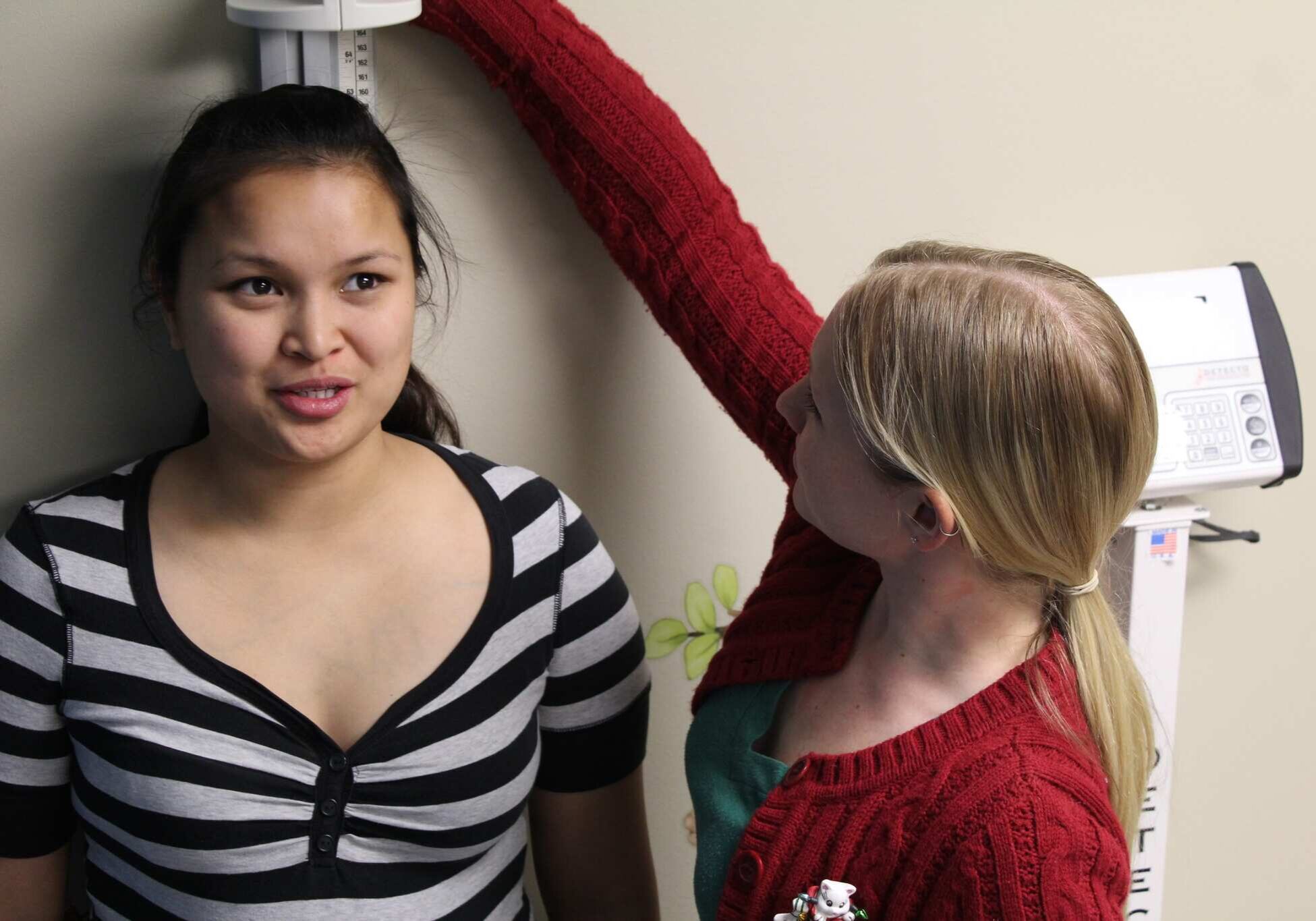
Dietician Kelly Green (right) measured Maria Alano, of Overland Park, during Alano’s recent visit to the Johnson County Department of Health and Environment. County officials are worried that other pregnant women are not taking advantage of a federally funded nutrition program. (Mike Sherry/The Hale Center for Journalism)One other possibility, she said, is that potential clients view food stamps as an easier alternative with a broader range of acceptable food purchases. WIC requires clients to undergo nutrition counseling and to come in for periodic weighing and measuring.
Drake worried that a continued drop in enrollment could mean less funding for the Johnson County program from the state, even though she is convinced there is unmet need in the county.
She said officials on the state and local level are redoubling outreach efforts to get the word out to potential clients.
In Washington, D.C., the nonprofit National WIC Association lobbies on behalf of state and local WIC agencies. The Rev. Douglas A. Greenaway is president and chief executive of the association.
He said it would be nice to attribute the smaller caseloads to a lack of need, but, he said, “With poverty at levels it hasn’t been in some time, the level of income inequality that is out there, stagnant wages for those at the bottom, WIC still obviously has a place.”
He said caseloads might rebound if birthrate increases after some families feel more financially secure as the recession eases.
Greenaway said more women might also turn to WIC now that additional funding for food stamps, authorized as part of the 2009 federal stimulus bill, expired in November.
On the day before Christmas, Maria Alano, 24, of Overland Park, was at the Johnson County WIC office in Mission. She is pregnant with her third child, a boy, who is due in April.
The program, she said, supplements the income she and her boyfriend make as nursing aides in retirement centers.
Through WIC, Alano said, she can buy the grapes that her children love. It also satisfies her occasional craving for milk.
“And that’s the thing,” she said. “With pregnancy, it’s kind of what you are in the mood for.”
Major Funding for Health coverage on KCPT provided by Assurant Employee Benefits and the Health Care Foundation of Greater Kansas City
Reading these stories is free, but telling them is not. Start your monthly gift now to support Flatland’s community-focused reporting.

Related Stories

Nick’s Picks | Obama Visits KC, Debates and Fall’s Arrival
Obama in KC With Election Day just six weeks away, some of the nation’s top political names are now rolling through Kansas City. Last week, Vice President JD Vance was in town. This week, it’s Barack Obama. The former president takes the stage Saturday at the Overland Park Convention Center for a leadership event hosted…

Preparations Aside, KC World Cup was Quiet for Hospitals, Police
Officials said months of planning will serve them well in the year's to come through improved collaboration.

Nick’s Picks | Veep, Gerrymandering, Football and More …
Vance Lands in KC Again … Vice President JD Vance will make two stops in the Kansas City area today, his second visit to the metro in less than four months. The White House says Vance will visit a federal law enforcement facility in Kansas City, Missouri, to highlight the Trump administration’s crackdown on fraud….