
Children’s Mercy Hospital develops app for infant heart defects
November 20, 2014 | Alex Smith | 3 min read
About 3,000 infants are born each year with single-ventricle heart defects.
While that’s a relatively small number, for the newborns’ families the diagnosis can be devastating, says Dr. Girish Shirali, co-director of the Ward Family Heart Center at Children’s Mercy Hospital in Kansas City.
“It’s very difficult for families, because nobody expects this. So it kind of comes like a bolt from the blue,” he says.
These infants have underdeveloped lower heart chambers, or chambers that are missing a valve. They typically need three major heart surgeries to redirect blood circulation, including one within a few days of birth.
The period between that surgery and the second one a few months later is perilous. As many as one in five newborns with the diagnosis die in the first few months of life, and their condition needs to be carefully tracked and recorded for danger signs.
During that critical time, it’s usually up to the parents to closely track their babies’ oxygen saturation levels and weight at home.
“One of our concerns has been just the amount of stress that that puts on the families, because the responsibility is kind of now shifted on to them,” Shirali says.
In the past, when parents of newborns with single-ventricle heart defects left the hospital, they usually brought home both their baby and a big, clunky three-ring binder.
But at an American Heart Association conference today in Chicago, Shirali will introduce a tablet-based app that could make a big difference in monitoring and treating these conditions.
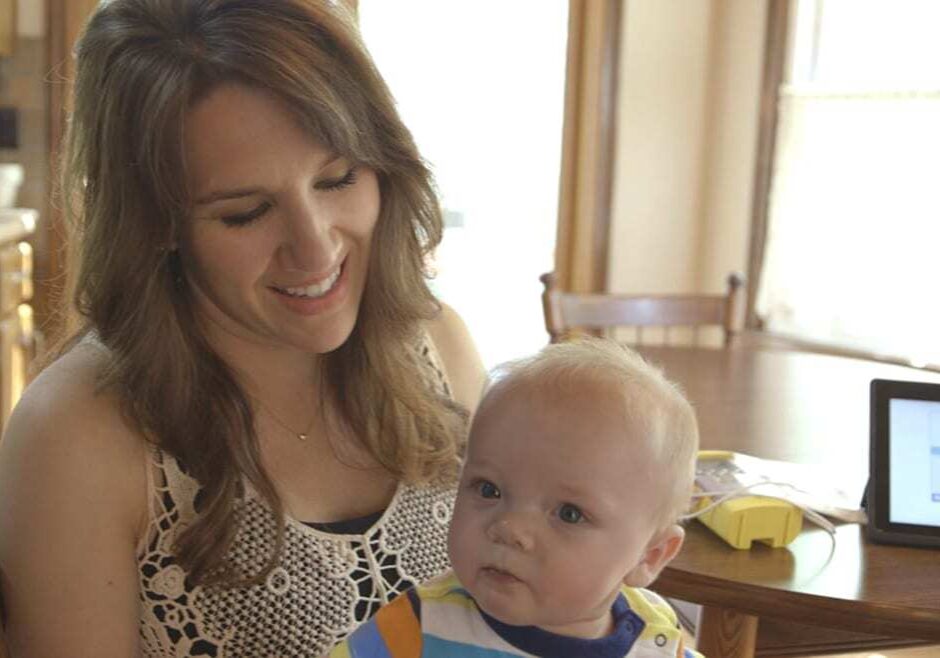
The app, created by Children’s Mercy researchers, is called the Cardiac High-Acuity Monitoring Program, or CHAMP. It connects via Bluetooth to oxygen meters and sends the oxygen saturation data along with weight and feeding information to the infant’s pediatric team.
“So then situations that we consider high risk, for example, the coordinator’s pager might go off instantly, as soon as they confirm the saturation level is too low,” Shirali says.
If the team sees warning signs in the data, it may ask the parents to bring the infant in for emergency treatment.
The app can also send videos showing how an infant is breathing and interacting.
“If they’re feeling good, they lock eyes with their parents, and they start to smile and coo and gurgle and interact, which is just great,” Shirali says. “And if they’re not feeling that good, they get a little furrow between their eyes, and they don’t feel like smiling. They’re very straightforward and simple, these babies.”
Shirali says that it’s hard for now to say what effect the app might have on mortality rates. A test group of 18 families used the device along with other new interventions, and the outcomes were promising.
“We have not lost any of those babies,” he says. “And that’s been really exciting for us, because, on average, out of 18, we would expect to lose two or four by this time.”
Shirali says he’s also excited about other potential uses for the technology, including monitoring of blood pressure, diabetes and asthma. And not just for newborns, but for adults as well.
The app was developed in collaboration with the Claire Giannini Fund and Heart to Heart Network, Inc. The fund has financed the distribution of 200 units nationally.
Reading these stories is free, but telling them is not. Start your monthly gift now to support Flatland’s community-focused reporting.

Related Stories

Nick’s Picks | Messi, Jail, Buses, and More …
World Cup Team(s) Arrive It’s starting to feel real. The first World Cup team has landed in Kansas City. Defending champions Argentina touched down at KCI airport on Sunday and will begin practicing today at Sporting KC’s training facility in Wyandotte County. Much of the attention, of course, is focused on Lionel Messi. The soccer…
World Cup ‘Statement Piece’ Evokes Best Version of Kansas City
Before I moved to Kansas City almost 56 years ago, I had been here only once — for a brief visit to the Kansas City Press Club when I was attending the University of Missouri School of Journalism. But because of that visit and the fact that I grew up in the Midwest (Woodstock, Illinois,…
KU Center Helps Women Gain Foothold After Incarceration
A flier from her probation officer was the turning point for Jodi Whitt, who had spent more than two decades in and out of the criminal justice system. The piece of paper introduced Whitt to the Technology Education Program offered by the University of Kansas’ Center for Digital Inclusion. Since 2019, Whitt has risen through…