
The Declaration at 250: How Expansionism Helped Fuel A Revolution
Patriots Bristled at British Restrictions on Moving Westward
June 16, 2026 | Brian Burnes | 11 min read
Editor’s Note: With the 250th anniversary of the Declaration of Independence close at hand, Flatland is looking at how the historical document influenced the development of Kansas City and highlighting programming examining the legacy of the Declaration, including a panel discussion hosted Thursday by American Public Square, one of our partners in the KC Media Collective.
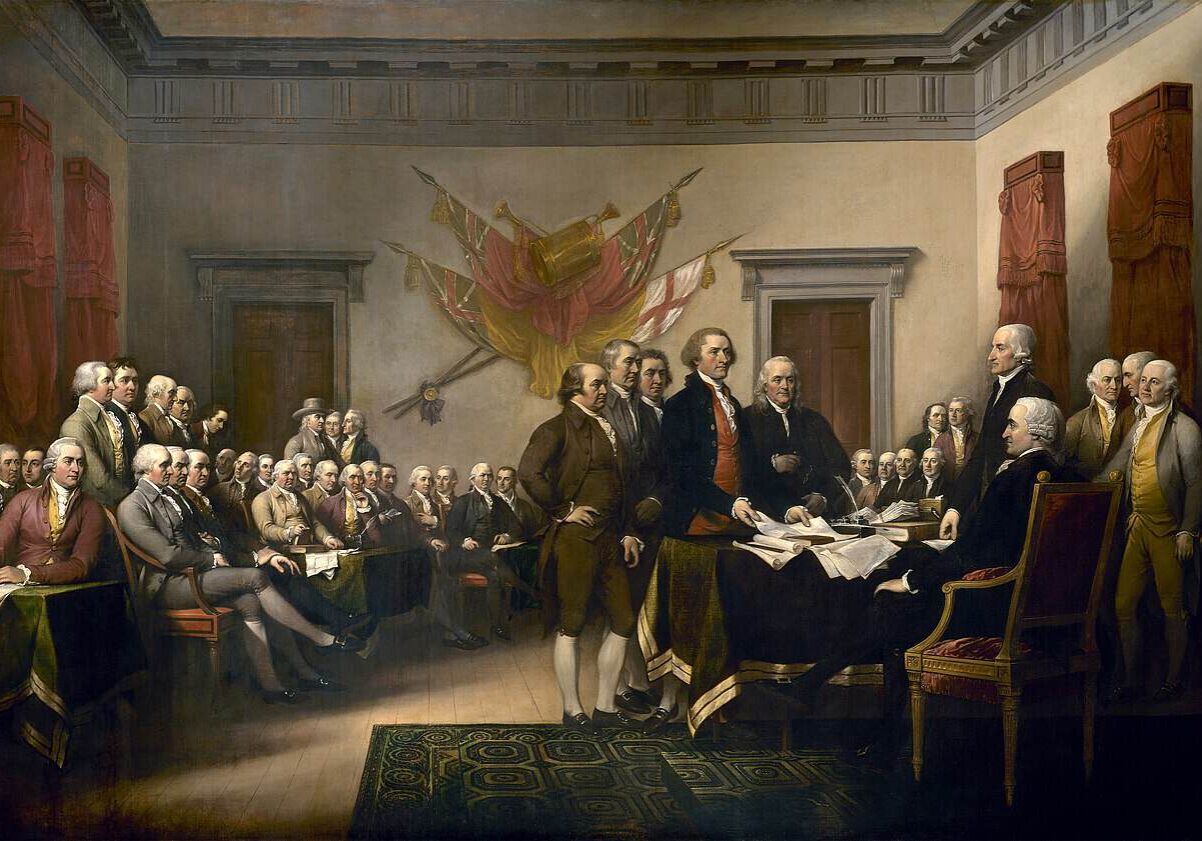
When delegates to the Second Continental Congress adopted the Declaration of Independence 250 years ago next month, some celebrated — but not all.
First, there was the small matter of whether the sometimes shoeless colonial military could somehow defeat Britain, the global superpower with an unrivaled Navy.
Only after that could the elite gathered in Philadelphia begin thinking about creating a coherent federal government that would not abuse its powers, levy random taxes, or in any way resemble the tyranny they were trying to defeat.
Because the Declaration did not come with an owner’s manual, the new nation’s founders had to ratify a constitution in 1788 before Virginia congressional representative James Madison could introduce what became the Bill of Rights.
Ultimately, 11 states ratified the slate in 1791, enshrining rights to freedom of speech (the First Amendment), the right to bear arms (the Second), and eight others.
“I think of the Bill of Rights as the ‘belt and suspenders’ approach,” Nadine Strossen, a former president of the American Civil Liberties Union, said in a recent interview. Strossen is moderating a local panel this week put on by American Public Square.
“The belt already had existed in the original Constitution, but they added the suspenders because some of the states said they were conditioning ratification of the Constitution on the addition of the Bill of Rights.”
Local Events
- Self-Evident Truths: Grading the Declaration of Independence’s Legacy at 250: Hosted by American Public Square on Thursday at 6 p.m. in Yardley Hall at Johnson County Community College.
- Celebrating America 250: Made with Love: Hosted by Kansas City PBS on Aug. 22 from 9:30 a.m. to 3 p.m.
National PBS Programming (Check Local Listings)
- Declarations: Black Americans and the Revolutionary War: The one-hour film explores the heroic stories of enslaved and freed Black Americans who fought to define democracy and ensure their liberty through the Revolutionary War. Premiers June 29.
- Lucy Worsley Investigates: The American Revolution: The British historian explores the sabotage, espionage, and unrest that led to the birth of a new nation.
- Revolutionary War Weapons: NOVA explores key military technologies in the American colonies’ fight for freedom.
Strossen, a First Amendment scholar and professor at New York Law School, will be joined by others from across the country to discuss how the nation has lived up to the principles articulated in the Declaration. The panel includes Lindsay Chervinsky, a presidential historian and executive director of the George Washington Presidential Library at Mount Vernon, Virginia.
The program “will be a constructive critique of what we got right and what we got wrong; where we are living up to the ideals stated in the Declaration of Independence and where we continue to fall short,” Strossen said.

“We are celebrating 250 years of independence at a time when Americans have historic low levels of trust in democratic institutions, and we often disagree on what patriotism means,” said Tricia Marsee Maxfield, American Public Square program director.
“We hope to bring a panel of legal and historical experts together, in the same room, to wrestle with this treasured document, the Declaration of Independence.
“But let’s not be too heady,” she added. “We also want to celebrate a huge birthday and the Declaration of Independence’s success. It has been the envy of the world.”
Gen. George Washington ordered the document read to colonial troops in Manhattan on July 9. Citizens of Manhattan, when learning of it, soon toppled a nearby statue of George III.
The text first appeared in newspapers in Philadelphia (on July 6), Boston (on July 18), and Virginia (on July 20).
Reliable word of the Declaration would not reach Missouri, then part of the vast Spanish Empire known as Upper Louisiana, for two years.
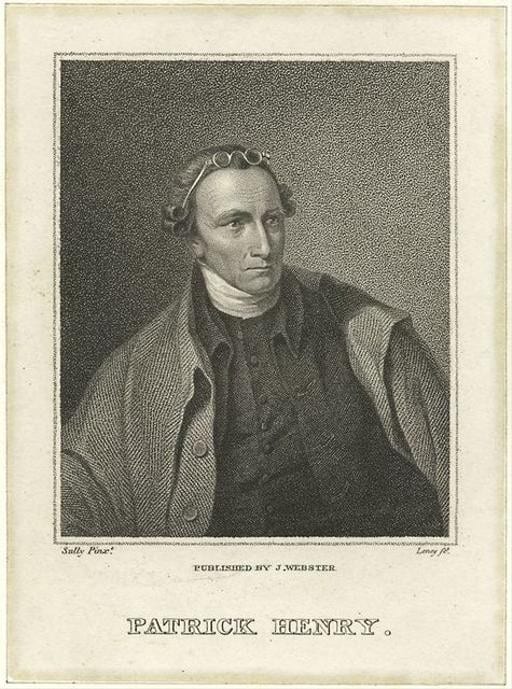
Patrick Henry, he of “Liberty…or…Death!” fame, would play a role in that.
Met with a shrug by some
If some believe the Declaration’s 250th anniversary is occurring during a time of division and doubt, that is nothing new, according to Chervinsky.
In a recent post on her “Imperfect Union” Substack, Chervinsky details how four different 50th anniversary observances, starting in 1826 and running through 1976, also occurred during challenging times.
In 1826, citizens were rattled by the deaths of John Adams and Thomas Jefferson on the very same day – July 4. John Quincy Adams, then president and son of John, wrote in his diary that “The time, the manner, the coincidence with the decease of Jefferson are visible and palpable marks of divine favour.”
Perhaps, Chervinsky writes, “providence had shined on the nation, but many Americans wondered whether the nation would survive without the leadership of the founding generation.”
Meanwhile, in 1976, she adds, “Trust in public institutions and government officials was at an all-time low (thus far), and the age of American hegemony after World War II appeared to be in a fatal decline.”
President Richard Nixon had resigned in 1974 during the Watergate scandal, and South Vietnam fell to North Vietnamese troops a year later.
And yet, she adds, the 1976 Bicentennial is today remembered by many as a joyous event, marked by the visit of the “Tall Ships,” representing 30 nations, gathered in New York Harbor, and by Johnny Cash joining the Mormon Tabernacle Choir on the National Mall in Washington, D.C.
It’s possible, Chervinsky writes, that something similar could happen in 2026, even though much of the country resembles a “complacent society” as the members of the World War II generation — sometimes known as the “Greatest Generation” — continue to pass.
The approximately 30,000 to 45,000 veterans who may yet be alive represent less than 0.2% of 16.4 million Americans who served.
What they fought to preserve is met with a shrug by some, Chervinsky writes.
“Many younger Americans don’t believe in democracy and don’t think it’s worth fighting for,” she writes.
But, she adds, “Maybe the anniversary is an opportunity to inspire the younger Americans just as 1976 did for a previous generation.
‘It is an opportunity to remind us all of the incredible inheritance of this nation and our collective responsibility to make it more perfect for those who follow.”
Secret orders from Patrick Henry
In his approved text of the Declaration of Independence, Jefferson’s litany of grievances against George III included the king’s restriction of the westward growth of the colonies.
One example was the Proclamation of 1763, which had banned independent colonial settlement west of the Appalachian Mountains.
Henry continued to keep his eyes on that prize as the Revolutionary War continued.
His ambitions indirectly contributed to, decades later, the establishment of what became Kansas City.
In the 1770s, approximately 1,500 people of European descent and enslaved persons lived in what is now Missouri, alongside many thousands more of indigenous nation members.
Prominent among the former were members of the Chouteau fur-trading family, who did not learn of the 1776 signing of the Declaration until almost exactly two years later, upon the arrival of military commander George Rogers Clark.
As Virginia governor, Henry had dispatched Clark west with secret orders to capture British-held forts north of the Ohio River in what then was known as the Illinois Country.
American settlers in western Virginia and the colony’s annexed Kentucky district had suffered attacks by indigenous tribes that Henry believed were being armed by the British.
Ostensibly, Clark’s 175-man militia was to protect those settlers.
Henry, however, was eager to assert patriot interests to the vast territory north of the river, then controlled by the British.
On July 4, 1778, Clark’s militia surprised the British-held fort at Kaskasia, some 60 miles south of St. Louis, and took it without a shot being fired.
Dignitaries welcomed the victorious Clark in St. Louis, among them Capt. Fernando de Leyba, lieutenant governor of the Spanish-controlled Upper Louisiana, and Auguste Chouteau, a stepson of French fur-trader Pierre Laclede.
Chouteau would take his stepfather’s fur-trading initiative and build it into an empire.
In the westernmost conflict of the American Revolutionary War, Spanish troops — with Chouteau joining them — defeated British forces in the 1780 Battle of St. Louis.
The British surrendered at Yorktown, back in Virginia, the following year.
Chouteau then began building a fur-trading monopoly with the Osage Nation, whose members harvested pelts primarily along the rivers in what is now western Missouri.
In 1795, the family built Fort Carondolet for Spanish troops (as well as a family trading post) in what is now Vernon County, 115 miles southeast of Kansas City.
And in 1821, the same year Missouri entered the Union, Francis Chouteau, a nephew of Auguste, with his wife Berenice, established the first permanent trading post near the confluence of the Missouri and Kansas rivers that would become Kansas City.
Speech you love or loathe
On April 26, 1777, less than a year after the Declaration was adopted, John Adams wrote to his wife Abigail lamenting that posterity “will never know how much it cost the present Generation to preserve your Freedom!”
“I hope you will make good use of it,” he wrote, adding, “If you do not I shall repent in Heaven, that I ever took half the Pains to preserve it.”
Yet for all the trouble the country’s founders endured, Strossen said, the Declaration, along with the Constitution and Bill of Rights, doesn’t seem as necessary to some today.
She remembers the many surveys conducted by free speech advocacy groups during the Bill of Rights bicentennial in 1991.
“Most people did not know what the First Amendment of the Bill of Rights was, and when they were told what it was, a substantial majority said, ‘Let’s get rid of it.’ “
One frustration for Strossen and other First Amendment scholars is the narrow view some Americans take on one of its fundamental principles.
“Virtually everybody says ‘I support free speech, I oppose censorship,’ ‘’ Strossen said.
“And then virtually everybody wants to make exceptions to speech that is constitutionally protected.”
One dramatic example of that prompted the American Civil Liberties Union to recently represent the National Rifle Association.
Following the 2018 mass shooting at a Parkland, Florida, high school, which left 16 people dead and 17 injured, the head of the New York State Department of Financial Services urged banks and insurance companies operating in the state to cut ties to the NRA, citing possible “reputational risks.”
The NRA sued the state official, as well as then New York Gov. Andrew Cuomo, arguing that leveraging state regulatory power to enact a boycott of an advocacy organization violated that organization’s First Amendment rights
The ACLU signed on not only to defend the NRA’s right to advocate against gun control legislation, Strossen said, but also to prevent a precedent.
If a state were allowed to use regulatory powers to control the speech of the NRA, other states could follow the same plan, for instance, to silence the speech of organizations advocating pro-choice abortion policies.
In 2024, the U.S. Supreme Court agreed, ruling unanimously in favor of the NRA.
Strossen, who served as ACLU president from 1991 through 2008 and was not a member of the ACLU leadership team at the time, fully supported the organization’s advocacy on the NRA’s behalf.
“If the Cuomo administration could get away with silencing the NRA,” Strossen said, “then this same administration could get away with silencing Planned Parenthood.”
“It was the ‘viewpoint-neutral’ principle that the Supreme Court has called the bedrock of the First Amendment,” she added.
“When the ACLU famously or infamously defended the freedom of speech of Nazis in Skokie, that was a principle that redounded to the benefit of anti-Nazis across the country,” said Strossen.
In 1977, the ACLU represented the National Socialist Party of America, then planning a rally in Skokie, a Chicago suburb which had a large Jewish population, a significant number of them Holocaust survivors.
Skokie officials attempted to block the rally through legal injunctions and ordinances.
Ultimately, the Supreme Court in 1977 ruled in favor of the neo-Nazis, determining that Skokie’s attempt to ban the display of uniforms and associated Nazi imagery, such as swastikas, would violate their constitutional rights.
“Most people believe in freedom of speech for me, but not for thee,” Strossen said.
“But it doesn’t work that way. If you like freedom of speech for what you love, you have to defend it for the speech that you loathe.”
Reading these stories is free, but telling them is not. Start your monthly gift now to support Flatland’s community-focused reporting.
Related Stories
25 Years Later, Still Trying to Make Sense of 9/11
Flatland columnist Bill Tammeus reflects on the "misguided, ugly and wildly destructive version of Islam" that drove the 9/11 hijackers.

The Checkered History of Bruce R. Watkins Drive
East Side residents have long complained that this stretch of U.S Highway 71 cleaved Black neighborhoods. The road is also considered unsafe for pedestrians and drivers.
Restoration of Black church in Parkville inspires rainbow coalition
The community has rallied around the restoration of Parkville, Missouri's, Washington Chapel. Built in 1907, the chapel has been a haven for a Black population that has not always been welcome in town.