
City Dwelling Growers Provide a Fresh Alternative to the Grocery Aisles
Sunday's Urban Grown Tour offers a glimpse of the Kansas City plots that are ‘hidden all around you.'
September 10, 2026 | Jill Wendholt Silva | 10 min read
Unnerved by summer’s wave of foodborne illnesses?
“These are the moments when people recognize the value of our local food systems,” Ami Freeberg said of the headlines warning consumers to avoid shredded lettuce, berries, jalapeños, alfalfa sprouts, and ricotta cheese.
Freeberg is the director of strategy and partnerships for Cultivate KC, a non-profit organization dedicated to growing food, farms, and community interested in sustainable and healthy food sources.
The organization is hosting a self-guided Urban Grown Tour from 10 a.m. to 4 p.m. on Sunday. The event provides an opportunity to visit 15 farms and gardens showcasing sustainable agriculture practices.
“Every time I tell people what I do, (they respond), ‘I didn’t know there were urban farms.’ Let alone 15,” said Jessica Garcia, Cultivate KC’s education specialist, “but they’re actually hidden all around you.”
Flatland is profiling a diverse sampling of the participating growers. The full list of sites and more information about the event is here.
Kansas City Urban Farm Co-Op
5051 E. Gregory Blvd., Kansas City, Missouri
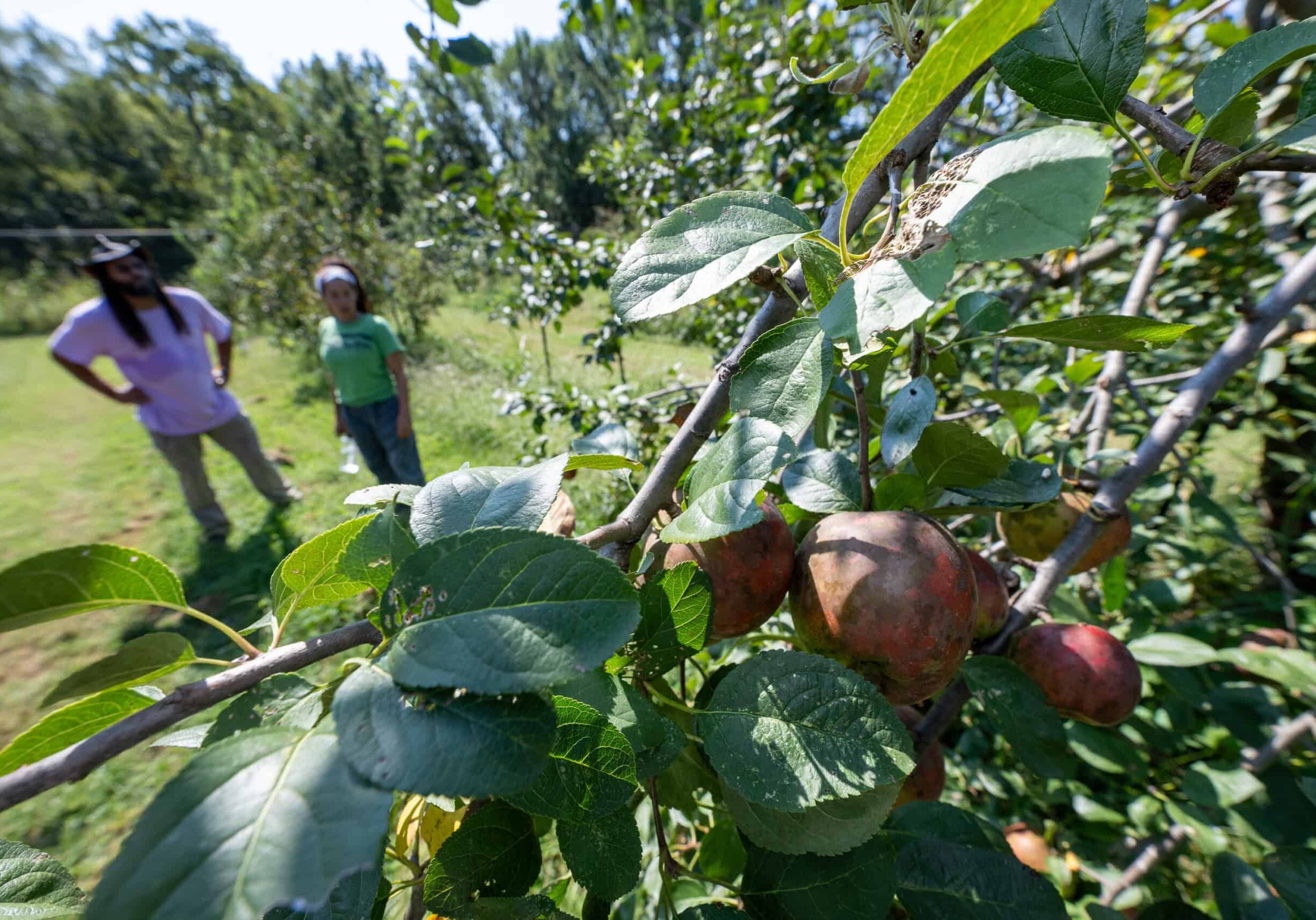
Darrian Davis grows some unsightly fruit at Kansas City Urban Farm Co-Op.
“I’m trying to educate the public on what organic fruit looks like,” he said, “and sometimes we look ugly. Especially our apples.”
Yet a misshapen, grey-green apple with splotches plucked from the tree yields a crisp bite followed by sweet-tart juices.
“It’s just hard to put these on the shelf the way they look. People just don’t understand the process that the stuff in the store goes through, all the way to the wax that they put on it,” Davis said. “The culling process of throwing away anything that doesn’t look perfect means (Americans) throw away so much food.”
Davis and his wife, Nicolette Paige-Davis, are the caretakers and community organizers behind Kansas City’s largest orchard of 100-plus fruit trees growing in the heart of Swope Park near an off-leash dog park.
Related Content
Davis, an outspoken community leader on the subject of food insecurity, planted the orchard in response to political unrest surrounding the 2014 police killing of Ferguson, Missouri, teenager Michael Brown.
“There were all these rumors of martial law, and everything was real tense,” Davis recalls. “We got to thinking, if something like that was to happen here and the grocery store shuts down, what would we do?”
Davis posted his concerns on social media.
Three hundred people showed up to a Sunday night organizational meeting, where discussions focused on food sovereignty, the right of a community to control its own sustainable food and agriculture systems.
Davis figured that even if they couldn’t produce enough food for the community, they could at least begin teaching one another sustainable farming practices.
A decade later, the urban orchard includes pears, persimmons, pawpaws, blackberries, raspberries, bush cherries, and jujube, a bush that bears an apple-like berry. The co-op got a jumpstart from The Giving Grove, which helps neighborhoods develop community orchards.
Between raising their five children, working other businesses, mentoring youth, and supporting elders, the couple still manage to tend the orchard four days a week. They also welcome volunteers who want to learn and grow alongside them.
The co-op uses organic cultivation, including black soldier fly larvae to break down organic material into compost. Along with fruit trees, they also tend raised beds with tomatoes and have installed an herb garden for Paige-Davis’s herbal medicine and spiritual practices.
Her great-grandparents were urban farmers in the Argentine neighborhood of Kansas City, Kansas.
“They raised 12 children, and they had this yard that they turned completely into a garden,” Paige-Davis said. “I did a ritual in honor of my ancestors and asked that their spirit help guide me in growing food as they did. And now we have this huge orchard, and our front yard is full of food.”
St. John Community Gardens
3922 St. John Ave., Kansas City, Missouri
St. John Community Gardens in Kansas City’s Historic Northeast neighborhood is an open-air canvas for artist Rebecca Koop. She displays bits of recycled whimsy among the tomato plants, raspberry bushes, and towering stalks of corn and sunflowers.
Most of the raised garden beds are constructed from rebar posts and recycled concrete roofing tiles from Habitat ReStore. She has wryly outlined some of the gardens with vintage head and footboards.
A scarecrow made of found objects, including a rusted ironing board, sheet pans, an old whistling kettle, and car parts, joins a scary metal crow with slightly prehistoric teeth perched on a pole.
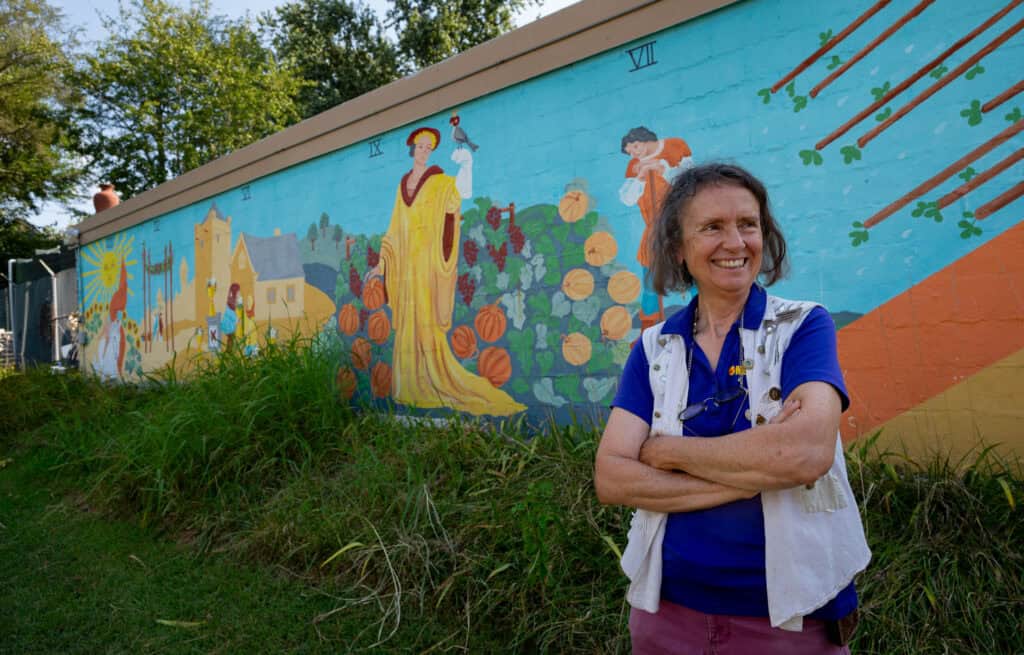
A harvest-themed mural based on tarot card readings is punctuated by a rainbow that bends around to the pièce de résistance, a 450-square-foot mosaic mural that brightens the neighborhood with a dreamscape of zodiac signs, constellations, whales, and flying saucers.
Koop bought the 100- by 150-foot lot next door to her studio, Back Door Pottery, in 2004 for $2,000. For just $15 a year, gardeners get seeds, plants, and technical assistance through Kansas City Community Gardens, as well as infrastructure.
A difficulty for many gardeners reclaiming vacant lots: access to water. With grant funding, Koop installed three 1,300-gallon towers to store rainwater collected from her studio roof. Now gardeners can tap water from a spigot or run a hose to their bed.
When Koop started, community gardens were still an unfamiliar concept to many of her neighbors. But today well-established plots dot the city’s urban landscape.
“I’m surprised we’ve been around 20-something years,” she said. “I think it’s still a little challenging, finding really good gardeners, or dedicated gardeners.”
New Roots, an intensive refugee and immigrant farm training program, was active at St. John Community Gardens in the early days, but its participants have moved on.
The gardeners who can walk, bike, or take a short drive weekly to tend their garden generally stick around the longest.
During a wander between the beds, Koop stopped.
“This gardener has been with me…,” she paused to do the math in her head, “… 20 years now.”
The Garden at Dogwood Forest
4141 Joyce Drive, Kansas City, Kansas
Although fairy tales paint them as dark, foreboding, and sinister, Rick Mareske reads the forest as a friendly space.
“I just want people to appreciate what the woods can look like, and that it’s an open and inviting and beautiful and cool place,” Mareske said of The Garden at Dogwood Forest, the 35-acre food expanse located in the hilly Quindaro Bluffs of Kansas City, Kansas.
On a recent morning, we follow a footpath before clambering over a fallen tree to arrive at an enchanting green pond ringed by flowering lotus plants in bloom. Mareske pulls up the stem of an otherworldly lotus pod, a three-dimensional addition florists use in arrangements for texture and dramatic impact.
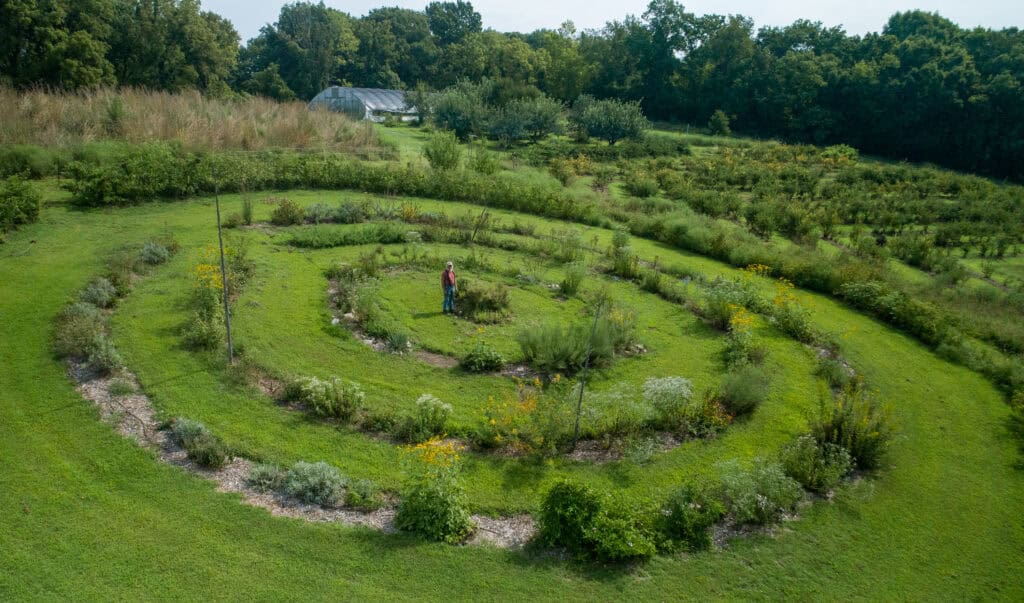
As we ascend a hill, we look up as Mareske shakes a pawpaw tree and stop to admire the alligator-hide pattern on the bark of a persimmon tree.
We look down at a wild white mushroom that, under the right parasitic circumstances, may become a lobster mushroom, and at the acorns dropped from white oak trees that Native Americans ground into a naturally gluten-free flour.
We arrive at the hoop house and orchard growing elderberries, blackberries, raspberries, apples, pears, peaches, cherries, and figs.
Some of the blueberries harvested last year went to The Savoy and The Antler Room, local restaurants. But 90-degree February days followed by a mid-March freeze mean the remaining berries will go to Rolling Prairie Farmers Alliance.
Rolling Prairie is a 10-farm coalition started in 1994 that delivers weekly bags of locally grown produce. One of the oldest CSA’s in the United States, 300 subscribers collect the harvest at five pickup sites, including the addition of Garmin headquarters in Olathe this year.
A medicinal garden provides herbs, flowers, and grasses for Mareske’s wife, Regina Compernolle, who offers educational programs focused on herbalism and apprenticeships through Sacred Earth Arts.
“There are a lot of the herbal schools around, but they kind of get bags of stuff, and they make things. Regina is really dedicated to the idea of people getting experience with the plants and having a relationship with the plants,” he said.
They farm using regenerative practices that “go beyond organic” with mineral liquid treatments to the plant leaves and soil to enhance immunity, improve nutrient efficiency, and stimulate soil microbes.
“For plants, their gut is the soil,” Mareske said.
Before we wind back toward the start of the trail, we stop in a clearing tiled with flagstones to create a natural patio. Terracotta masks put a human face on the surrounding trees. It’s easy to imagine a play, a concert, or a poetry reading taking place here.
“It’s kind of like an honoring of the forest or, like, welcoming ourselves to the forest. It’s like an attempt at trying to get people to enjoy and not be afraid of the woods,” Mareske said.
Bread & Roses Farm
2323 Agnes Ave., Kansas City, Missouri.
Bread & Roses Farm, named for a political slogan associated with the women’s suffrage movement, has come a long way, baby.
Four ugly vacant lots became a community garden and eventually grew into a 30-member CSA, a community supported agriculture subscription service for locally grown fruits and vegetables.
Every week from May to October, farmer Flora Mahaffy delivers fresh produce to members. She recently added the option of weekly flower bouquets.
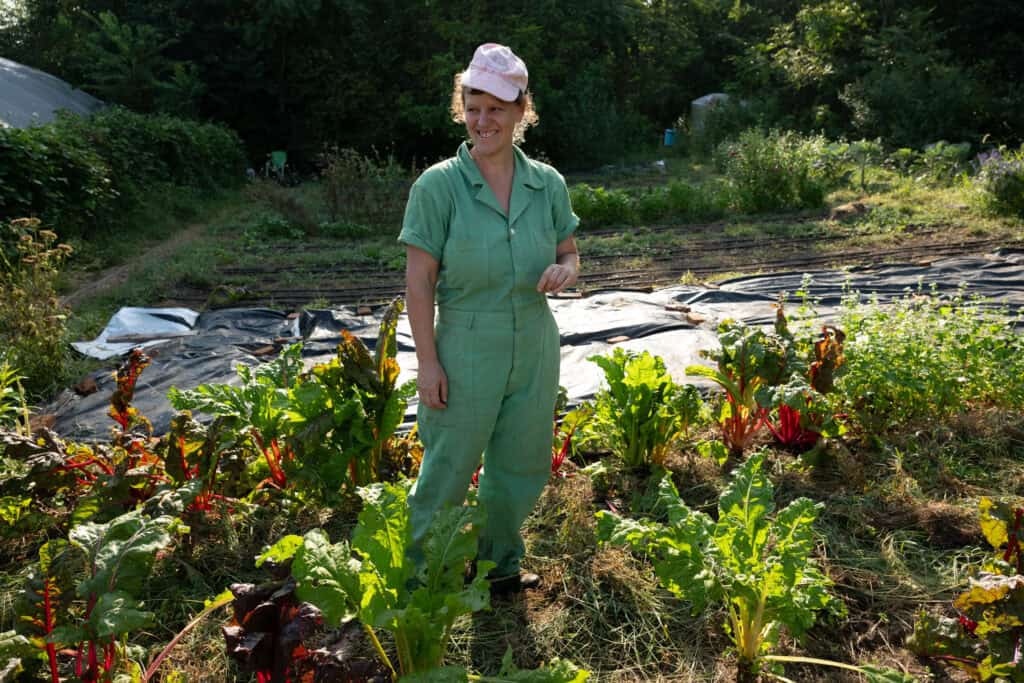
The lots now include a hoop house for growing tomatoes, cucumbers, sweet potatoes, and fragrant musk melons. The structure is surrounded by neat rows of Swiss chard and greens fed by a drip irrigation system. A strip of worn grass links to another lot with zinnias and butterflies basking in the sunlight.
“It’s a tiny hub of biodiversity in a couple vacant lots, and then we have part-time jobs for a couple people… I think people were skeptical at first, because they had lived next to something so crazy for so long,” Mahaffy said of the Washington Wheatley neighborhood, which suffered a rash of property foreclosures during the Great Recession.
Recently, Mahaffy received a grant to promote an onsite farm stand open on Fridays where she delights in seeing her neighbors interact with the fruits of her labor.
“There was this one kid a couple years ago (that) would bring quarters to the farm stand and buy vegetables. He was, like, 6 years old and said, ‘I want to try this tomato,’” she recalled.
Unlike CSAs that encourage their members to try new vegetables, Mahaffy tends to stick with the staples.
“We’re not giving kohlrabi…we try to have carrots as much as possible. We try to have cucumbers, tomatoes… I mean, we throw them some crazy stuff, and they do a great job cooking it, too. But our baseline is the stuff you would pick up every week in the store,” Mahaffy said.
If she wasn’t committed to hosting visitors at Bread & Roses Farm, Mahaffy would be visiting the other farms on Cultivate KC the tour.
“I’m hoping some of our (CSA) members come. That’s always fun. And… yeah, I love it when other people who grow, or are starting to grow, come, ask questions, and see that you can transform a lot into something pretty cool.”
Reading these stories is free, but telling them is not. Start your monthly gift now to support Flatland’s community-focused reporting.

Related Stories

Nick’s Picks | I-70, Tax Break, School Petition, and More …
An Interstate 70 closure, a tax rebate for Jackson County property owners, a school closure petition, and more ...
Kansas City Helping Renters Avoid Eviction
On any given Thursday, a small hallway in the Jackson County Courthouse crowds with tenants, landlords, and attorneys arriving for their scheduled hearings and trials. The scene unfolds on Floor 7M, which is half the height of the building’s other levels, and is where Associate Circuit Judge Mary Weir recently worked through 55 eviction cases…
Nick’s Picks | Costco, Homicides, Rain and More …
Is Missouri's congressional map saga over? It seems so, but who knows if there will be another twist or turn. That story and more ...