
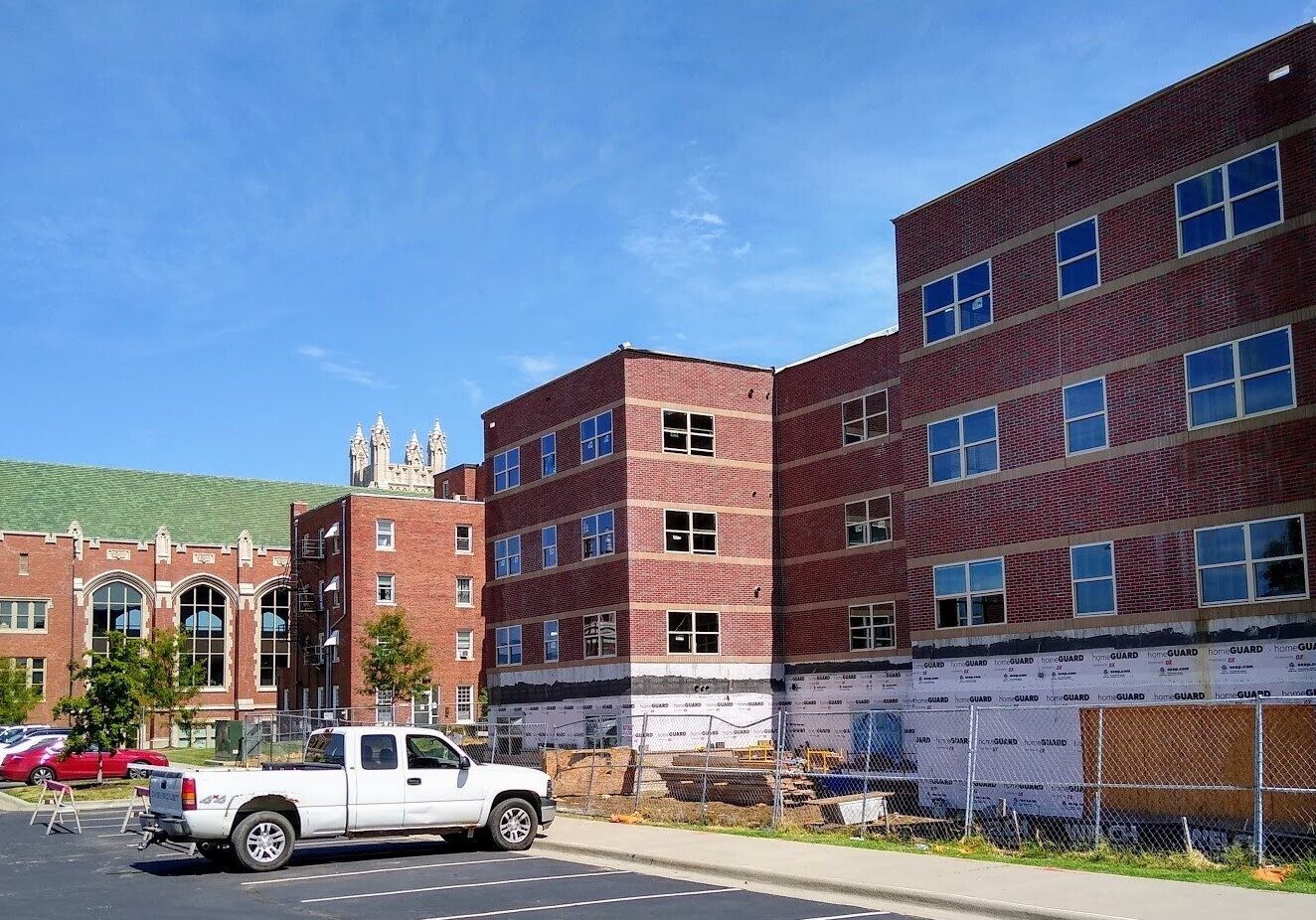
Jim Scott and David Warm spent many sleepless nights — especially in 2013 and 2014 — worried about how the Linwood Area Ministry Place (LAMP), a campus of community services at Linwood Boulevard and Bruce R. Watkins Drive, would ever survive.
“There were a number of times with this project,” says Warm, volunteer chairman of Linwood Property, Inc., the not-for-profit developer that manages the site, “that we really had to take a leap of faith in order for us to keep going.” (Warm’s full-time job is being executive director of the Mid-America Regional Council.)
Scott, head of Scott Associates, the architectural and planning firm that designed a soon-to-open 32-unit apartment complex on the LAMP site, describes that uncertain period this way: “There was more than one time that I saw David rescue this project. There was more than one real crisis in there, but somehow we got to the next step… There were a million points where it was a real act of faith to keep going. We lived to fight another day over and over.”
Those new apartments will be permanent — not transitional — housing mostly for families coming out of domestic abuse shelters. The residents will become part of an increasingly vibrant location that once was the home of Linwood United Presbyterian Church, which closed decades ago, and the Harold Thomas Center, which contained office space for nonprofits.

Today the site is home to PCs for People, which provides affordable computers and low-cost internet for eligible individuals and nonprofits; ReDiscover, which offers mental health and substance use disorder services for individuals and families; the Front Porch Alliance, a community partnership that provides youth, senior and other services in the Ivanhoe neighborhood; Heartland Presbytery, the regional governing body of Presbyterian Church (USA) congregations in eastern Kansas and western Missouri, and the Ivanhoe Farmer’s Market, overseen by the Ivanhoe Neighborhood Council, which provides many social programs in the area bounded by 31st Street, the Paseo, Prospect Avenue and Cleaver II Boulevard.
The neighborhood council used to have offices in the Harold Thomas Center. Now it has two offices — one at LAMP and one nearby at 3700 Woodland Ave. — so “this is kind of a renaissance moment for us by having our health initiatives staff re-emerge on that campus,” says Karen Boyd, executive director of the council.
The Ivanhoe council, Boyd says, “has always had representation on the LAMP board. Now we’ve grown more in terms of being a more visible and active partner with LAMP and some of the agencies on the LAMP campus.”
That greater engagement with LAMP is taking place, Boyd says, as “the Ivanhoe demographics are changing. We’re still predominantly African-American, but we’re experiencing more ethnic and racial diversity, but also having more younger people moving into the neighborhood. So this will be a little bumpy for Ivanhoe going forward, but we’re committed to making that happen.”

LAMP has survived many of its own bumps since 1995, when Heartland Presbytery committed itself to taking over the site, relocating its offices there and working to revive the area, making use of a tax credit system coupled with public and private donations. As Warm notes, “The idea of presence, service and leadership (LAMP’s stated mission) is at the heart of what our Christian faith is about.”
But the future — both for LAMP and for the neighborhood — is far from guaranteed.
As Scott explains, “the logic underlying the economics of this project are bounded in pretty flawed federal policy that we abide by and try to manipulate to serve social policy. This project was what the tax credit system was set up to do.” But, Scott says, the system is cumbersome and presents endless challenges for a project designed to provide community services as opposed to developments built for profit reasons.
And yet it’s precisely the kind of community services now located at LAMP that the neighborhood has needed for a long time, especially after the decades of upheaval caused by construction of the Watkins freeway right through the middle of it.
Scott says that in the 1960s and ’70s the area experienced white and middle-class flight and became “a site of disinvestment. Ironically, the Bruce R. Watkins Drive is a pattern of reinvestment. All the crises that came along with that were difficult to manage. But the construction of a once-in-a-hundred-years infrastructure actually now has promoted reinvestment. Whatever the past was, the future is now more about the reinvestment.
That’s a hard story to tell, he says, “because it’s not a simple story. Those highways were intended to bound poverty areas. Thoughtless or not, that was a social objective and not just maniacal. But it’s been terribly hard for a generation there.”
Now, however, the new LAMP apartments are about to become home to more than 30 families who badly need hope and a way forward.
The idea, leaders say, is to offer a holistic approach to help families emerge from homelessness by providing a safe place to live and help with other needs through the nonprofit ReStart, an agency that serves all homeless populations in the area.
In the end, however, Scott says: “The real value of this (LAMP) project should be what we cause to happen on adjacent blocks. I think we could do a better job there.”
So while justifiably celebrating the new apartments, LAMP leaders know there’s still much to do to assure the site’s long-term future and its worth to the broader neighborhood around it.
Bill Tammeus, a former award-winning columnist for The Kansas City Star, writes the “Faith Matters” blog for The Star’s website and columns for The Presbyterian Outlook and formerly for The National Catholic Reporter. His latest book is The Value of Doubt: Why Unanswered Questions, Not Unquestioned Answers, Build Faith. Email him at wtammeus@gmail.com.
Reading these stories is free, but telling them is not. Start your monthly gift now to support Flatland’s community-focused reporting.
Related Stories
Nick’s Picks | I-70, Tax Break, School Petition, and More …
An Interstate 70 closure, a tax rebate for Jackson County property owners, a school closure petition, and more ...
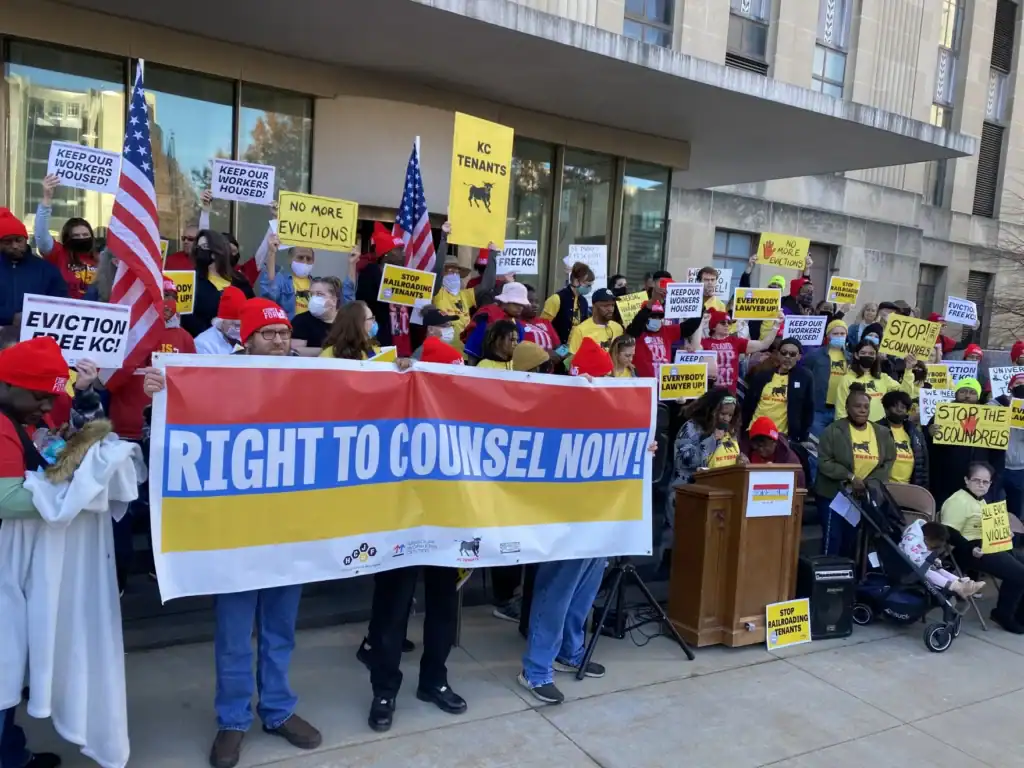
Kansas City Helping Renters Avoid Eviction
On any given Thursday, a small hallway in the Jackson County Courthouse crowds with tenants, landlords, and attorneys arriving for their scheduled hearings and trials. The scene unfolds on Floor 7M, which is half the height of the building’s other levels, and is where Associate Circuit Judge Mary Weir recently worked through 55 eviction cases…
Nick’s Picks | Costco, Homicides, Rain and More …
Is Missouri's congressional map saga over? It seems so, but who knows if there will be another twist or turn. That story and more ...