
Advocates Look to Make KCK Next Abandoned Housing Success Story
Kansas City's Lykins Neighborhood illustrates power of statutes targeting slumlords
August 27, 2026 | Cole Deaver, Mike Sherry | 11 min read
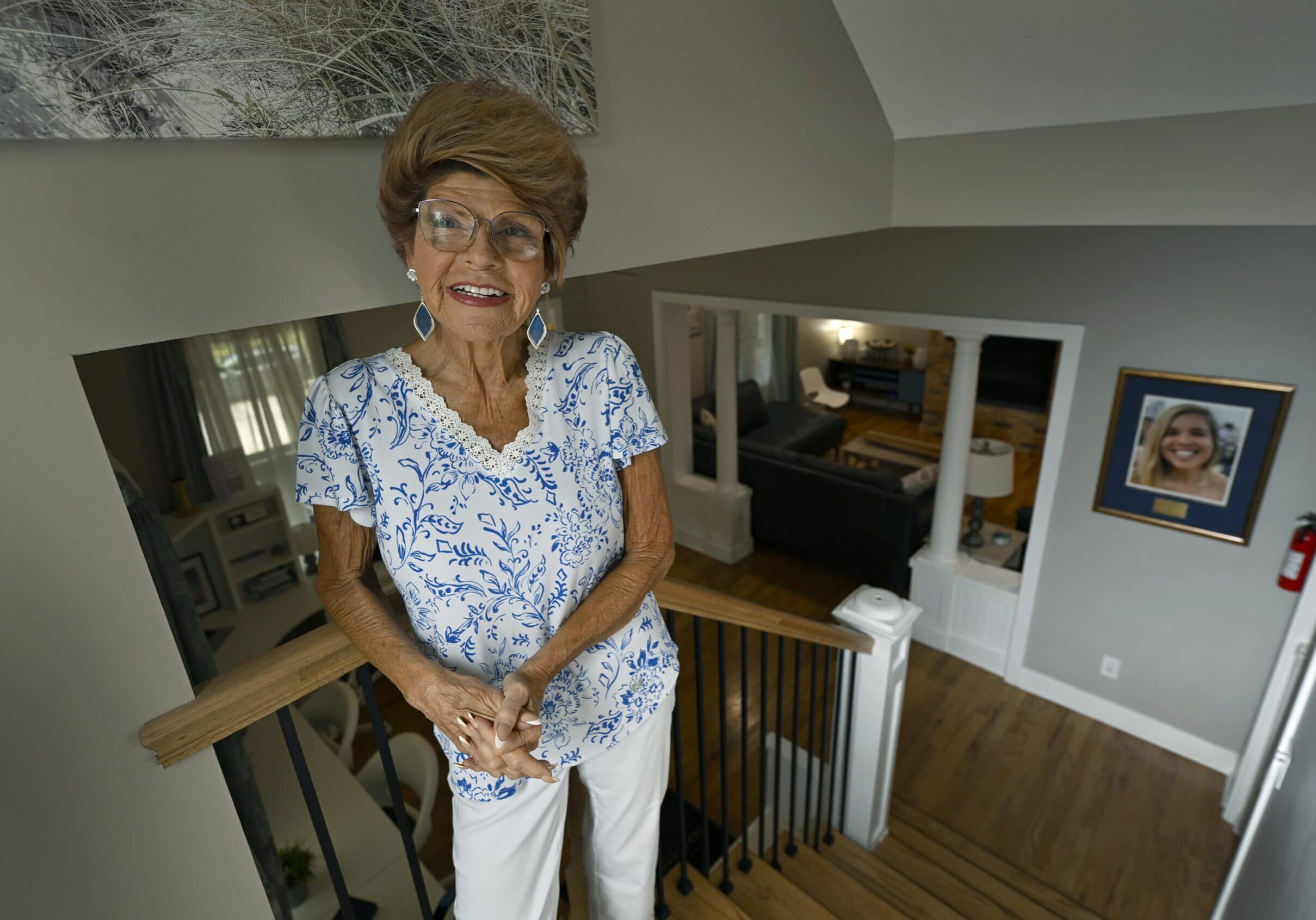
Sister Amy Willcott was born and raised in Leavenworth, but it’s not the city she once knew.
“Growing up here…I loved it,” Willcott said. “There was community. And something has shifted…I think neighbor to neighbor, things have changed all over.”
Willcott is the director of Depaul USA Leavenworth Attainable Housing, which was founded in 2021 to address homelessness within the community.
Looking at North Leavenworth, Willcott recognized the opportunity to further her organization’s mission while also improving a dilapidated part of town.
The mechanism was the Kansas Abandoned Housing Act, an underutilized statute that had been on the books for years. Work in Leavenworth is underway, and proponents are working to extend its reach into Kansas City, Kansas.
Kansas followed Missouri’s lead in enacting an abandoned housing statute.
The Missouri Abandoned Housing Act was the brainchild of retired Kansas City attorney Lawrence Hamel. Hamel began his career in 1982, working for Legal Aid’s Neighborhood Attorney Project.
The initiative began after Kansas City neighborhoods asked the city to help them deal with vacant houses. The city partnered with Legal Aid of Western Missouri, a nonprofit that provides free legal representation in civil cases, to dedicate a full-time attorney to the cases.
Related Content
Hamel teamed up with neighborhood associations to force owners of abandoned houses to assume responsibility for their properties.
Using a variety of legal tactics (including lawsuits, if necessary), Hamel and his team compelled owners to take care of the properties blighting neighborhoods.
“We don’t want your money,” Hamel told property owners. “We just want (you) to do whatever you have to do to take care of the problem.”
But one problem emerged: He could not always identify the property owner.
“At some point, it became obvious that there were some vacant, dilapidated houses that did not have an owner you could go after,” Hamel said. “So that’s when I…came up with this idea for the Abandoned Housing Act.”
Hamel drafted the statute, then teamed up with Managing Attorney Michael Duffy, who worked with Missouri legislators to enact the law in 1993.
One organization that continues to use the Abandoned Housing Act is Neighborhood Legal Support of Kansas City. Gregg Lombardi is the executive director.
Under the statute, Lombardi explained, courts can deem a property abandoned if the owner is delinquent on taxes, it hasn’t been legally occupied for six months, and it has serious code violations. The court can then turn over the property to the neighborhood association so it can fix it up.
He said one of the key benefits of the act is cost.
The $60,000 to $80,000 it costs to rehab a house, Lombardi said, is about a quarter to a third cheaper than building new.
Neighborhood Legal Support works with the associations (which serve as the plaintiffs in these cases) to draft a contract for a third-party rehabber to complete work on the home. After the work is complete, the rehabber can sell the home, but in many cases, Lombardi and his team work with “urban homesteaders.”
Urban homesteaders are neighborhood residents with rehab skills who want to upgrade their housing circumstances.
The neighborhood association hires these homesteaders to work on the blighted property, and once they rehabilitate the home to the court’s satisfaction, they sign a commitment to live in the house for at least five years.
“We are creating housing for people who are from the neighborhood, who are lower income, and who will get to be homeowners at a very low cost,” Lombardi said.
Expanding in Kansas
Lombardi said Kansas modeled its own abandoned housing legislation after the Missouri Abandoned Housing Act, passing its equivalent in 1994.
But, Lombardi said, “There was no one in Kansas who was ready, willing and able to go forward when the statute was passed.”
But after he and his team decided to expand their work, they realized Kansas’s legislation made it a prime choice for additional rehabilitation projects.
Soon, Neighborhood Legal Support connected with Willcott, the sister in Leavenworth, through her colleagues, Christina Ashie Guidry and Katie Killen.
Willcott and her team have identified three houses in North Leavenworth that they would like to rehabilitate with funding they have set aside. However, each house has its own challenges to solve before rehabbing teams can get started.
Wilcott’s organization owns or manages 19 houses, and it’s looking to add three more to its stock with the help of Lombardi and the abandoned housing statute. The details of each of these three properties illustrate the complications of acquiring properties through the act.
Leavenworth Houses
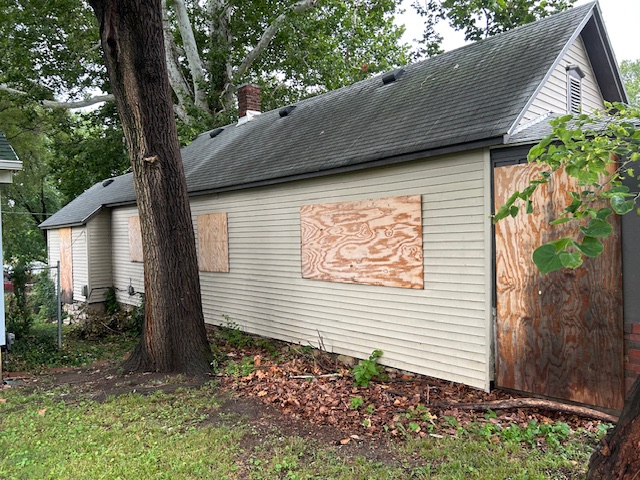
The first house is located at 426 Ottawa St.
Willcott and her team call it the “butterfly house,” and not just because it has one of the winged insects on its roof.
“There are open windows, and the porch is falling off, but it’s a butterfly, which goes through much transformation and all, so that kind of spoke to all of us,” she said.
Willcott may believe the butterfly house is ready for a transformation, but before that can happen, Lombardi and his team need to gain control of the property.
Lombardi explained that the property has three owners: a trio of East Coast companies called Abel’s Painting, Miranda ICracked LLC, and Smart Property Services LLC.
Lombardi said these companies likely partnered to acquire blighted properties and picked up the Butterfly House during a tax sale.
Lombardi guesses the owners either lost interest or lacked the money to rehab the house, which makes it an ideal choice for Willcott’s project. He hopes to gain control of the property in September.
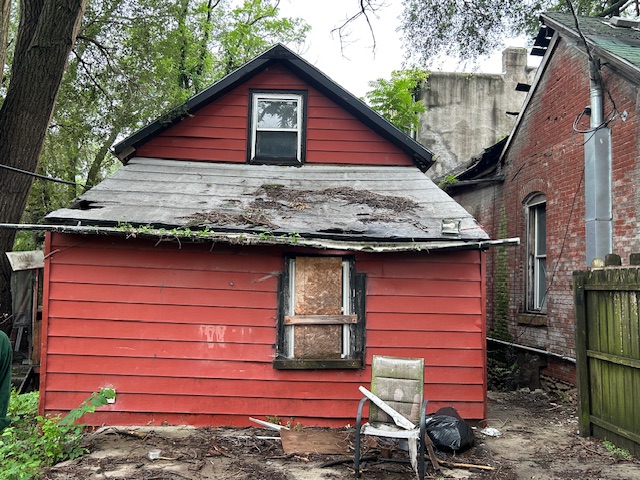
The second house, 733 Pawnee St., is a mess of boarded-up windows sitting atop a cracked foundation. Lombardi described this case as a bit more complicated.
“One of the owners has passed away with no will, no trust, no heirs,” Lombardi said. “So we have to file with the court to get approval to serve the world…all the potential unknown heirs by publication.”
According to Lombardi, “serving by publication” means publishing a notice in a newspaper, giving interested parties an opportunity to learn about the case.
Lombardi said another owner of 733 Pawnee disclaimed his interest in the property, and another has disappeared completely.
“There are no signs of whether he’s alive, dead, anything,” Lombardi said. “So the court requires us to do due diligence… we find out as much as we can, and when we can’t find any leads, we ask the court to allow us to serve by publication.”
Lombardi said this process can take a while, but it won’t take as long as the last house on the list, 922 Osage St.
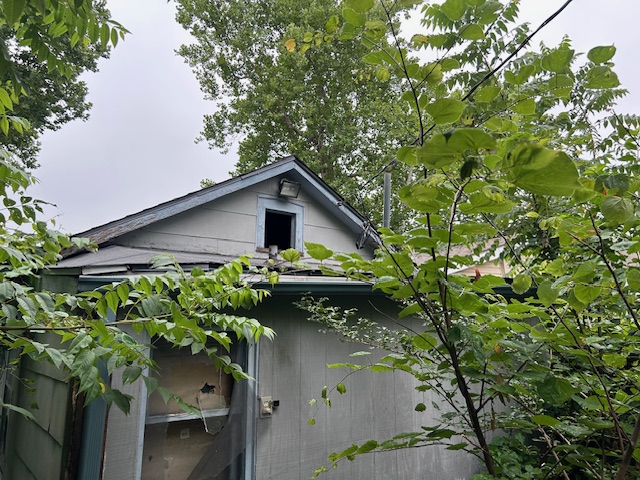
922 Osage is obscured by overgrowth. Its windows are shattered, and its paint is faded and chipped.
It sits next to an occupied, well-maintained home, so Lombardi views this property as a way to help house people in need while also beautifying the neighborhood.
Lombardi says the case of the 922 Osage house is particularly complicated because of the late owner’s siblings.
“There’s no will or trust to pass along assets, and he had no children or spouse,” Lombardi said. “But (he did have) three siblings, one of whom has since died, so that makes for a pretty darn complicated ownership.”
Lombardi said the remaining siblings don’t want the house and are happy for someone to take it off their hands. However, serving them appropriately and ensuring there aren’t any remaining heirs is difficult. He says the extra work could cost them months.
In Kansas City, Kansas, Neighborhood Legal Support is working with another nonprofit, Build WyCo, to put the Abandoned Housing Act to use in three neighborhoods. Lombardi declined to identify the neighborhoods so early in the process.
From what he can tell, Lombardi said, there is a “gigantic need” for Abandoned Housing Act work in Kansas.
Making Progress in Missouri
Neighborhood Legal Support’s work in Kansas City’s Lykins Neighborhood illustrates just how transformative these rehabilitation projects can be.
In eight years of using the Missouri Abandoned Housing Act in Lykins, Lombardi said, they have all but eradicated abandoned homes in the neighborhood.
Erin’s House is a crown jewel in the Lykins rejuvenation.
The six-bedroom house is named in honor of Erin Langhofer, the 25-year-old woman killed by a stray bullet in 2019 while attending First Fridays in the Crossroads. The house serves women with children.
It is one of the 17 homes Healing House Kansas City, a substance-abuse recovery nonprofit, operates in the Historic Northeast. Bobbi-Jo Reed founded Healing House nearly 25 years ago and serves as its director.
Langhofer was a counselor and therapist at a Kansas City domestic violence agency. She had also volunteered for several years for Healing House, accompanying her father, who pastored to the organization’s clients.
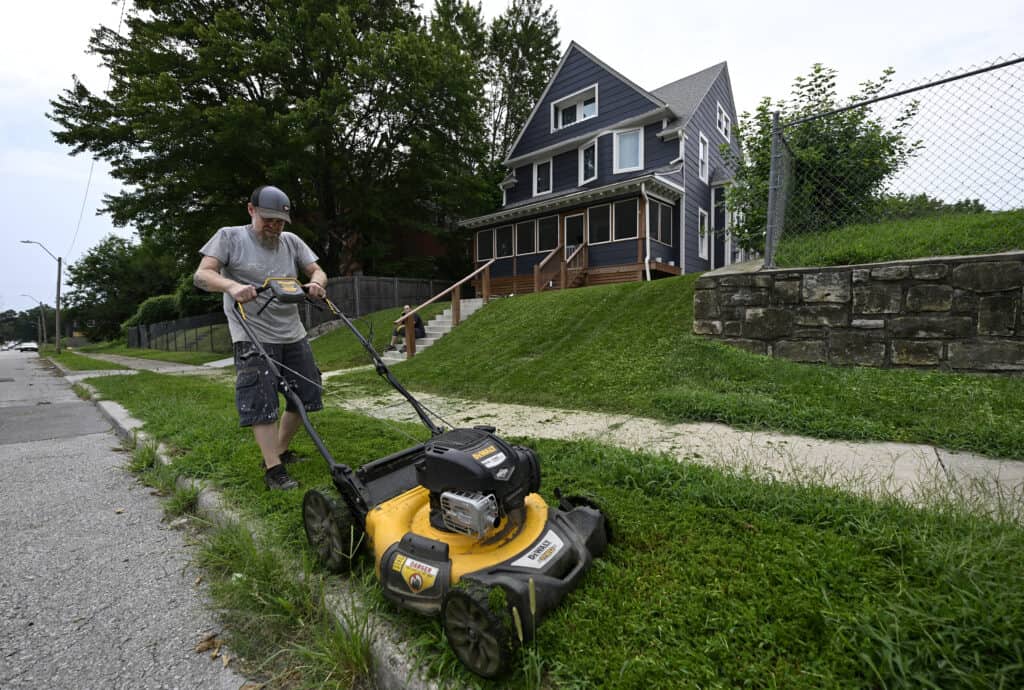
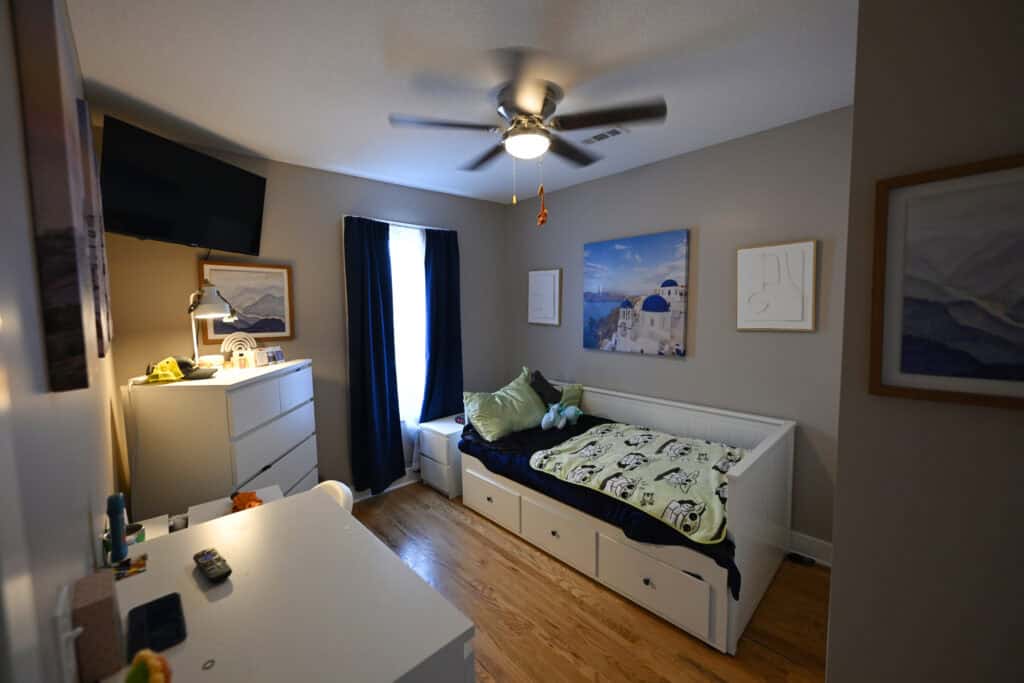
Healing House also operates three apartment buildings. The blighted property that would ultimately have a roughly $400,000 makeover to become Erin’s House sat adjacent to one of the apartment buildings’ playgrounds.
Reed said the house had caught fire three times and was a haven for homelessness, drug use, and prostitution. People would go to the bathroom right next to the playground.
But the owner’s absurd asking price was around $100,000 when Reed offered to buy the house. If nothing else, Reed thought she would level it and put in a parking lot.
But then Healing House teamed up with the neighborhood association and Neighborhood Legal Support to gain possession of the house through the Abandoned Housing Act.
Reed said Healing House had neither the money nor the expertise to fight the landlord. It took about a year and a half of wrangling through the courts to gain possession of the house, which dates back to the late 1800s.
The landlord “was trying to say he had not abandoned it. He was fighting that,” Reed said. “Of course, there had been no lights on in this house forever, that I’m aware of, and so he was just trying to battle it every step of the way and trying to keep ownership of the house, and basically the neighborhood association is coming in and saying, ‘We’re not going to tolerate this anymore.’”
Healing House ultimately got the house for $10,000.
Reed hopes for more partnerships with the neighborhood association.
Healing House can usually rehab a house for a fraction of the cost it spent on Erin’s House, but the property was in terrible shape, and the Langhofer’s connections in the home-building industry drew a lot of donations through the foundation they established in Erin’s honor.
The refurbishment included expanding the kitchen and adding the bright playroom with the ocean motif.
Reed knows folks who have run into stumbling blocks in area Kansas communities trying to do what she does. Her impression is that there is definitely a need on that side of the state line to utilize the Abandoned Housing Act.
“Every abandoned home brings nothing but despair to that community because all the things that go along with it,” Reed said. “There’s nothing good. You’re just letting the city die when you have abandoned homes. Why not be an active part of fixing it up?”
Across the State Line
In Leavenworth, Willcott said the benefits of rehabilitating properties extend beyond individual homes.
“I can see this really transforming North Leavenworth,” she said. “As Leavenworth can become more livable, presentable, welcoming, and supportive, that can only help as we continue to grow.”
Willcott has big plans for those blighted homes on Ottawa, Pawnee, and Osage streets.
Leavenworth Attainable Housing prioritizes individuals who are employed and seeking to improve their circumstances. Participants pay a third of their income toward rent and receive wraparound support, including budgeting lessons.
“So as a resident,” Willcott said, “I am willing to also have myself kind of molded and supported in a way that maybe we’ve also done to the house.”
Reading these stories is free, but telling them is not. Start your monthly gift now to support Flatland’s community-focused reporting.
Related Stories
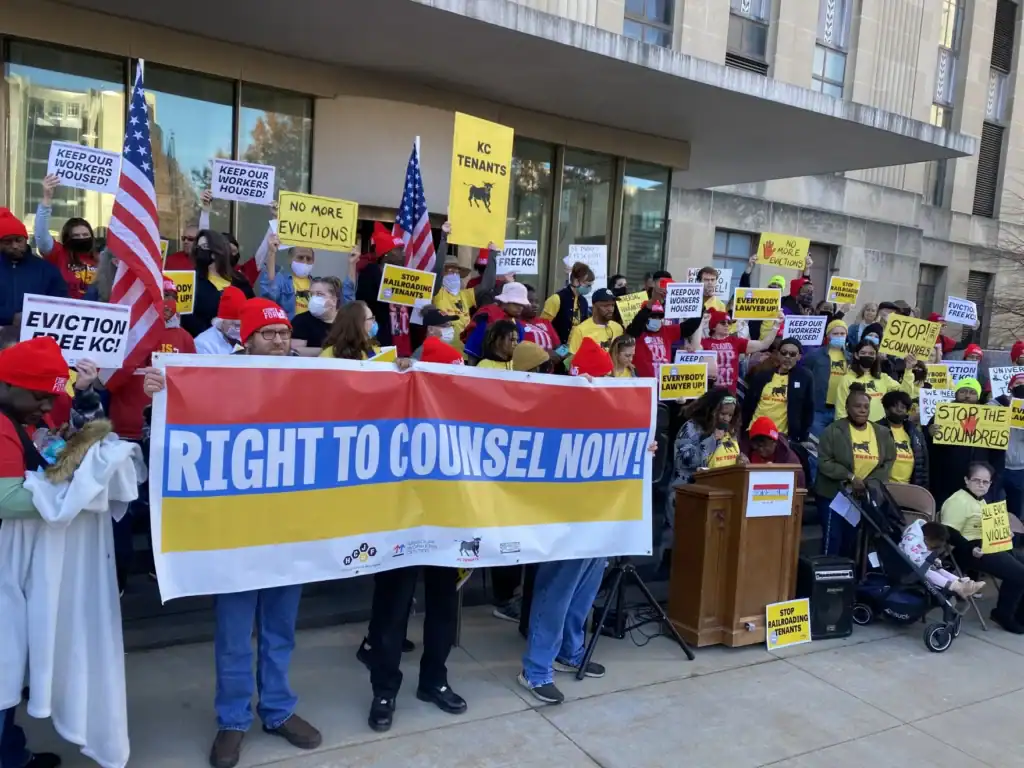
Kansas City Helping Renters Avoid Eviction
On any given Thursday, a small hallway in the Jackson County Courthouse crowds with tenants, landlords, and attorneys arriving for their scheduled hearings and trials. The scene unfolds on Floor 7M, which is half the height of the building’s other levels, and is where Associate Circuit Judge Mary Weir recently worked through 55 eviction cases…
Nick’s Picks | Costco, Homicides, Rain and More …
Is Missouri's congressional map saga over? It seems so, but who knows if there will be another twist or turn. That story and more ...

Nick’s Picks | Obama Visits KC, Debates and Fall’s Arrival
Obama in KC With Election Day just six weeks away, some of the nation’s top political names are now rolling through Kansas City. Last week, Vice President JD Vance was in town. This week, it’s Barack Obama. The former president takes the stage Saturday at the Overland Park Convention Center for a leadership event hosted…