
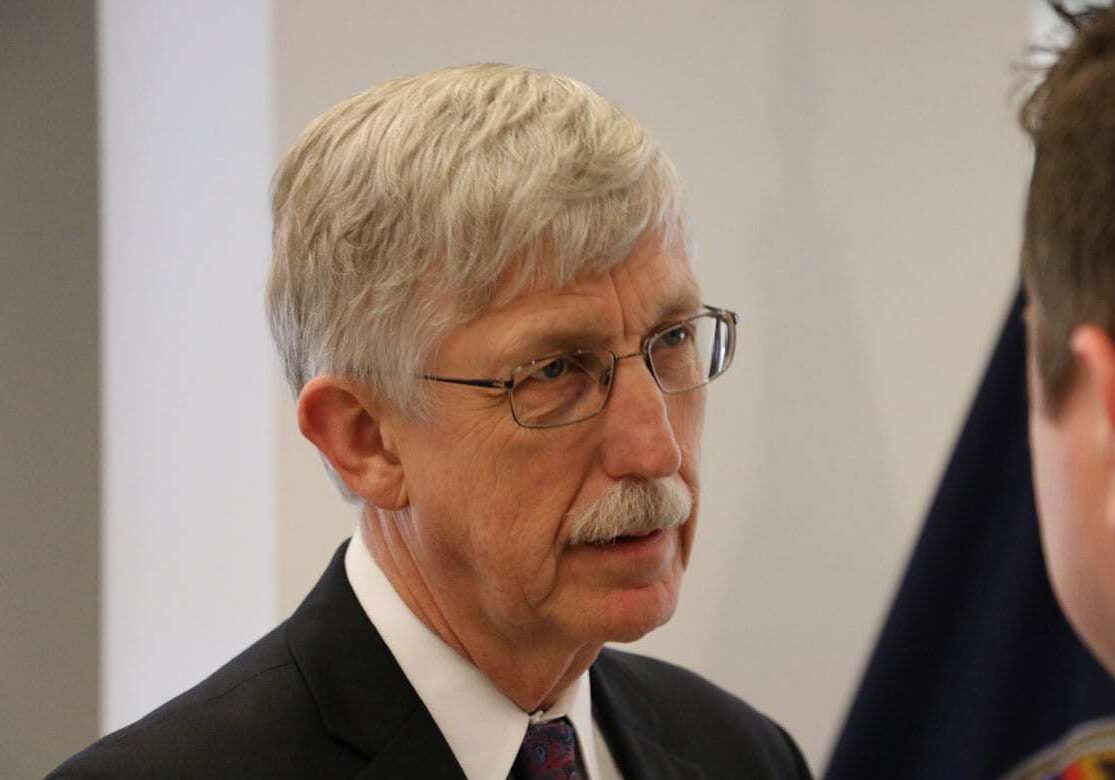
NIH director talks about one and done at KU — for flu shots
April 15, 2014 | | 4 min read
That annual flu vaccine could be a thing of the past by the end of the decade, the director of the National Institutes of Health said during a Monday visit to the University of Kansas Medical Center.
Dr. Francis Collins said that NIH-funded researchers are perhaps five years away from developing a universal flu vaccine, one that is effective against virtually all strains. Individuals might need a booster down the road.
In recent congressional testimony, Collins discussed progress on the flu vaccine and told lawmakers that the flu kills up to 49,000 Americans each year and costs the economy about $87 billion. He amplified those comments during his visit to KU Med, where he was accompanied by U.S. Sen. Jerry Moran, a Kansas Republican.
A protein that sits atop the influenza virus is shaped like a mushroom, Collins said, and the body’s immune system targets the top. The problem, he said, is that this cap is what mutates from year to year — necessitating a new vaccine.
Clinical trials are focusing on the stem, he said.
To school
“We are learning how to convince the immune system to do something smarter,” Collins said. “We are sort of teaching, taking it to school, and saying, ‘Ignore that cap — it’s not going to help you.’”
It will take a few flu seasons to determine if the new vaccine works, he said.
However, the biggest payoff, Collins said, may be in treatment of pandemic flus that burst forth from overseas, leaving authorities scrambling to develop a vaccine.
Collins is a physician-geneticist who took over as director of the NIH in August 2009. He also served as director of the National Human Genome Research Institute at the NIH from 1993–2008.
According to the university, in fiscal year 2013, KU had 601 NIH-funded projects that received total funding of $103 million.
Collins said the NIH distributes 85 percent of its $30 billion annual budget in grants. About a third of the applications used to receive funding, he said, but budget cuts have diminished that figure to about 16 percent.
At KU Med, Collins received a lunchtime briefing at the Robert Hemenway Life Sciences Innovation Center. Presentations included talks on three NIH-supported projects at KU Med:
-
Kansas Intellectual and Developmental Disabilities Research Center, which supports basic and applied research on the causes and prevention of intellectual and developmental disabilities. The center is part of a broader effort known as the Institute for Neurological Discoveries
-
Frontiers: The Heartland Institute for Clinical and Translational Research, which aims to accelerate development of drugs and devices for new cures and therapies for patients
-
Institute for Advancing Medical Innovation, a regional initiative that includes local and national partners that are also working to quicken the pace of bringing new drugs and devices to the market.
The director said work at KU Med parallels the broad range of research that NIH supports — from the very basic to clinical trials.
‘Wonderful examples’
“The things that I am seeing here are wonderful examples of all of those aspects,” Collins said. “Some of those are quite basic — trying to understand how the brain works … or very applied, such as we were hearing about repurposing a drug that was developed for arthritis and finding that it works for leukemia.”
He said that one of his major focuses as director is decreasing the amount of time and money it takes to get a new drug to market. He wants to cut down the failure rate of promising compounds.
To that end, Collins noted, the NIH established the National Center for Advancing Translational Sciences about two years ago.
Collins’ visit comes five months after voters in Jackson County, Mo., resoundingly defeated a proposal by the local research community to establish a sales tax aimed at commercializing research.
He said he supported any attempt to find creative ways to fund potentially life-saving research. Philanthropy plays a large role as well, Collins said.
But, he said, “You end up with a kind of lumpy landscape, if you are depending on sources of that sort, because people have their own special interests” in the diseases they choose to target.
The visit to KU Med came after a morning ceremony at the Dole Institute of Politics in Lawrence, where Moran received the Champion of Science Award from the Science Coalition, a nonprofit organization of more than 50 of the nation’s top research universities, including KU. The award recognizes members of Congress for their support of science research conducted at universities and national labs across the country.
Major Funding for Health coverage on KCPT provided by Assurant Employee Benefits and the Health Care Foundation of Greater Kansas City.
Reading these stories is free, but telling them is not. Start your monthly gift now to support Flatland’s community-focused reporting.

Related Stories
Kansas City Helping Renters Avoid Eviction
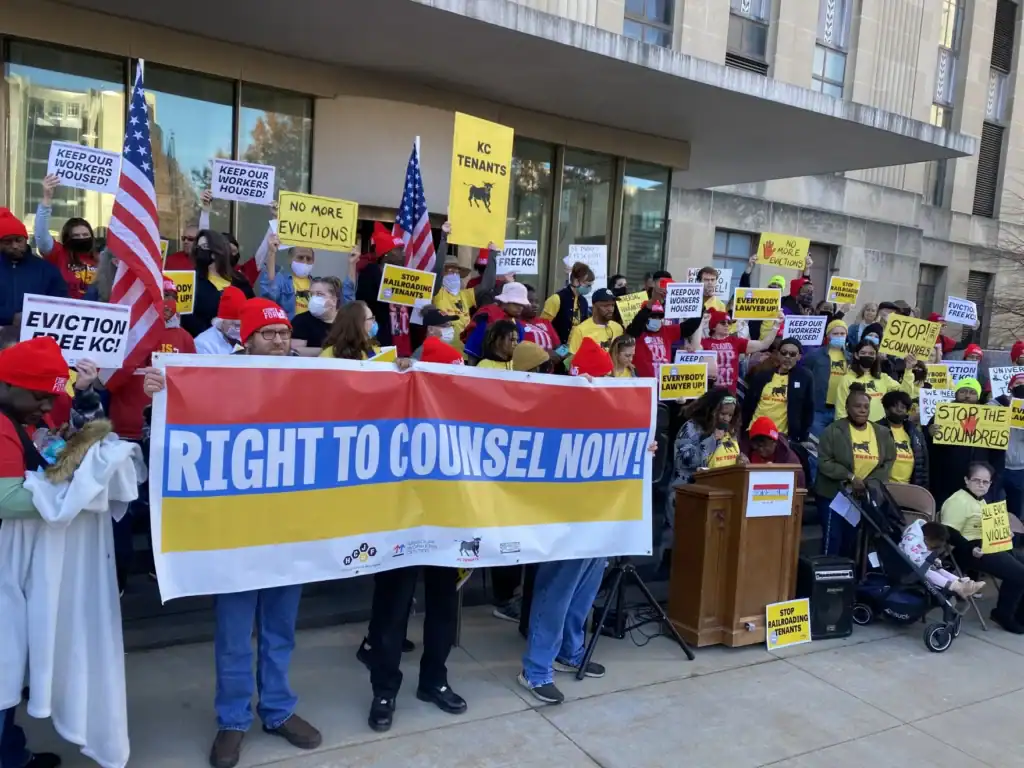
On any given Thursday, a small hallway in the Jackson County Courthouse crowds with tenants, landlords, and attorneys arriving for their scheduled hearings and trials. The scene unfolds on Floor 7M, which is half the height of the building’s other levels, and is where Associate Circuit Judge Mary Weir recently worked through 55 eviction cases…

Nick’s Picks | Costco, Homicides, Rain and More …
Is Missouri's congressional map saga over? It seems so, but who knows if there will be another twist or turn. That story and more ...

Nick’s Picks | Obama Visits KC, Debates and Fall’s Arrival
Obama in KC With Election Day just six weeks away, some of the nation’s top political names are now rolling through Kansas City. Last week, Vice President JD Vance was in town. This week, it’s Barack Obama. The former president takes the stage Saturday at the Overland Park Convention Center for a leadership event hosted…