
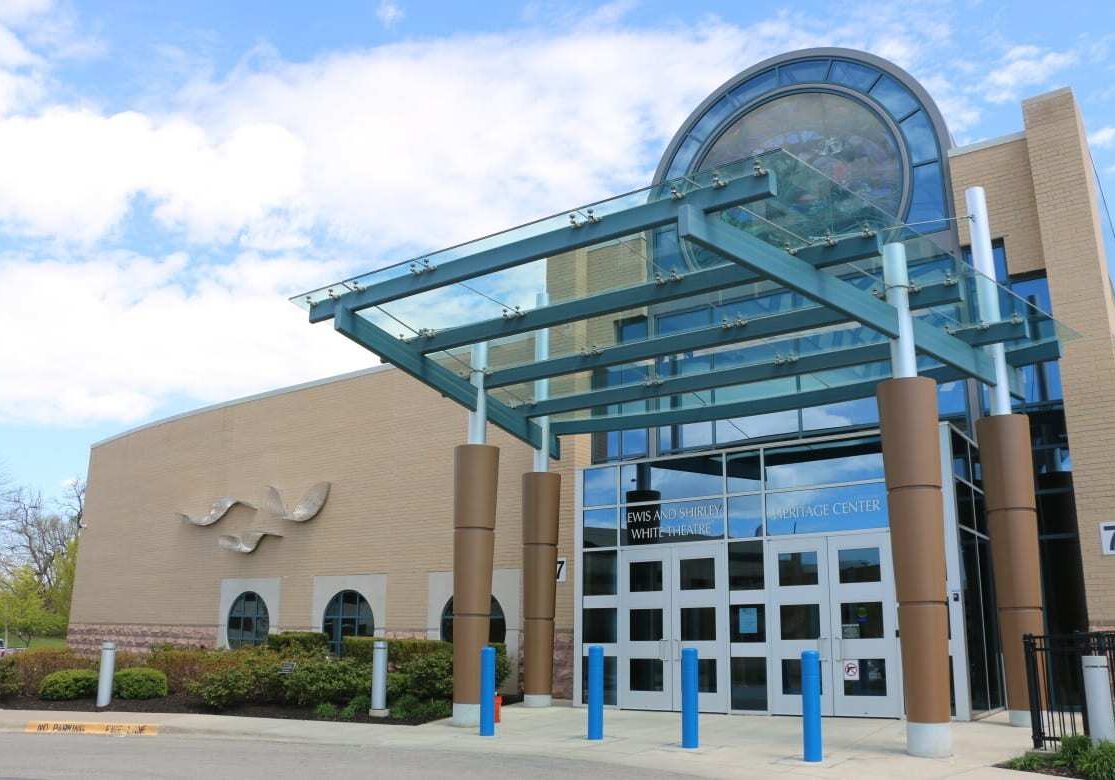
This story is part of our coverage of Kansas City’s SevenDays project, which aims to bring people together to conquer hate and celebrate diversity. The project is led by Mindy Corporon, who lost two family members in the April 2014 shootings at the Jewish Community Center in Overland Park, Kansas. For each of the seven days, Corporon joins us for a video intro to the day’s activities (above), and Flatland is running a daily dispatch inspired by the day’s theme. Flatland reporter Daniel Boothe wrote on today’s theme, “discover,” and the Tuesday dedication of the Jewish Community Center memorial.
[FLEX-CONTENT]
(Roll over the circles to learn more about the memorial)
3 Questions With Memorial Artist Jesse Small
Can you tell me what the three pieces represent, and what was your inspiration when designing the piece?
We came up with the idea of having multiple elements other than a single object, but still understanding that they are connected to each other. I had this idea that perhaps, there is something more going on inside the wall, that perhaps those three pieces are linked on the other side. So for instance, try to imagine a child’s drawing of a dragon coming in and out of the water. As the head pops up out of the water, its back curves out, as does the tail, and so the brain completes the dragon’s body, even though the rest is unseen. It is that idea, allowing people’s imagination to fill the unseen in, to finish the story or to add to it. The other idea I wanted to explore is how the shadows interact with each other. The three elements are arranged so that the shadows overlap at different times of the day, and they really kind of become their own unique story.
How does this piece differ from other works you have done?
With some of my other work, I try to pack in a ton of information, an entire library or a cacophony of ideas with the piece. So with my sculptures, I am trying to make a whole library, not just a book. Much of my work is based in theory, and also the idea of having multiple future uses. With the memorial, this piece had an editing process that I don’t usually have because everyone in the room had to agree and be satisfied with the final product. The word ‘ripple’ kept coming up, and ripple has such imagery to it, so that simplified things. Once I got that language, that pattern, where the rings overlap and become a grid, everything fell into place. The material was extremely important as well. It became vitally important to use stainless steel, because to ensure the victim’s loved ones would be able to honor their memory, I couldn’t use metal that would rust over time. It is a time capsule, it is a voice, a statement that is loud enough to be heard long after we are all gone.
What message do you hope to convey?
The message was chosen carefully, and I really followed their [the Jewish Community Center Board] lead. The memorial is a symbol for knowledge and understanding. When this tragic event happened, and the waves of sadness swept across the nation, they [the JCC] are turning all of that sadness upside down, proclaiming that they are not going to have anger or negative feelings about this. Instead, they are carefully going about to lead engaging conversation, and talking about the issues that need discussing. So the message is kindness, awareness, and education.
At the Unveiling
[FLEX-CONTENT]
Daniel Boothe is a reporter with Kansas City Public Television’s Hale Center for Journalism. To reach Boothe, email reporter@kcpt.org. This story is part of the KCPT and Hale Center for Journalism project Beyond Belief, a series of stories and discussions about faith in our city. The project is part of Localore: Finding America, created by AIR, a Boston-based network of independent public media producers. Principle funding comes from the Corporation for Public Broadcasting.
Reading these stories is free, but telling them is not. Start your monthly gift now to support Flatland’s community-focused reporting.
Related Stories
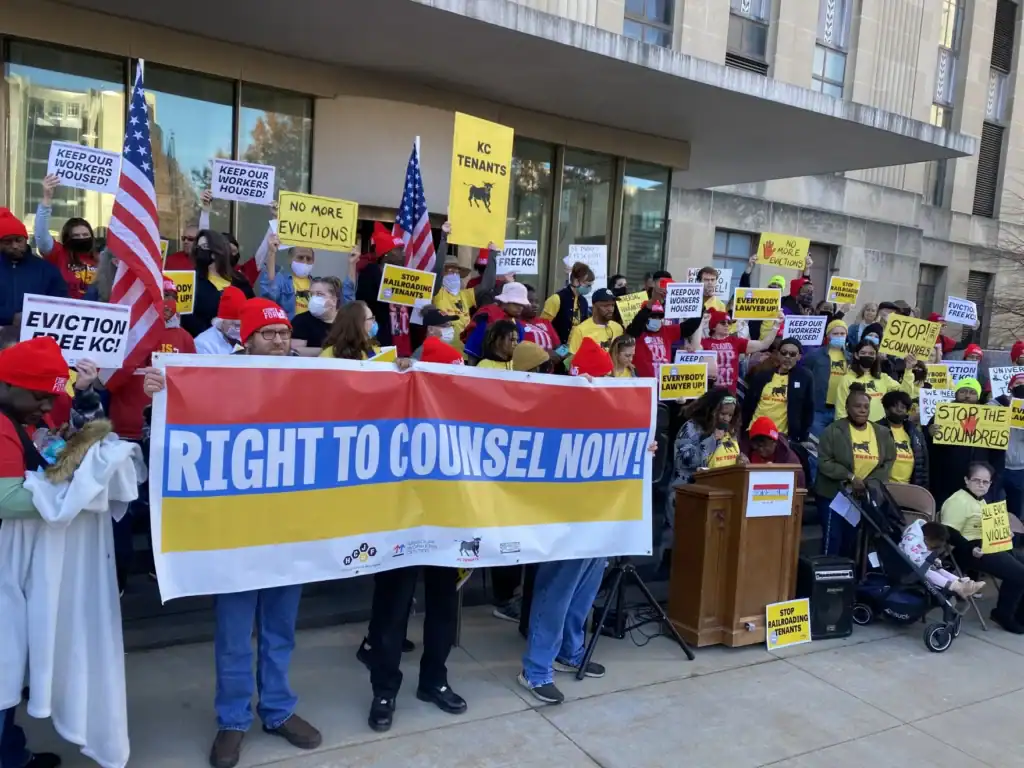
Kansas City Helping Renters Avoid Eviction
On any given Thursday, a small hallway in the Jackson County Courthouse crowds with tenants, landlords, and attorneys arriving for their scheduled hearings and trials. The scene unfolds on Floor 7M, which is half the height of the building’s other levels, and is where Associate Circuit Judge Mary Weir recently worked through 55 eviction cases…
Nick’s Picks | Costco, Homicides, Rain and More …
Is Missouri's congressional map saga over? It seems so, but who knows if there will be another twist or turn. That story and more ...

Nick’s Picks | Obama Visits KC, Debates and Fall’s Arrival
Obama in KC With Election Day just six weeks away, some of the nation’s top political names are now rolling through Kansas City. Last week, Vice President JD Vance was in town. This week, it’s Barack Obama. The former president takes the stage Saturday at the Overland Park Convention Center for a leadership event hosted…