
Crossroads Chilling Thanks to New Pipeline from River Market
September 8, 2020 | Kevin Collison | 3 min read
By Kevin Collison
After disrupting downtown for more than a year laying a chilled-water pipeline below Wyandotte, Vicinity Energy has tapped into the new convention hotel and is looking to expand further into the Crossroads.
“We’ve seen a lot of growth downtown with buildings going up and being renovated,” said Scott Stordahl, Vicinity general manager.
“The writing is on the wall the next big area of growth downtown is the Crossroads area.”
Vicinity provides what’s called “district energy” service from a massive industrial plant at First and Grand that opened in 1904 to supply electricity to the old Kansas City street system. It later switched to supplying steam to downtown buildings.
It was operated for many years by KCP&L, but was purchased in 1990 by Trigen. In 1997, Trigen added chilled water capacity to the facility. It was then purchased by Veolia, a French firm, in 2008. Vicinity became the new owner in January.

Vicinity Energy supplies steam and chilled water through an extensive downtown pipeline system. The red lines are steam, the blue is chilled water and the green is the new chilled water extension. (Map from Vicinity Energy)
With district energy, buildings are heated and cooled using the steam and chilled water generated and piped out at the plant rather than buying and operating their own equipment.
The old plant had supplied steam to buildings, including City Hall, County Hall and other government buildings on the east side of downtown via a line beneath McGee Street. It also scored a coup when it landed the T-Mobile Center, formerly Sprint, as a customer.
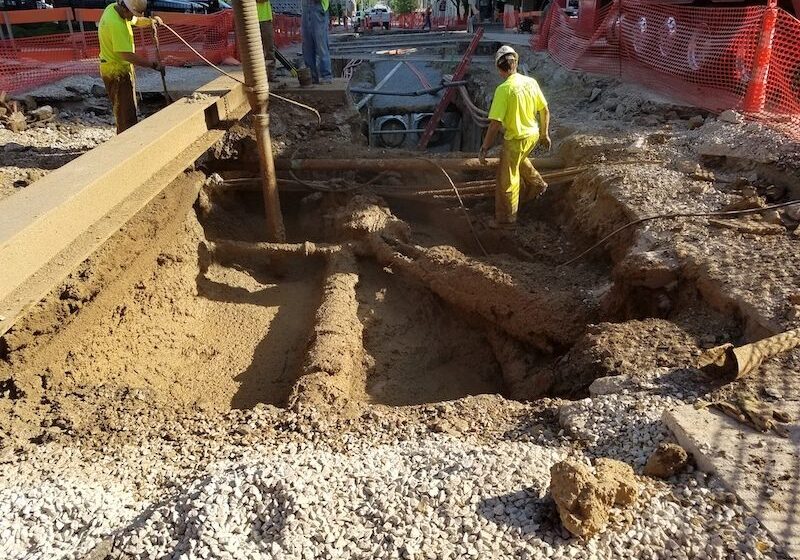
The big project that dug up Wyandotte between late 2017 and early 2019, was to bring the facility’s chilled water service to the new Loews Convention Hotel at 16th and Wyandotte and other customers on the west side of downtown.
The $13 million- to $16 million project required laying 6,000 linear feet of parallel 24-inch pipes beneath Wyandotte, one for outgoing chilled water, the other return. During construction, a thicket of other buried utilities had to be navigated, some uncharted.
“There’s a lot of stuff that’s either not marked and unknowns,” Stordahl said.
“We even were digging up old streetcar rails that you thought would have been gone after decades. It took us two months to through the intersection of 12th Street because of all the utilities.”
The developers of Loews were receptive to the district energy concept because of their experience in other cities.
The new chilled water line also found a willing customer at the new Flashcube apartment project at Seventh and Main, and the former Kansas City Southern office building at 114 W. 11th St.
“All buildings within a couple of blocks of Wyandotte are now in play,” Stordahl said.

The Vicinity Energy plant opened at First and Grand in 1904 as the Metropolitan Street Railway Company Powerhouse.
The chilled water service supplied by Vicinity also was connected to the Bartle Hall convention center as a backup for its in-house cooling equipment.
The company believes the expense of extending the line will be justified by the new customers it hopes to land on the west side of downtown and the Crossroads.
While the chilled water line stops now at the convention hotel, it could be extended to Union Station and even Crown Center if there’s demand.
“There are a myriad of potential customers,” Stordahl said. “Many buildings have aging equipment.
“If the economy was booming, this would be the right time to do it, but people are hesitant because of Covid.”
Reading these stories is free, but telling them is not. Start your monthly gift now to support Flatland’s community-focused reporting.
Related Stories
Kansas City Cooks as Site for National Anti-ICE Dinner Series
Celebrated chefs from throughout the metro collaborated for three nights on dinners that raised money for a local immigrant-rights nonprofit.
Nick’s Picks | Top Cop, Mission Mall, Lucas’ Travels and More …
Nick Haines also has the lowdown on information for the upcoming election, the arrival of fall and Kansas City's Day of the Dead celebration.
Nick’s Picks | I-70, Tax Break, School Petition, and More …
An Interstate 70 closure, a tax rebate for Jackson County property owners, a school closure petition, and more ...