

curiousKC | Send Your Questions on Reproductive Rights and Abortion
June 27, 2022 | Vicky Diaz-Camacho | 3 min read
Inform Flatland’s Next TV Episode, Airing July 21 on Kansas City PBS
Last week, the U.S. Supreme Court overturned Roe v. Wade in a landmark ruling that rolled back the legal right to an abortion that had been on the books for nearly 50 years.
Following last week’s ruling, almost all abortions are now illegal in Missouri. Access to abortions in Kansas hangs on the outcome of a proposed constitutional amendment on the state’s Aug. 2 ballot.
Read the official Roe v. Wade decision from 1972 here.
In the Kansas City area, abortion options are extremely limited or at risk.
Live in Missouri? Abortion is now banned with the exception of medical emergencies that threaten the life fo the mother. Once Roe v. Wade was overturned, Missouri’s trigger law meant the near complete ban immediately went into effect.
In Kansas, abortions are at risk of being restricted. Although the state has protections because of a Kansas Supreme Court ruling in 2019, voters will have a say on just how much that protects.
Changes in Kansas hinge on the Aug. 2 primary ballot outcome. Residents will vote for or against a constitutional amendment that “would affirm there is no Kansas constitutional right to abortion or to require the government funding of abortion,” according to the official description.
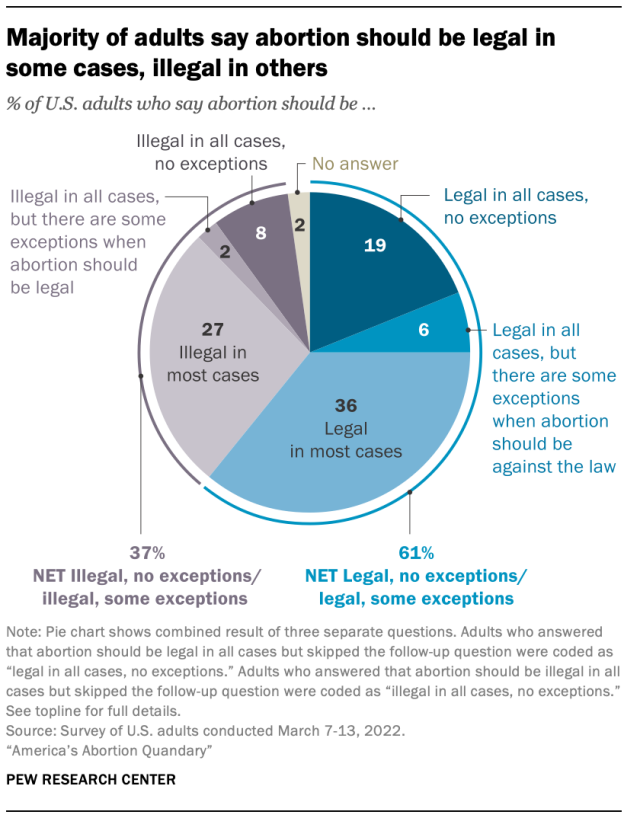
A 2021 statewide poll by the Docking Institute of Public Affairs show that nearly 60% of people in Kansas agree that most forms of abortion should be legal. Nationwide, 61% of people believe abortion should be legal “in all or most circumstances,” according to Pew.
Polling Data
Advocates and a majority of health professionals say it’s important to allow access to choice, reproductive health care and health services by Planned Parenthood clinics, which are often provided at lower or discounted rates for folks who need it most. It’s not only a health issue, but also an economic one.
“Research demonstrates that abortion access does, in fact, profoundly affect women’s lives by determining whether, when, and under what circumstances they become mothers,” according to the Brookings Institute report.
Additionally, “abortion legalization reduced the number of women who became teen mothers by 34% and the number who became teen brides by 20%, and again observed effects that were even larger for Black teens.”
With so much still up in the air, Flatland turns to audience members to share their questions. Your voice and stories will help shape Flatland’s July 21 episode airing on Kansas City PBS.
Write to us below.
<
Vicky Diaz-Camacho covers community affairs for Kansas City PBS.
Reading these stories is free, but telling them is not. Start your monthly gift now to support Flatland’s community-focused reporting.

Related Stories
curiousKC | How Refugee Resettlement Works for Those With Careers
How do refugees who had existing lives and careers rebuild in Kansas City? The answer in this curiousKC story.
curiousKC | A Resource Guide for Youth with Developmental Disabilities
Here's a guide to transition supports and programs for youth with disabilities in the Kansas City area confronting the "high school cliff."
Confronting the ‘High School Cliff’: What Young Adults with Disabilities Need to Succeed
Four years ago, a Kansas City mom created a program for young adults with disabilities like her son. Today, that program has become a resource for people facing the "high school cliff."