
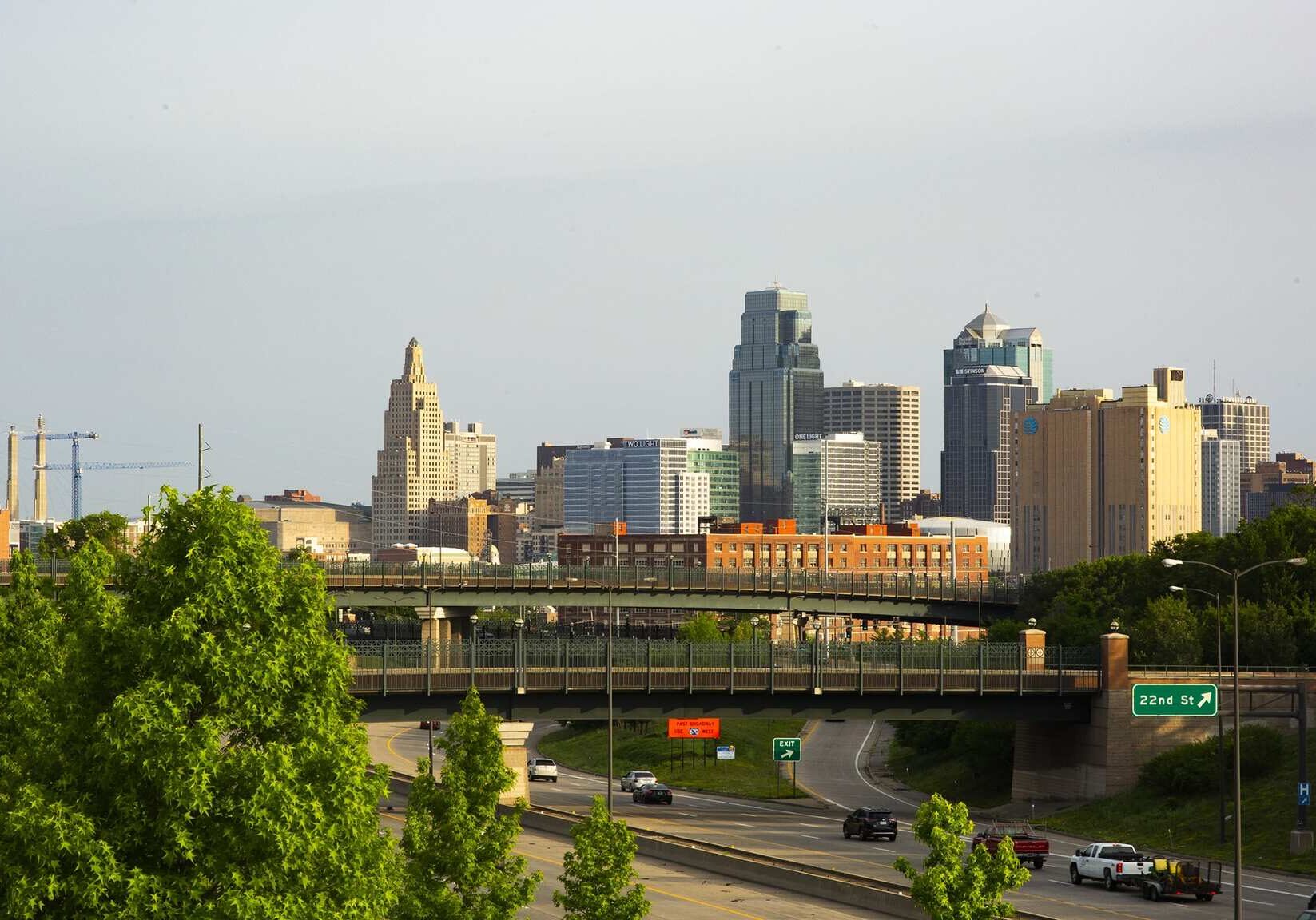
This is my first foray into answering a curiousKC question. I decided to answer (what I thought would be) a straightforward history question thrown our way by Kansas Citian Stacey McBride. “What are the top three oldest surviving buildings in Kansas City?”
“How hard could it be?” I thought. It’s just math. A simple equation: 2019, subtracted by the year the building was built, equals the age of the building. But I am terrible at math and completely forgot about variables in equations.
And when it comes to the question about the buildings, the variable involved is the evolution and growth of Kansas City. More specifically, it has to do with Westport.
That’s because Kansas City annexed Westport in 1899, following a brief legal challenge ultimately settled by Missouri Supreme Court.
So, let’s build our equation, shall we? Don’t be surprised if we get two different answers.
Albert G. Boone Store
Let’s start with the Albert G. Boone Store at 500 Westport Road, now Kelly’s Westport Inn, built in 1850.[FLEX-CONTENT]
The old Boone store, which is listed on the National Register of Historic Places, played an important role in the western trade and migration on the Santa Fe and Oregon Trails.
A plaque on the side of the building reads:
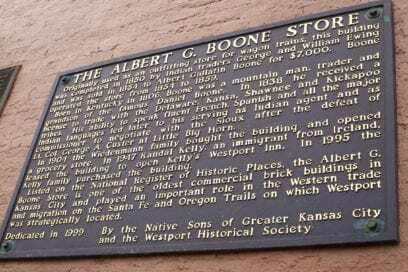
A plaque is bolted to the side of what is now Kelly’s Westport Inn. (Brad Austin | Flatland)
“Originally used as an outfitting store for wagon trains, this building was completed in 1850 by (American) Indian traders George and William Ewing and was sold in 1854 to Albert Gallatin Boone for $7,000. Boone operated the store from 1854 to 1859.”
In 1904, the Wiedenmann family bought the Boone store and opened a grocery store. In 1947, Randal Kelly, an immigrant from Ireland, leased the building to open Kelly’s Westport Inn. The Kelly family later purchased the building in 1995.
Bridger-Chouteau Building
Walk next door to the building that now houses Johnny Kaw’s at 504 Westport Road. It was built around 1851.
This old building once housed Westport’s only newspaper in the 1850s, but it was shut down by Union soldiers for pro-Southern sentiments, according to the Westport Historical Society.
According to the Missouri Valley Special Collections at the Kansas City Public Library, Cyprien Chouteau, along with two others, built this as a mercantile store. Later in 1866, Chouteau sold the building to the famous mountain man Jim Bridger.
Threlkelt and Co. Building
The city of Kansas City was established in 1853 with original boundaries of Bluff Road on the west (roughly where Interstate 35 is today), Holmes Road on the east, the Missouri River to the north and Ninth Street to the south.[FLEX-CONTENT]
The oldest known building that survives in the original footprint of Kansas City is the Threlkelt and Co. Building at 310 Delaware St. in the River Market, according to the U.S. Department of Interior’s National Register of Historic Places Inventory. Today it is The Glam Room.
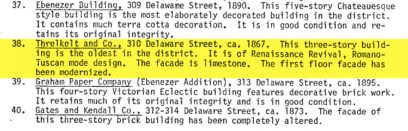
Threlkelt and Co. is listed here in the Department of Interior’s National Register of Historic Places Inventory record from 1963.
The record, typed in black ink, states:
“Threlkelt and Co., 310 Delaware Street, ·ca. 1867. This three-story building is the oldest in the district. It is of Renaissance Revival, Romano Tuscan mode design. The facade is limestone. The first-floor facade has been modernized.”
OK, so there you have it: The oldest building in Kansas City is either the Albert G. Boone Store, now Kelly’s Westport Inn, at 169 years old (annexed in with Westport) or the Threlkelt Building, now The Glam Room, at 152 years old (within the original city limits).
Bonus Building
In my search for the oldest buildings in KC, I came across this interesting fact. The New York Life building at 20 W. Ninth St., now the Catholic Church Administrative offices, is Kansas City’s oldest and first skyscraper. Completed in 1890, it was the first building in Kansas City to have an elevator.
[FLEX-CONTENT]
Stacey, I hope this has answered your curiousKC question. If anyone can add to this, please comment. We would love to hear from you. Or leave your own questions below.
[FLEX-CONTENT]
Reading these stories is free, but telling them is not. Start your monthly gift now to support Flatland’s community-focused reporting.
Related Stories
curiousKC | How Refugee Resettlement Works for Those With Careers
How do refugees who had existing lives and careers rebuild in Kansas City? The answer in this curiousKC story.
curiousKC | A Resource Guide for Youth with Developmental Disabilities
Here's a guide to transition supports and programs for youth with disabilities in the Kansas City area confronting the "high school cliff."
Confronting the ‘High School Cliff’: What Young Adults with Disabilities Need to Succeed
Four years ago, a Kansas City mom created a program for young adults with disabilities like her son. Today, that program has become a resource for people facing the "high school cliff."