
Winning the War: Truman, Eisenhower and the Fight for Democracy
May 15, 2025 | Brian Burnes | 18 min read
First of two installments
Consider it an example of just how small two towering global figures could be.
The year: 1961.
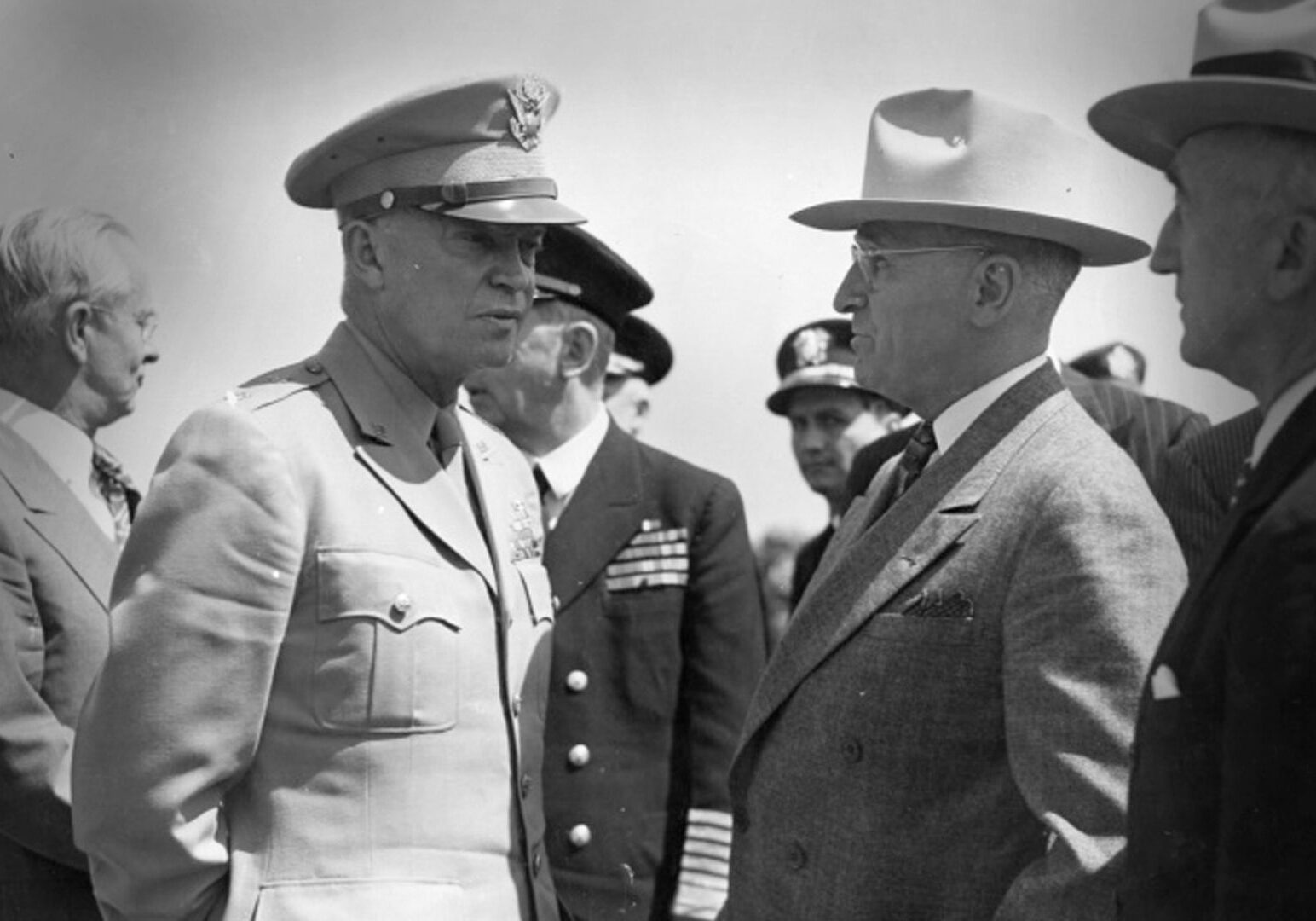
The event: a high-stakes summit that called for discretion and diplomacy, given that two titans on the world stage — Harry Truman and Dwight Eisenhower — for years had maintained an often-frosty distance from each other.
The site: the Harry S. Truman Presidential Library & Museum in Independence.
The two had agreed to meet there.
Eisenhower, the 34th president of the United States who recently had left the White House, was preparing to build his own presidential library in Abilene, Kansas.
Truman, the 33rd president, already had built his library and would show Eisenhower around.
Aside from the 1959 funeral of retired general and former Secretary of State George Marshall, the two had not shared the same space since 1953, when Eisenhower had taken the oath of office. Truman never visited the White House during the Eisenhower administration years of 1953 through 1961.
For years journalists had been referring to the “feud” between them.

Both had grievances to air, according to two grandchildren of the former presidents.
Not long after the German surrender in May 1945, Eisenhower had completed an awkward assignment.
“Granddad kind of had to do some of Truman’s not-quite-so-pleasant tasks, like the firing of Patton,” Mary Jean Eisenhower recalled in a recent interview.
It’s uncertain today whether Truman demanded that Gen. George Patton, commander of the U.S. Third Army in Europe, be removed because of postwar remarks about the Soviet Union following the Nazi capitulation. Nevertheless Eisenhower, who had been Supreme Commander of the Allied Expeditionary Force since 1943, removed Patton.
During and just after the war Truman and her grandfather were “very united,” she added.
“They didn’t have their rift, if you will, until Granddad ran for president.”
That was in 1952. But the feud’s origins dated back several years before, said Clifton Truman Daniel, Truman’s eldest grandson.
In 2003, National Archives officials released the contents of a 1947 diary discovered by Truman Library archivists. In its pages Truman described how he had made the enormously popular Eisenhower an extraordinary offer. Eisenhower could run for president in 1948 as the Democratic nominee while Truman would join him on the ticket as his running mate.
“And Eisenhower turned him down,” Daniel saId in a recent interview. “And then he ran as a Republican.
“So I think that got under Grandpa’s skin.”
The feud would include several low moments.
One famously involved Eisenhower’s break with tradition on the morning of his 1953 inauguration, when he declined to come into the White House for a cup of coffee with Truman.
Eisenhower’s high regard for coffee was well known.
But first, a reality check.
The ‘American Century’
In 1941, the editor-in-chief of all Time Inc. publications articulated his vision for an “American Century.” This could be a time, he believed, when the U.S. could dominate the globe through not only its military prowess but especially its unapologetic display of freedom and democracy.
Henry R. Luce, a member of the East Coast elite, wrote it.
But it took two sons of America’s heartland to make it happen.
Luce insisted the U.S. should shed the isolationism that had prevailed following World War I. The war then underway in Europe gave the country, Luce wrote, “the complete opportunity of leadership.”
That’s the superpower role the U.S. filled from 1945 through 1961, during the Truman and Eisenhower administrations.
In 1941, the two may not have been the most obvious choices to achieve Luce’s ideal.
That year Truman was a re-elected U.S. senator who had been derided in 1935, when he arrived in Washington as the “senator from Pendergast,” a derogatory reference to Kansas City machine boss Tom Pendergast who had selected Truman to run.
But 1941 also would be when Truman would launch his Senate committee investigating corruption in the country’s war contracts, raising his profile and also making the cover of Time, one of Luce’s magazines.
Eisenhower, meanwhile, spent much of 1941 serving as chief of staff to the commander of the Third Army at Fort Sam Houston in Texas, fostering his reputation as an administrator.
Both men had grown up some 150 miles apart in Independence, Missouri, and Abilene, Kansas.
Both were khaki to the core. Truman served as a U.S. Army artillery battery captain in France during World War I. Eisenhower, graduated in 1915 from the U.S. Military Academy at West Point, New York.


During their consecutive administrations the U.S. was one of the planet’s two superpowers, working to frustrate the ambitions of the Soviet Union.
Both would seem sufficiently accomplished to be above petty discord. Yet representatives of both Truman and Eisenhower skirmished over the Truman Library meeting on Nov. 10, 1961.
Truman had told friend and lawyer Rufus Burrus that he wanted him to greet Eisenhower when his limo arrived. He would receive Eisenhower just inside the door.
“He’s calling on me,” Truman told Burrus.
Then, hours before his arrival, there was sudden brinkmanship.
Kansas City Star Editor Roy Roberts, a long-time Truman nemesis, approached Burrus, saying he expected Truman would come out and greet Eisenhower.
“I said, ‘No sir, Mr. Roberts, we’re not going to do that,’” Burrus recalled in a 1985 Truman Library oral history.
When Eisenhower got out of his limo, Burrus was outside waiting for him. He escorted him through the door, where Truman stood waiting.
The tour also would include awkward moments when Truman directed Eisenhower to examine artifacts that Truman had placed to make his guest mildly uncomfortable and causing him, according to Burrus, to grow “red in the face.”
Despite personal friction, from 1945 through 1961, Truman and Eisenhower had agreed on the important stuff.
Cold War Comrades
The two first met in Washington on June 18, 1945, when Eisenhower addressed a joint session of Congress and received from Truman a second oak leaf cluster on his Distinguished Service Medal during a brief ceremony at the White House.
Their next meeting occurred on July 15, 1945, when Eisenhower boarded the USS Augusta after its arrival at Antwerp, Belgium.
One reporter who had accompanied Truman on the trip to the postwar Potsdam Conference remembered seeing Eisenhower standing on the dock waiting, alone.
Truman, then vice president, had become president on April 12, 1945, when President Franklin Roosevelt died.
While Eisenhower wasn’t an official delegate at the summit that brought together British Prime Minister Winston Churchill and Soviet Premier Joseph Stalin, Truman did invite Eisenhower to be in the rooms where some things happened. Eisenhower soon met with Truman and U.S. Army Gen. Omar Bradley to discuss whether to deploy the atomic bomb, which had been successfully tested only days earlier.
Eisenhower had wondered whether the weapon was necessary, saying he believed Japan was close to surrender.

Across the 15 years that followed, Truman and then Eisenhower worked to confront communism across the globe and display a united front in defense of what would become known as the “Free World.”
In 1947, his mouth fixed in what The Kansas City Star described as a “grim line,” Truman had signed documents authorizing $400 million in aid to Turkey and Greece. The humor-free ceremony in a Muehlebach Hotel dining room was considered a landmark response to the perceived threat of Soviet aggression that would “contain” communism and become known as the “Truman Doctrine.”
Eisenhower, during his own administration, maintained that resolute stance, signaling a departure from the isolationist posture the U.S. had maintained after World War I. Although Republican strategists after Eisenhower’s landslide 1952 election had pondered more aggressive strategies, they ultimately agreed with Truman’s policies.
That fit Eisenhower’s practice of often resisting more extreme actions, preferring a moderate path he called the “Middle Way.”
In 1949 the Soviet Union detonated its first atomic bomb, and in 1950 North Korean troops invaded South Korea. That same year Truman asked Eisenhower to lead the North Atlantic Treaty Organization, which included 12 European nations.
Eisenhower would develop his own political priorities over time, said Samuel Rushay, Truman Library supervisory archivist. Those would include support of domestic policies long associated with the Republican Party, such as an enthusiasm for smaller or limited government.
“He did advocate for that,” Rushay said. “But in some ways he was very close to Truman’s point of view, particularly on foreign policy.”
Both Eisenhower and Truman agreed not only in resisting Soviet aggression but also in rebuilding Europe, said Daniel, the former president’s eldest grandson.
“You read my grandfather’s letters to my grandmother from the front in World War I, he was all for grinding Germany into the dust, “ Daniel said.
“Well, of course, a quarter-century later, now you’ve got Adolph Hitler and the Nazis and World War II is ending — he wasn’t going to make the same mistake,” Daniel said.
“Hence the Marshall Plan, NATO as a bulwark against the Soviets, all of that bringing peace and stability to all of Europe. And, of course, at that time General Eisenhower thought the same thing. They were in lockstep, I think, on that one. ‘Let’s do something different, let’s get all that settled, make sure people have enough to eat, make sure the economies are good. Let’s rebuild. Democracies. Here we go.’”

Such cohesion on the world stage would make their later personal friction seem undistinguished.
“I think that, you know, they obviously did agree more than they probably gave themselves credit for,” said Todd Arrington, director of the Dwight D. Eisenhower Presidential Library, Museum and Boyhood Home.
That included building back prosperity in the U.S.
Between 1945 and 1960, the nation’s economy more than doubled in size, led in part by growth in the housing industry.
Truman signed the Housing Act of 1949, which expanded mortgage insurance and provided federal funding for public housing. Eisenhower, in turn, signed the Housing Act of 1954, which authorized the federal government to insure larger home mortgage loans.
“Eisenhower was incredibly intelligent to keep a lot of the New Deal programs in place rather than try to replace a lot of those, as some Republicans wanted him to,” said Arrington.
Chief among those programs was the Social Security Act, signed into law in 1935.
Under Truman, Congress approved the Social Security Act of 1950, which expanded benefits to agricultural and domestic workers. Amendments approved under Eisenhower in 1956, meanwhile, provided assistance to disabled workers and children.
Eisenhower considered federal welfare programs as a “floor over the pit of personal disaster,” according to a 2015 article by former Eisenhower Library Deputy Director Timothy Rives.
Eisenhower defended his sentiments from Republicans who opposed them — including Eisenhower’s brother Edgar.
“Should any political party attempt to abolish Social Security, unemployment insurance, and eliminate labor laws and farm programs, you would not hear from that party again in our political history,” Eisenhower insisted to his brother in a 1954 letter.
The same year the Supreme Court issued its unanimous ruling in Brown v. Board of Education of Topeka, declaring state-sanctioned segregation in public schools unconstitutional.
Although historians have debated Eisenhower’s apparent ambivalence towards the decision, he ultimately enforced that as well as Truman’s civil rights initiatives.
In 1947, Truman had become the first president to address members of the National Association for the Advancement of Colored People, or NAACP.
In 1954, Eisenhower became the second.
In 1948, Truman issued Executive Order 9981, initiating the integration of the armed forces. Eisenhower later enforced that order, directing the desegregation of military bases and hospitals.
The actions of both presidents directly affected Johnnie Cheatom of Kansas City, who served 25 years in the U.S. Army, with stints in Korea, Germany and Vietnam.
He enlisted in 1946.
The walls of his Kansas City home display photos of his service, one of them dating to 1950 when he was a member of Company A of the 1402nd Engineers. The photo, depicting only African Americans, suggests the effect of Truman’s executive order was not immediate.
That changed when Cheatom arrived in Germany with the First Infantry Division, part of the Allied occupation forces following the Nazi surrender.
“The colonel called us all inside this conference building,” Cheatom said. “He said: ‘We are not going to have any trouble. We are going to stick together, and work together, and that’s it.’
“So, everybody treated everybody right, and it worked.”
It worked in Germany and also within the confines of U.S. Army posts in America, such as Fort Campbell, Kentucky, where Cheatom was stationed with the 27th Engineers Battalion.
“A guy told me once, he said, ‘Sergeant, I’ve never worked for a black man.’ And I told him, ‘You work for one now.’“
Cheatom admired Eisenhower’s 1957 decision to send federal troops to Arkansas to enforce the integration of Central High School in Little Rock.
On Sept. 9, Eisenhower had signed the Civil Rights Act of 1957, the first such legislation since the post-Civil War Reconstruction era, authorizing federal protection of African American voting rights.
Two weeks later Eisenhower sent 101st Airborne troops to Arkansas to enforce integration initiatives in Little Rock. That was the same division whose paratroopers had landed behind the beaches of Normandy, France, during the 1944 D-Day invasion.
“Eisenhower did a beautiful thing,” Cheatom said.
Truman and Eisenhower also built roads.
In 1928 Jackson County, Missouri, voters approved a $6.5 million bond proposal to develop a network of reliable roads. Many would later say that Truman, then Jackson County presiding judge, had lifted the county “out of the mud.”
Eisenhower’s support of a nationwide interstate highway network, meanwhile, transformed the country.
Eisenhower signed the Federal-Aid Highway Act of 1956, authorizing the construction of the Interstate Highway System. The massive public works project — estimated at $128.9 billion — reshaped the country as Americans embraced the newfound mobility of a car-oriented culture.

Eisenhower had experienced the challenges of post-World War I road readiness while a military observer assigned to the 1919 Transcontinental Motor Convoy.
The exercise had been meant to examine America’s ability to move troops efficiently on existing infrastructure. The trip covered 3,200 miles from Washington, D.C., to San Francisco.
Eisenhower described to his superiors the patchwork of roads the convoy had encountered, making mobility of military assets problematic.
Some 25 years later Eisenhower saw the autobahns of Germany. The expressways featured central medians separating multiple lanes of traffic, allowing for higher-speed travel across rural districts.
“The convoy,” Eisenhower wrote in a memoir, “had started me thinking about good, two-lane highways but Germany had made me see the wisdom of broader ribbons across the land.”
While the system could be an investment in the country’s defense, potentially aiding in the evacuation of large cities in case of atomic attack — a Cold War reality Americans had to process — Eisenhower supported the system for its civilian applications.
Those included convenient access to all that new housing. Yet that same mobility also contributed to the flight from cities by those eager to invest in the ever-growing suburbs that — decades later — would be recognized as one symptom of “urban sprawl.”
Continued interstate construction also contributed to higher greenhouse gas emissions and flood-producing water run-off from freshly paved farmland.
By the mid-1990s, the Kansas City area claimed more freeway lane miles per capita than any other metro area in the nation with a population of more than 1 million people.
Bucking the Rivet
Besides the interstate system, other legacies of the Truman and Eisenhower eras can still be seen across the Kansas City area.
That includes the sites of several defense plants.
Federal planners approved them with the support of Truman, who didn’t much mind if a plant was built on the Missouri or Kansas side of the state line, said William Worley, a longtime Kansas City area historian and professor.
But Truman also would insist any federal contracts be handled honorably.
After winning his second Senate term in 1940, officials broke ground on Fort Leonard Wood, in south central Missouri.
Truman soon began receiving letters from constituents, describing sloth and careless neglect of construction materials.
Truman drove down to investigate, said Steve Drummond, author of “The Watchdog: How the Truman Committee Battled Corruption and Helped Win World War II.”
“Guys were sitting around playing cards,” Drummond said.
In December 1940, at about the same time Truman found the loafers at Fort Leonard Wood, he also gripped a shovel at a groundbreaking ceremony for the Lake City Army Ammunition Plant, to be built not far from the Independence city limits.
Whatever regard Truman may have had for employment opportunities in his hometown, that didn’t mean he would let such investments go unmonitored.
“I know for a fact that he came out to investigate the Lake City plant,” Drummond said. “I never saw any indication that Truman was going light on Kansas City.”
Three days before Truman attended the Lake City groundbreaking, workers at the new North American Aviation plant, adjacent to the Fairfax Municipal Airport in Kansas City, Kansas, completed the first of 6,680 B-25 bombers.
The factory attracted workers who sometimes left distant homes to find steady employment. Over the course of the war, 59,337 employees built bombers at the plant, about 40% of them women.

That included Vaughnie Tinsley of Mission, who signed on in 1943.
She had grown up in Sullivan County, in north central Missouri. Her father found work at the bomber plant, then her mother. After Vaughnie graduated from Green City High School in 1943, she joined them building B-25s.
She met her work partner, whom everyone called “Shorty,” during training. Their task was installing rivets in the left bomb bay of every B-25.
While Shorty stood only 5 feet tall, she was good with the rivet gun, so it fell to Vaughnie to climb inside the compartment and hold an iron bar, anchoring the pre-cut holes that Shorty drove the rivets through.
“She was the riveter on the outside and I was the ‘bucker’ on the inside,” she said.
Plant operators suspended production in August 1945 after the Japanese surrendered. On Aug. 20, the first 3,000 employees made jobless received their final paychecks.
Tinsley was among those in line when a Kansas City Star staff member approached her.
“Her ambition now is to attend the Northeast Missouri State Teachers College in Kirksville,” the reporter wrote in that afternoon’s paper.
That’s what Tinsley did, earning a degree and going on to a career in the Shawnee Mission School District, spending 32 years as a school principal.
While Tinsley was proud of joining the war effort, she never thought she deserved a medal.
“The whole country was working at winning the war,” she said.
Another example was not a plant but a laboratory — the Midwest Research Institute.
In 1943 victory was already in sight for some Kansas City business leaders who wondered if there was a way — after the war was over — to retain the many industrial engineers and researchers who had moved to Kansas City to work in its several defense plants.
Among them was real estate developer J.C. Nichols, who, as a member of an advisory committee to the National Council of Defense — a federal agency coordinating resources for national security — had helped attract those plants, such as the North American Aviation B-25 assembly facility in Kansas City, Kansas.
Inspired by the Mellon and Armour research institutes of Pittsburgh and Chicago, respectively, the founders of the Midwest Research Institute, chartered in 1943, sought to keep Kansas City competitive with cities with their established scientific development professional communities.
Today what is known as MRIGlobal, located next to the University of Missouri-Kansas City, conducts research in a variety of fields, among them national security, agriculture and energy.
Flatland contributor Brian Burnes is a Kansas City area writer and author.
Reading these stories is free, but telling them is not. Start your monthly gift now to support Flatland’s community-focused reporting.
Related Stories
Nick’s Picks | Costco, Homicides, Rain and More …
Is Missouri's congressional map saga over? It seems so, but who knows if there will be another twist or turn. That story and more ...

Nick’s Picks | Obama Visits KC, Debates and Fall’s Arrival
Obama in KC With Election Day just six weeks away, some of the nation’s top political names are now rolling through Kansas City. Last week, Vice President JD Vance was in town. This week, it’s Barack Obama. The former president takes the stage Saturday at the Overland Park Convention Center for a leadership event hosted…
Preparations Aside, KC World Cup was Quiet for Hospitals, Police
Officials said months of planning will serve them well in the year's to come through improved collaboration.