
World War II Left Lasting Economic Imprint in the Region
May 29, 2025 | Margaret Mellott | 7 min read
Harry S. Truman would scarcely recognize today’s technological wizardry and business advancements, 80 years after his instrumental role in the Allies’ victory in World War II.
But the former U.S. senator and president from Independence, Missouri, helped lay the groundwork for some of the pillars still fueling the Kansas City-area economy, including components of a defense industry that his successor in the White House, Dwight Eisenhower, warned against in his 1961 farewell address.
Eisenhower, another son of the Heartland, from Abilene, Kansas, acknowledged that the U.S. could no longer rely on an “improvisation of national defense” where the country scaled up to address a threat.
“We have been compelled to create a permanent armaments industry of vast proportions,” he said. “Yet we must not fail to comprehend its grave implications. . . . In the councils of government, we must guard against the acquisition of unwarranted influence, whether sought or unsought, by the military-industrial complex. The potential for the disastrous rise of misplaced power exists and will persist.”
But Truman had other thoughts when he was in office, said local historian Bill Worley.
“He viewed his job — whether it was county court presiding judge or U.S. senator or, for that matter, even as president, but particularly while he was senator — to essentially bring in as much business and economic activity to the state of Missouri as possible,” Worley said.

Truman had a hand in many of the large projects brought to the region in the 1940s, including: the Sunflower Army Ammunition Plant in De Soto, Kansas, Bendix Corporation in Kansas City, and the Lake City Army Ammunition Plant in Independence, Missouri.
“Because he lived in the Kansas City area, which, of course, laps over the state line, he was interested in projects that would possibly be in Kansas, but would overlap, in terms of workers and that sort of thing, in Missouri,” Worley said.
Around the same time, the North American Aviation B-25 Bomber Plant and the Midwest Research Institute also played roles in the region’s growth.
Many of these businesses have carried forward to today.
The Midwest Research Institute, now MRIGlobal, has expanded its scope internationally from its headquarters near the Country Club Plaza.
Lake City Army Ammunition is the world’s largest small arms ammunition plant.
And after a series of business acquisitions, Bendix Corp. is now Honeywell Federal Manufacturing & Technologies LLC, with its Kansas City National Security Campus in the southern reaches of the city.
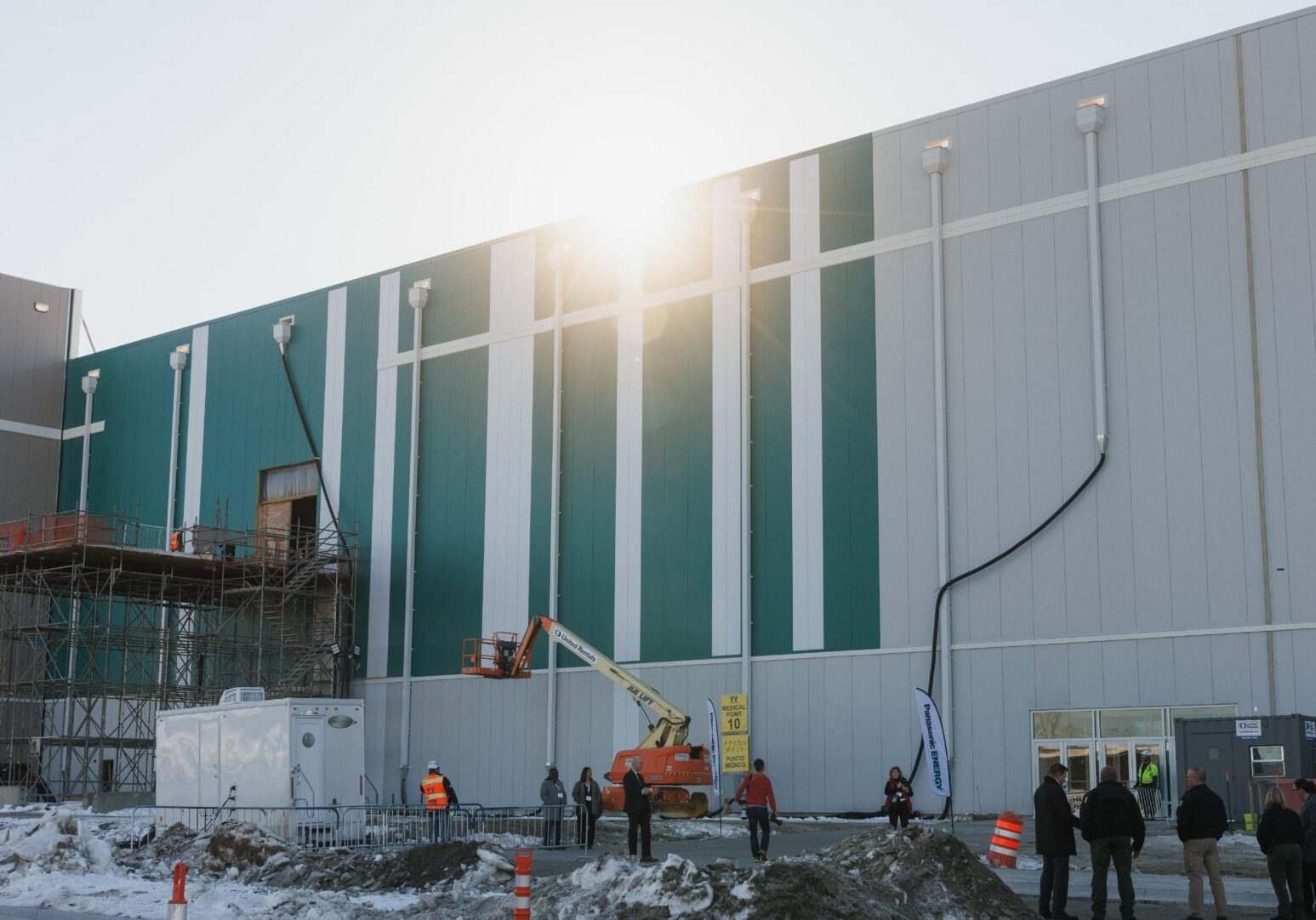
While the North American Aviation bomber plant and the Sunflower Army Ammunition plant are closed, their sites are home to major industries — the former bomber plant is now the General Motors Fairfax plant, and a portion of the Sunflower site will soon be a Panasonic plant producing electric car batteries.
Dave Pack is disappointed that the U.S. has ignored Eisenhower’s warning.
He is the board chair for PeaceWorks Kansas City, the local affiliate of Peace Action, a national organization working to end wars and prevent the use of nuclear weapons.
“One of the concerns is the resources it (military-industrial complex) consumes and the inability to use those resources to deal with the real problems in terms of people being fed, housed, and generally cared for,” Pack said. “When you are spending the enormous amounts of money that we do on the military, you limit what you can do to take care of the real needs.”
In 2024, the United States spent $997 billion on defense, which is more than the next nine countries’ spending combined, according to the Peter G. Peterson Foundation, which focuses on long-term fiscal challenges for the U.S. and promotes solutions to ensure a better economic future.
“I have often used the term ‘real security,’” Pack said. “Where does people’s real security lie? It’s in their health and in their ability to live in a house and to have food, and the military-industrial complex uses up so many resources that could be used in so many other ways to provide for people’s real security.”
Related Content
Though Truman advocated for Bendix Corp. to settle in Kansas City, making non-nuclear parts for nuclear weapons, he wanted to avoid further use of the weaponry.
Shortly after the U.S. dropped the first atomic bomb on Hiroshima, Truman told a U.S. senator that, “I certainly regret the necessity of wiping out whole populations because of the ‘pigheadedness’ of the leaders of a nation, and, for your information, I am not going to do it unless absolutely necessary.”
He also refrained from using nuclear weapons during the Korean War, though he kept the possibility open to prevent a “major military disaster.”
And in his farewell address to the American public on Jan. 15, 1953, Truman noted that the world was living in the eighth year of the atomic age.
“We are not the only nation that is learning to unleash the power of the atom. A third world war might dig the grave not only of our communist opponents but also of our own society, our world as well as theirs,” he said. “Starting an atomic war is totally unthinkable for rational men.”
Truman’s reticence did not extend to expanding the U.S. nuclear arsenal, with many of the non-nuclear components produced at the Bannister Federal Complex, where Bendix Corp. was located.
Today, Honeywell reports that the Kansas City plant produces about 85% of the non-nuclear components used for nuclear weapons.
After 34 years, Bendix merged with Allied Corp., in 1983. Just two years later, the company would merge again, this time becoming Allied-Signal, Inc., expanding its aerospace, automotive, and engineered materials functions.
Allied-Signal acquired Honeywell in 1999 for $14 billion, retaining the Honeywell name.
Gauging the Impact
In just one example of how companies spawned by World War II continue to impact the regional economy, the Kansas City Area Development Council says that the GM Fairfax plant is part of an automotive manufacturing industry that generates about $21 billion in GDP for the region.
The region’s thriving engineering sector — an outgrowth of companies like Bendix and MRIGlobal — is another post-war legacy, said economist Chris Kuehl, managing partner and co-founder of Armada Corporate Intelligence in Lawrence.
“You’ve got these core industries that set up in Kansas City and then spawned other industries,” Kuehl said.
That ripple effect makes it difficult to quantify the current overall economic impact from the industries started back in the 1940s, he said.
For instance, he said some of the engineering expertise might have ended up at Garmin, the Olathe-based company that specializes in GPS navigation and wearable technology. Garmin also does business with the military, Kuehl said.
It is also hard to track the movement of workers who switched careers after being drawn to the region by a company like Honeywell, Kuehl said.
“There are a lot of aspects of that development that go unnoticed because we don’t really connect it with the military-industrial complex,” Kuehl said. “The interstate highway system originated with the military saying, ‘We need better internal transportation.’ Now, we don’t think about it, it’s just the highways.”
The military example illustrates the general effects of a dynamic economy.
“What you see here is that you get an innovation in one company, and then it triggers an innovation in another,” Kuehl said. “You see it all over the country.”
Margaret Mellott is a freelance writer and photographer in the Kansas City area, primarily covering government and education.
Reading these stories is free, but telling them is not. Start your monthly gift now to support Flatland’s community-focused reporting.
Related Stories

Nick’s Picks | Messi, Jail, Buses, and More …
World Cup Team(s) Arrive It’s starting to feel real. The first World Cup team has landed in Kansas City. Defending champions Argentina touched down at KCI airport on Sunday and will begin practicing today at Sporting KC’s training facility in Wyandotte County. Much of the attention, of course, is focused on Lionel Messi. The soccer…
World Cup ‘Statement Piece’ Evokes Best Version of Kansas City
Before I moved to Kansas City almost 56 years ago, I had been here only once — for a brief visit to the Kansas City Press Club when I was attending the University of Missouri School of Journalism. But because of that visit and the fact that I grew up in the Midwest (Woodstock, Illinois,…
KU Center Helps Women Gain Foothold After Incarceration
A flier from her probation officer was the turning point for Jodi Whitt, who had spent more than two decades in and out of the criminal justice system. The piece of paper introduced Whitt to the Technology Education Program offered by the University of Kansas’ Center for Digital Inclusion. Since 2019, Whitt has risen through…