
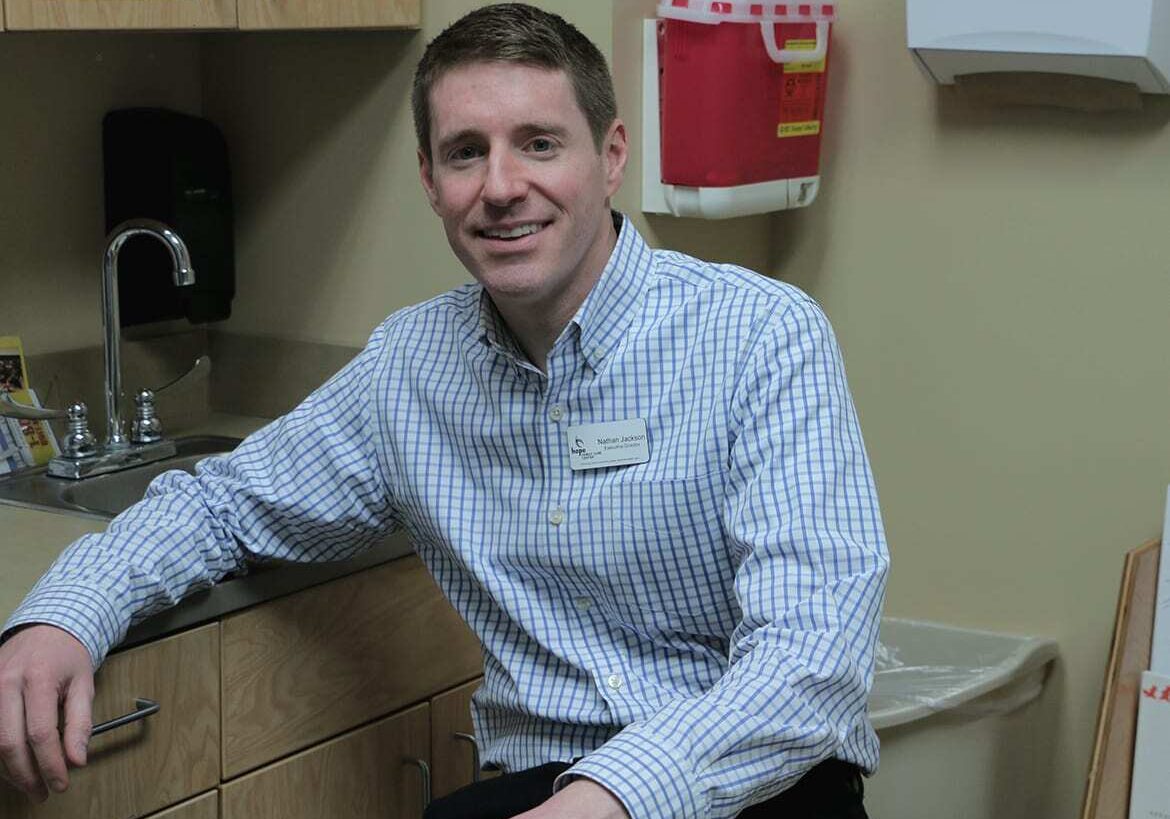
Health Profile: Nathan Jackson, Executive Director, Hope Family Care Center
April 18, 2014 | | 7 min read
Mike Sherry – The Hale Center for Journalism
Hope Family Care Center provides primary care to three medically underserved, low-income ZIP codes in the urban core of Kansas City, Mo. The faith-based clinic at 3027 Prospect Ave. opened five years ago as an initiative of The Hope Center, a Christian community development organization that has operated in the neighborhood since 1998.
The clinic operates on about a $1 million budget, serves patients on a sliding-fee schedule, and averages about 550 to 600 patient visits per month.
Hope Family Care opened with support from College Park Family Care, a medical practice with 10 locations in Johnson County. Physicians from College Park Family Care served as volunteer staff of Hope Family Care for about the first year and a half it was open. Research Medical Center then stepped in with financial assistance that allowed the clinic to hire a full-time doctor about three years ago (a commitment the hospital has since increased so the clinic could bring on a second doctor).
At about the same time, in early 2011, Nathan Jackson came aboard as the clinic’s first full-time executive director. A Kansas City native, Jackson, 39, graduated high school from a small, now-closed Christian school in Grandview.
He holds a bachelor’s degree from the University of Missouri-Columbia and a master’s degree from the University of Missouri-Kansas City. As an amateur guitarist and one-time band member, Jackson took his inspiration for his master’s thesis from the humanitarian work of the lead singer of the Irish rock band U2 – titling his work (replete with an accompanying website) “Bono’s Politics: The Future of Celebrity Political Activism.”
In addition to his position at the clinic, Jackson also serves as the co-chair of the Safety Net Collaborative, a working group of health care executives from clinics and other organizations around the metropolitan area.
What led you to the position at the clinic?
I was volunteering in the youth program (at The Hope Center) for a few years and Chris (Jehle, founder of The Hope Center) had kind of mentioned they were thinking about doing this health clinic thing. And my background is pretty unique. My undergraduate degree is in business administration, and I worked out in the corporate world for a while, and then, in 2003, I decided I was kind of looking for a little more meaning in my work, and I decided to go back to school and ended up getting a master’s in political science at UMKC. I really enjoyed policy, and I kind of stumbled into health policy through some freelance work I was doing, so I ended up moving to New York City for a while. I was out there working for the Global Fund to Fight AIDS, Tuberculosis, and Malaria.
I worked for them for about five years freelancing and full-time, and going back and forth between Kansas City and New York. Then, I started freelancing for the Health Care Foundation (of Greater Kansas City). (Hope Center leaders) knew I had an interest in health care and they said, “Hey, do you want to help run this clinic?” And I initially said no.
I didn’t feel like it was something screaming at me, that I wanted to do, and they said, “OK. We understand.” And then a couple weeks later, they called me back and they said, we really think you would be a good fit for this, why don’t you think about this, so that kind of piqued my interest. And then I started dreaming a little bit, and thinking this could be a really cool thing. And I really came to love it, and it’s almost four years later, and I’m still trucking away.
What did you do in the business world?
A little bit of everything. My first job was pretty cool. I did it on the West Coast for about a year. I was doing the Freschetta Pizza bus – the frozen pizza in the green box. It was actually a converted shuttle bus that they had put two convection ovens in, so we drove around going to football games, the Albuquerque Balloon Festival, and handed out free pizza and coupons. My first assignment was the Taste of Denver. We drove it from Seattle to Denver and then back to California. We were everywhere.
Then I came back to Kansas City and worked for Cellular One. I was there for about a year in their marketing department, and then I was a manufacturer’s rep for a flooring manufacturer. I did that for a few years. I had a lot of freedom, traveling around the Midwest. It was kind of a different. Instead of sitting in front of a computer, I was out a lot more. I was in a couple bands, so it fit in nice with that. If we had a show in Des Moines or something, I could work it out that I could do my sales calls in the morning. I think all that windshield time is when I started thinking, you know, this is great, the making money and all that, but I‘d love to do something that kind of gave back a little bit more. I really got interested in social justice through my faith, you know, just thinking what that looked like in practical terms — that kind of spurred my interest in going back to grad school.
So, you are probably not your typical safety-net administrator?
Probably not.
What would like to achieve through the Safety Net Collaborative?
I don’t know if there is a grandiose goal to come out of that. You know, personally, I would love to see – I know San Francisco has done a lot with Healthy San Francisco. It provides primary health care for all their citizens. It’s based on geography, so you are assigned to a community health center or a hospital. One of the coolest things that came out it was a Web portal. You could jump on there, sign up and you would get a card in the mail. I think we could be a little more tech savvy. I think that would be really cool if there was a website that everyone knew — a way that was really easy to find what it is you are looking for, whether that’s a doctor, or maybe you just need some help with diabetes meds or a new pair of eyeglasses. I think that would be really helpful for Kansas City, and I think it could come out of that group.
What has been the biggest eye-opener in running the clinic?
The most surprising, and challenging, too, is just how complicated health care is. You intuitively know it’s complicated when you are a consumer, and you have your company distribute a plan, but when you are on my side, it is incredibly complicated. Now I know why people don’t just open up health clinics. It’s not easy to do.
The flip side of that is the reward, because you work hard and you see — our big thing here, we talk about our mission is to honor God by providing quality, personal health care, and I think we have really delivered on that. We try to get as many people as possible to fill out surveys. We regularly get really high feedback.
One of the different things about us — being tied to The Hope Center — is our long-term vision is we want to be right here, maybe add a few more docs and serve the capacity of this community — one square mile — and really be a full-service, patient-centered medical home. I’d love to add mental health services, maybe some other specialties. We don’t have any plans to ever expand from this community. We might outgrow this space, but we are not going anywhere.
Reading these stories is free, but telling them is not. Start your monthly gift now to support Flatland’s community-focused reporting.
Related Stories

Nick’s Picks | Soccer, Elections, Entertainment and More …
It's a soccer extravaganza in Kansas City, with the city reaching its halfway point as a host city and the City Council set to consider a bond package to expand the Kansas City Current stadium.

Nick’s Picks | Fan Fest, Streetcar, Liquor and More …
World Cup Begins The wait is finally over. The first ball of the 2026 World Cup will be kicked Thursday, ushering in 5 ½ weeks of competition across the United States, Canada and Mexico. It’s also opening day for Kansas City’s FIFA Fan Fest at the National World War I Museum and Memorial—our first real…
Nick’s Picks | Messi, Jail, Buses, and More …
World Cup Team(s) Arrive It’s starting to feel real. The first World Cup team has landed in Kansas City. Defending champions Argentina touched down at KCI airport on Sunday and will begin practicing today at Sporting KC’s training facility in Wyandotte County. Much of the attention, of course, is focused on Lionel Messi. The soccer…