
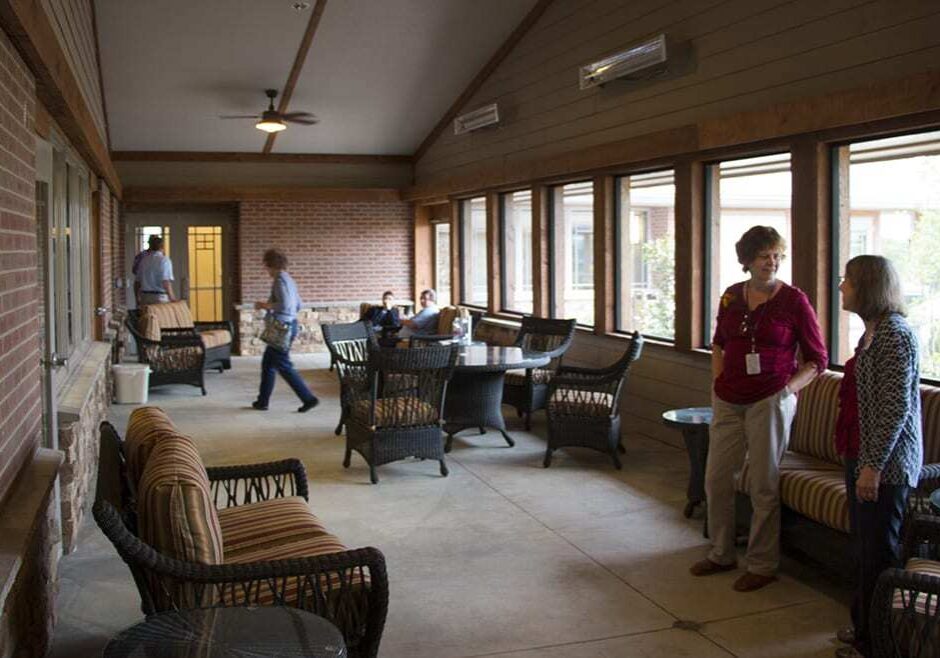
Olathe Medical Center opens facility for final stage of life
September 18, 2014 | | 3 min read
Olathe Medical Center officials say they have added a building block to their vision of providing cradle-to-grave care.
On Wednesday, in front of a crowd of about 300 donors, employees and other well-wishers, the hospital officially opened a freestanding inpatient hospice on its land at Interstate 35 and 151st Street.
“In the early 1980s, when we were considering what someday would be on this campus, our board of trustees and leadership discussed the full continuum of care — the continuum of care from birth to the end of life,” CEO Frank Devocelle said. “So it is with great pride that we take another step in that vision here today.”
Officially called Hospice of Olathe Medical Center, the $4.3 million facility covers about 10,000 square feet. It is opening with eight beds, but future plans call for an expansion to 32 beds.
The official opening came after about three years of fundraising and roughly 18 months of construction. Officials said they will continue fundraising to help finance operations.
It will likely be a few weeks before the facility gets the go-ahead from the state to start admitting patients, said Sally Lundy, director of hospice and home health for the medical center.
“This day has been a long-awaited dream of mine and for many in the community,” she said.
The primary purpose of an inpatient hospice facility, she said, is to stabilize medically fragile patients so they can return to a home-based setting. Inpatient hospice stays are typically no longer than a week, Lundy said.
First for Kansas side
Olathe Medical Center officials said their building is the first inpatient hospice facility on the Kansas side of the metropolitan area. Myra Christopher, an expert on pain and palliative care at the Center for Practical Bioethics in Kansas City, Mo., noted that the opening coincided with the release of a much-anticipated national report by the Institute of Medicine.
The authors of the report, “Dying in America: Improving Quality and Honoring Individual Preferences Near the End of Life,” concluded that the nation’s health care system is “increasingly burdened by factors that hamper delivery of high-quality care near the end of life,” including a fragmented care structure and payment models that incentivize use of acute-care services, such as intensive care units, “that often are costly and poorly suited to the needs, goals, and preferences of patients and their families.”
Christopher attributed some of that to a mindset among caregivers that death is tantamount to failure. That, she said, is beginning to change with the emphasis in the Affordable Care Act on continuity of care and seamless transitions among settings.
A lot of that emphasis is driven by efforts to keep a lid on health care costs, and Christopher said hospice care is unquestionably less expensive than an ICU.
She added, however, that the primary aim of hospice care is to provide the most comfortable and calming environment for terminally ill patients and their families.
Christopher said she’d heard of hospices honoring a patient’s request for a meal of lobster. She’d also heard a story about a facility in Las Vegas that paid to have a rancher’s horse transported to the hospice and tethered outside his room where he could see it.
“Could you imagine telling a hospital that is what you want them to do?” Christopher asked.
Major Funding for Health coverage on KCPT provided by Assurant Employee Benefits and the Health Care Foundation of Greater Kansas City.
Reading these stories is free, but telling them is not. Start your monthly gift now to support Flatland’s community-focused reporting.

Related Stories

Nick’s Picks | Messi, Jail, Buses, and More …
World Cup Team(s) Arrive It’s starting to feel real. The first World Cup team has landed in Kansas City. Defending champions Argentina touched down at KCI airport on Sunday and will begin practicing today at Sporting KC’s training facility in Wyandotte County. Much of the attention, of course, is focused on Lionel Messi. The soccer…

World Cup ‘Statement Piece’ Evokes Best Version of Kansas City
Before I moved to Kansas City almost 56 years ago, I had been here only once — for a brief visit to the Kansas City Press Club when I was attending the University of Missouri School of Journalism. But because of that visit and the fact that I grew up in the Midwest (Woodstock, Illinois,…
KU Center Helps Women Gain Foothold After Incarceration
A flier from her probation officer was the turning point for Jodi Whitt, who had spent more than two decades in and out of the criminal justice system. The piece of paper introduced Whitt to the Technology Education Program offered by the University of Kansas’ Center for Digital Inclusion. Since 2019, Whitt has risen through…