
Landmark Western Auto Sign to Dazzle Downtown Skyline Again
May 4, 2018 | Kevin Collison | 3 min read
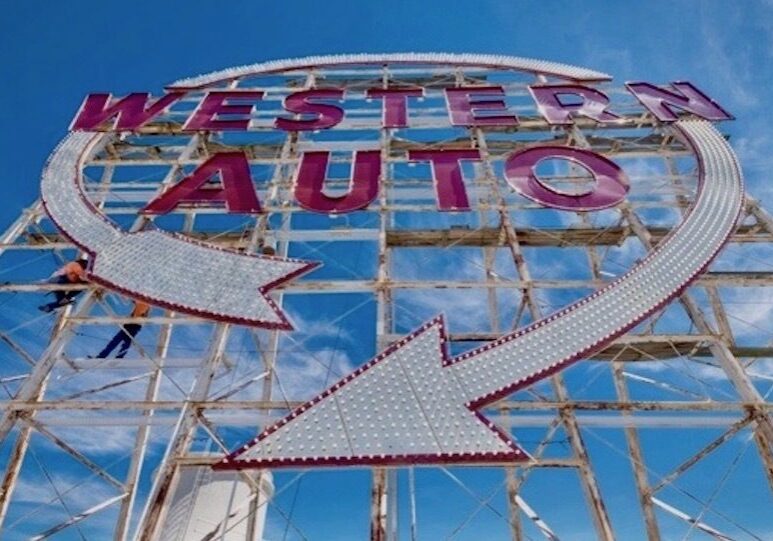
(Updated June 25) The landmark Western Auto sign is scheduled to light up the skyline again on again July 13, according to a release today from building’s homeowner’s association and Copaken Brooks.
If you’re looking for a souvenir, the old light bulbs from the sign will be available for purchase on July 9. For more information regarding the sign or purchasing a bulb, please follow the Western Auto Lofts Facebook page.
The iconic Western Auto sign is expected to light up the downtown skyline again by late summer following a major repair job by the condo owners living in the building and Copaken Brooks.
The dazzling sign that caps the 12-story building at 2107 Grand Blvd. has been a familiar landmark since 1952, but its 2,500 light bulbs and 1,000 feet of neon tubing have gone dark the past couple years.
But this week, the Western Auto Lofts Condominium Association and Copaken Brooks announced the old incandescent bulbs are being replaced with energy-efficient LED bulbs and any damaged neon will be repaired. Infinity Sign Systems is doing the work.
“The association is thrilled to give this gift back to the residents of Kansas City and can’t wait to be a part of the skyline once more,” according to a press release.
The Western Auto building was originally built in 1915 and was known as the Coca-Cola building. It was renamed the Candler Building in 1932 and became Western Auto in 1951 and was the headquarters for the national auto parts chain.

The building now known as Western Auto opened in 1915 as the Coca-Cola Building.
Western Auto was founded in Kansas City in 1909 by George Pepperdine and Don Abnor Davis. Pepperdine went on to found the university bearing his name in Southern California.
At first, the firm was a mail-order auto parts business, but as more people owned cars it began opening retail stores in 1921.
At its peak, there were 1,200 stores nationwide. The business was sold in 1961 and went through a succession of owners before finally shutting down its retail outlets in 2004.
The historic building and two neighboring structures were converted into 161 condos in 2003.
The distinctive sign with its hyper-active red arrow is 73-feet tall and 70-feet wide. It’s visible up to 15 miles, according to the release. Each letter is 10-feet high.
The renovation project will replace the existing catwalk structure behind the sign with what’s described as a more sophisticated steel-mesh design.
“The foremost concern for the repairs the association faces is completing them safely, while also preserving the integrity of this iconic landmark…which to so many Kansas City residents means ‘home,'” the release stated.
Copaken Brooks is a full-service commercial real estate firm.
Those services include managing condo properties for their associations. Its downtown clients are Western Auto, Wallstreet Tower, One Park Place, San Francisco Tower and Union Carbide.
The firm also is co-developing the 126-unit, 12-story ARTerra apartment project a few blocks from Western Auto at 2100 Wyandotte.

The historic Western Auto building was converted into loft condominiums in 2003.
Reading these stories is free, but telling them is not. Start your monthly gift now to support Flatland’s community-focused reporting.

Related Stories
Nick’s Picks | Costco, Homicides, Rain and More …
Is Missouri's congressional map saga over? It seems so, but who knows if there will be another twist or turn. That story and more ...

Nick’s Picks | Obama Visits KC, Debates and Fall’s Arrival
Obama in KC With Election Day just six weeks away, some of the nation’s top political names are now rolling through Kansas City. Last week, Vice President JD Vance was in town. This week, it’s Barack Obama. The former president takes the stage Saturday at the Overland Park Convention Center for a leadership event hosted…
Preparations Aside, KC World Cup was Quiet for Hospitals, Police
Officials said months of planning will serve them well in the year's to come through improved collaboration.