
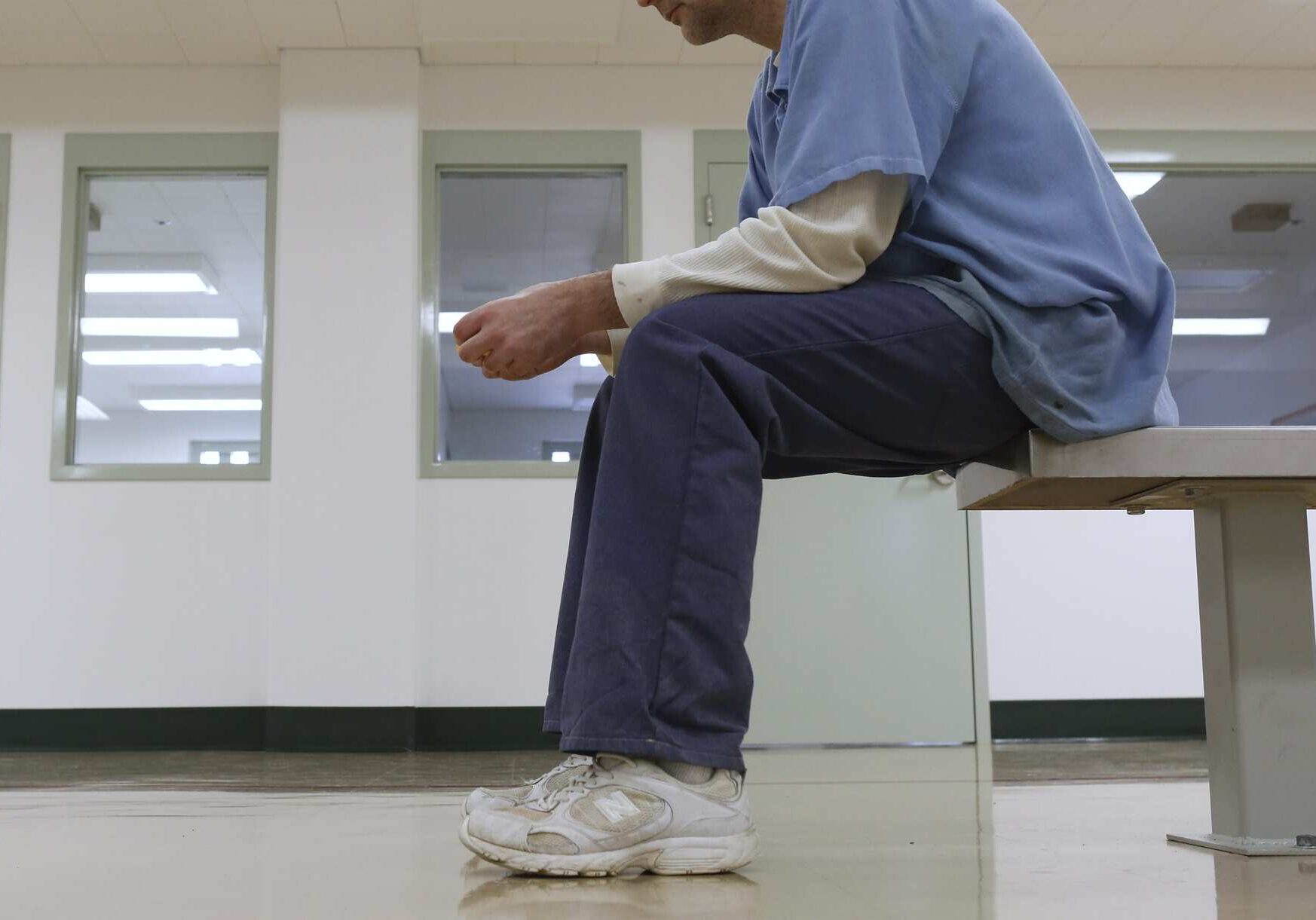
How Johnson County Is ‘Stepping Up’ for Inmates and Mental Health
May 6, 2015 | Mike Sherry | 3 min read
Johnson County was one of four communities nationwide introduced Tuesday as initial participants in a broad effort aimed at reducing the number of mentally ill individuals in local jails.
Dubbed “Stepping Up,” the initiative is a combined effort of the National Association of Counties, the Council of State Governments Justice Center and the American Psychiatric Foundation.
The other participants are Washington D.C., Miami-Dade County, Florida, and Sacramento, California.
According to the Step Up campaign, the nation’s jails hold two million adults with serious mental illness such as schizophrenia, bipolar disorder or major depression.

Johnson County Sheriff Frank Denning addresses the audience at Tuesday’s kickoff of a national campaign aimed at reducing the number of mentally ill individuals who end up in local jails. (Photo: Courtesy of Johnson County)
Campaign officials say it’s two to three times more expensive to care for an inmate with mental illness than someone not so afflicted.
A February 2012 report from the Health Care Foundation of Greater Kansas City estimated that untreated serious mental illness imposes $624 million burden on the metropolitan area.
There are an estimated 94,478 cases of untreated serious mental illness in the Kansas City metropolitan area, according to a documentary that aired last year on Kansas City Public Television.
Johnson County’s inclusion as a participant in the campaign “reflects the hard work Johnson County has already done to help decrease the number of people in jail who have a mental illness,” board Chairman Ed Eilert said in a news release.
By joining the Stepping Up campaign, the county has agreed to a six-step plan to:
- Convene or draw on a diverse team
- Collect and review prevalence numbers and assess individuals’ needs
- Examine treatment and service capacity
- Develop a plan with measurable outcomes
- Implement research-based approaches
- Create ways to track progress
There is no set timetable for completion, according to a county spokeswoman.
Local officials, along with an officer from the National Association of Counties, marked Johnson County’s participation at a ceremony at the Johnson County Crisis Recovery Center in Shawnee, Kansas.
Opened in 2006, the facility has helped approximately 1,300 individuals stay out of the hospital or jail.
Meanwhile, on Wednesday, advocates for the mentally ill from across the metropolitan area are scheduled to kick off their campaign, dubbed “It’s OK to Talk: Mental Health Matters in Kansas City,” as part of the national observance of May as Mental Health Month.
The effort is aimed at encouraging people to start conversations about mental health in their homes, neighborhoods, faith communities and businesses, according to the organizations mounting the campaign.
The kick-off is scheduled to start at 1:30 p.m. at the Kauffman Foundation Conference Center, 4801 Rockhill Road in Kansas City.
Editor’s note: The Health Care Foundation of Greater Kansas City contributes funding to Heartland Health Monitor.
Mike Sherry is a reporter for KCPT television in Kansas City, Mo., a partner in the Heartland Health Monitor team.
Reading these stories is free, but telling them is not. Start your monthly gift now to support Flatland’s community-focused reporting.

Related Stories

The Fight Against Forgetting 9/11
Schools, nonprofits, and firefighters work to ensure Kansas Citians remember the victims of the Sept. 11, 2001, terrorist attacks as the nation marks the 25th anniversary of the tragedy.

United in Opposition: The Bipartisan Response to Data Centers
From Independence, Missouri, to Osawatomie, Kansas, data centers are angering residents and spurring bipartisan opposition.
Nick’s Picks | Map, Recall, Trial and More …
The Missouri Supreme Court takes up a question about a local congressional district, an Independence councilman fights to keep his seat, and a long-delayed murder trial is set to get underway.