
By Kevin Collison
After five years, the developers of 2000 Vine are nearing the finish line of an ambitious historic renovation project that’s now the vanguard of an investment surge occurring in the 18th and Vine District.
The renovation of the two, 150 year-old buildings into a blend of office, retail, a restaurant and the city’s first Black-owned microbrewery is being joined by another $150 million in nearby projects either underway or planned.
Tim Duggan, one of the developers, believes it’s time for Kansas City residents to realize the 18th and Vine District is a strong part of the city’s cultural fabric.
“The perception of 18th and Vine hasn’t caught up to the hundreds of millions of dollars in development here,” he said. “We’re having event after event and its among the safest places in the community.”

Vine Street Brewing is expected to open by early summer in the historic Public Works building.
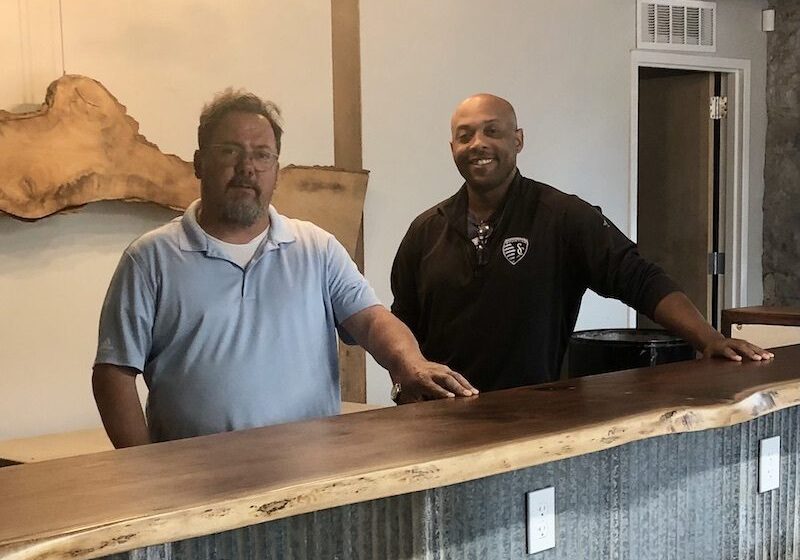
Duggan and Shomari Benton, another partner in the restoration project were sitting in the old City Water Department building, the north twin of the limestone buildings that were in ruins when the project started. The other was the Public Works building.
The project began with an estimated $5 million budget in 2018. Last week, the City Council approved a $950,000 grant to complete an outdoor patio. The funding comes from the Central City Economic Development special sales tax approved by voters.
“It’s been quite a process,” Duggan said. “The vision is starting to come true. We wanted to restore that buildings, not just in terms of of development, but to fill them with people with a similar vision.
“While it took more money, we’re now seeing the light at the end of the tunnel and not a train coming at you.”
Duggan’s firm, phronesis architecture, and Benton’s law firm, Benton, Lloyd and Chung, along with Parsons + Associates are tenants in the north building. Jason Parson is the third partner in the venture.

A patio paved with street bricks salvaged from a small Kansas town is behind the 2000 Vine development.
Other tenants in the north building are Keno G, a tattoo shop in the lower level, Lillian James Creative, a digital marketing and public relations firm, and the Warren Harvey art gallery.
The south building will be the home of Vine Street Brewing which is expected to open by early summer, and The Prospect, a culinary workforce development program operated by Shanita McAfee-Bryant that’s received funding from the Kauffman Foundation.
McAfee-Bryant also operates The Spot café, which serves hot food, pastries, coffee and other items. A small grocery store also is part of her operation in the fully-leased south building.
“We have a collection of talented individuals who represent the community and understand the importance of the history and nature of what Vine Street means,” Benton said.
The lower level of the two buildings opens to a wide patio that’s been paved with salvaged street bricks from Seneca, KS. It offers a view of the downtown skyline and is expected to be popular with Vine Street patrons.
The 2000 Vine development already has proven popular for events, attracting First Friday gatherings, a Gumbo Fest that drew 3,000 people and KC Can, a daylong program where nonprofits apply for grants.

The historic 2000 Vine buildings were in ruins when the development began construction five years ago.
The developers are anticipating even more activity when nearby projects are completed.
They include the 80-unit One Nine Vine apartment project under construction nearby; the proposed $25 million expansion of the Negro Leagues Museum at 18th and The Paseo, and the proposed $10- $15 million renovation of the Wendell Phillips school at 24th and Vine.
The second phase of One Nine Vine planned for the southwest corner of 19th and Vine would be 7,000 square-feet of ground floor retail, a 30,000 square-foot super market, 200 “middle income” apartments and more than 150 parking spaces.
Duggan said the 2000 Vine developers also own another 3.5 acres of vacant land.
“We’re within two blocks of the famous (18th and Vine) intersection and we want to infill that with mixed-use, destination type development,” he said.
Benton credited the city, it approved a 25-year property tax abatement, and the Central City Economic Development program with providing essential financial help.
“The public sector understand what it takes,” he said.
Reading these stories is free, but telling them is not. Start your monthly gift now to support Flatland’s community-focused reporting.
Related Stories

Nick’s Picks | Obama Visits KC, Debates and Fall’s Arrival
Obama in KC With Election Day just six weeks away, some of the nation’s top political names are now rolling through Kansas City. Last week, Vice President JD Vance was in town. This week, it’s Barack Obama. The former president takes the stage Saturday at the Overland Park Convention Center for a leadership event hosted…
Preparations Aside, KC World Cup was Quiet for Hospitals, Police
Officials said months of planning will serve them well in the year's to come through improved collaboration.
Nick’s Picks | Veep, Gerrymandering, Football and More …
Vance Lands in KC Again … Vice President JD Vance will make two stops in the Kansas City area today, his second visit to the metro in less than four months. The White House says Vance will visit a federal law enforcement facility in Kansas City, Missouri, to highlight the Trump administration’s crackdown on fraud….