
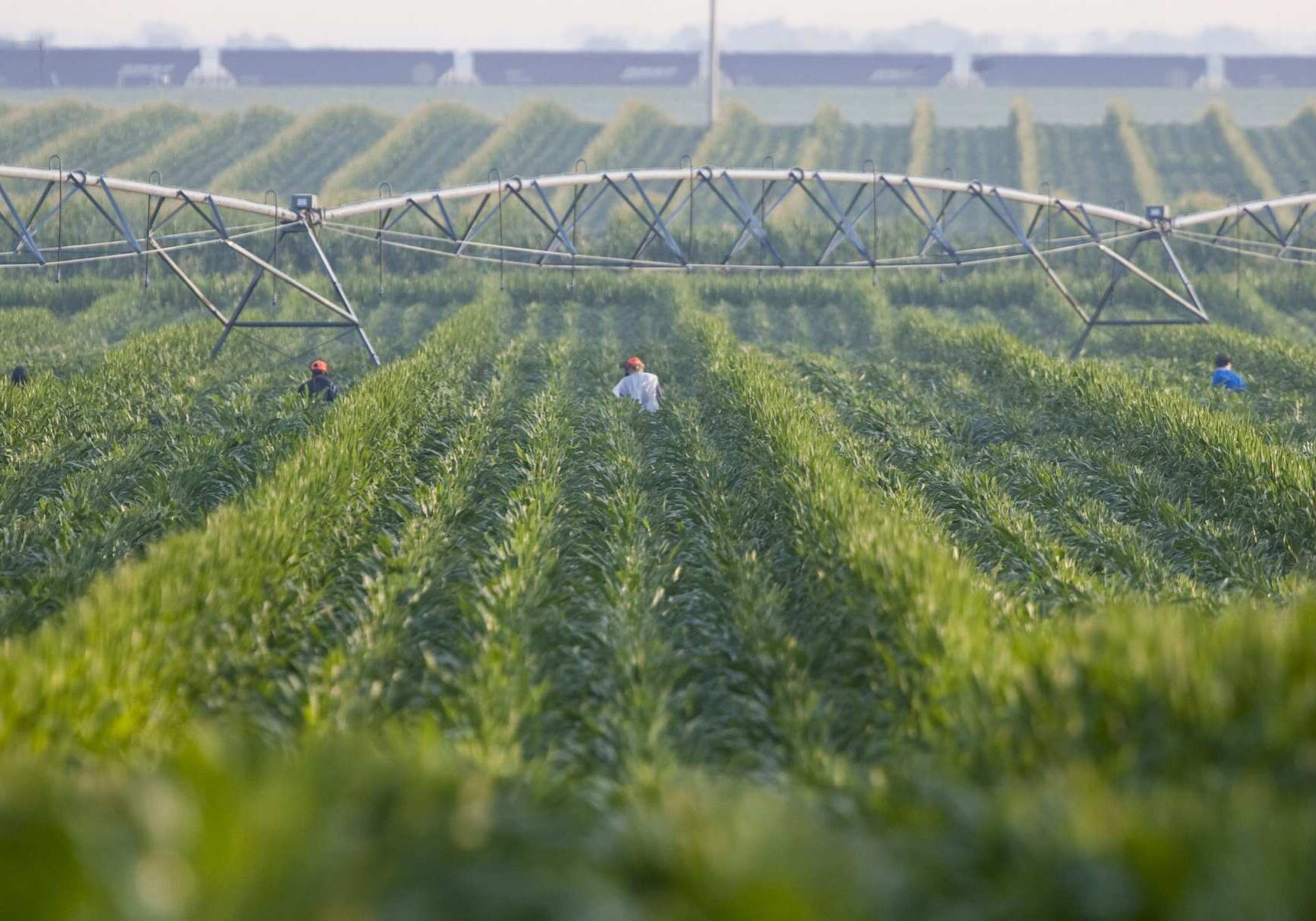
The U.S. Department of Agriculture has announced a new plan that offers incentives to farmers who volunteer to take steps that would help cut agriculture’s contribution to climate change.
Agriculture Secretary Tom Vilsack, speaking to an audience at Michigan State University, said the proposal will give farmers, ranchers, and foresters the technical support and financial incentive to implement more conservation measures on their land and in their operations.
The announcement comes on the heels of President Obama’s Earth Day declaration that climate change poses the single greatest threat to the planet. Fourteen of the 15 hottest years on record have happened this century, with 2014 being the planet’s warmest year recorded.
The new plan doesn’t help farmers who are already struggling under the weight of severe drought. Rather, it looks ahead towards an uncertain future that could include more drought, wildfires, flooding, pests, and disease.
“Over the next decade, Americans from all walks of life will face the growing challenge of a changing climate,” Vilsack said. “In order to address climate change, we have to get ahead of it.”
The USDA’s strategy is composed of ten “building blocks” that encourage producers to take better care of their soil, plant trees, and use fertilizer more efficiently – which reduces nitrous oxide emissions.
“We’re going to focus on the right time, the right type, the right placement, the right application method, and the right rate of Nitrogen fertilizer,” Vilsack said.
“Over the next decade, Americans from all walks of life will face the growing challenge of a changing climate,” Vilsack said. “In order to address climate change, we have to get ahead of it.”
According to the Environmental Protection Agency (EPA), farming accounts for about 9 percent of the country’s greenhouse gas emissions – slightly less than the 12 percent coming from American households.
By 2025, the USDA hopes to limit net emissions by 120 million metric tons of CO2 equivalent per year – comparable to taking about one out of every ten cars off the road.
The plan compliments President Obama’s economy-wide goal to reduce America’s total emissions by 26 percent to 28 percent below 2005 levels, setting the tone for a post-2020 international climate agreement.
The USDA’s strategy also encourages the livestock industry to adopt technologies that cut down on methane emissions from cattle, dairy, and swine operations, supporting 500 new anaerobic digesters – a process in which microorganisms break down manure – over the next decade.
But the plan comes with no real teeth – farmers, ranchers, and foresters are not required to participate in the conservation measures, and Vilsack admitted that neither he nor the USDA has the power to convince them to participate. Still, Vilsack said he could draw on programs in the 2014 Farm Bill that would encourage farmers to adopt the cleaner practices.
Speaking specifically about livestock producers adopting anaerobic digester technology, Vilsack said, “What USDA and what I can do is provide technical and financial support to make it work. Who will convince that farmer is another dairy farmer,” he said. “A dairy farmer who has adopted anaerobic digester technology and is seeing lower energy costs on their facility.”
Vilsack ended his remarks at Michigan State saying that climate change demands that the agriculture industry adopt what American ecologist and author Aldo Leopold called “The Land Ethic.”
“The land ethic simply enlarges the boundaries of the community to include soils, waters, plants, and animals, or collectively: the land,” Vilsack said, quoting from Leopold’s A Sand County Almanac.
“In short, a land ethic changes the role of people from conquerors of the land and community to plain members and citizens of it. It implies respect for his fellow-members, and also respect for the community as such.”
For more food and field stories, visit Harvest Public Media.
Reading these stories is free, but telling them is not. Start your monthly gift now to support Flatland’s community-focused reporting.

Related Stories

Nick’s Picks | Soccer, Elections, Entertainment and More …
It's a soccer extravaganza in Kansas City, with the city reaching its halfway point as a host city and the City Council set to consider a bond package to expand the Kansas City Current stadium.

Nick’s Picks | Fan Fest, Streetcar, Liquor and More …
World Cup Begins The wait is finally over. The first ball of the 2026 World Cup will be kicked Thursday, ushering in 5 ½ weeks of competition across the United States, Canada and Mexico. It’s also opening day for Kansas City’s FIFA Fan Fest at the National World War I Museum and Memorial—our first real…

Nick’s Picks | Messi, Jail, Buses, and More …
World Cup Team(s) Arrive It’s starting to feel real. The first World Cup team has landed in Kansas City. Defending champions Argentina touched down at KCI airport on Sunday and will begin practicing today at Sporting KC’s training facility in Wyandotte County. Much of the attention, of course, is focused on Lionel Messi. The soccer…