
Medicaid expansion still on table in Kansas, Missouri following elections
November 12, 2014 | Jim McLean, Kansas News Service | 5 min read
Kansas hospitals are moving ahead with plans to put a Medicaid expansion plan before lawmakers despite election results that returned Gov. Sam Brownback to office and solidified conservatives’ control of the Legislature.
Democrat Paul Davis favored expansion but came up short in his bid to upset Brownback, a Republican who thus far has opposed expansion. Also, several Democratic House members who likely would have favored expansion lost narrowly to GOP challengers.
Similar results across the country prompted national observers to declare expansion unlikely in Kansas and four other states where candidates who opposed expansion won close governor’s races.
“No one would say it was a good night for the prospects of Medicaid expansion,” Joan Alker, director of the Center for Children and Families at Georgetown University, told Kaiser Health News.
Twenty-eight states and the District of Columbia have expanded Medicaid eligibility, while Kansas and 20 other states have not. Policymakers in two states are considering the issue, according to the nonpartisan Kaiser Family Foundation.
Signals sent
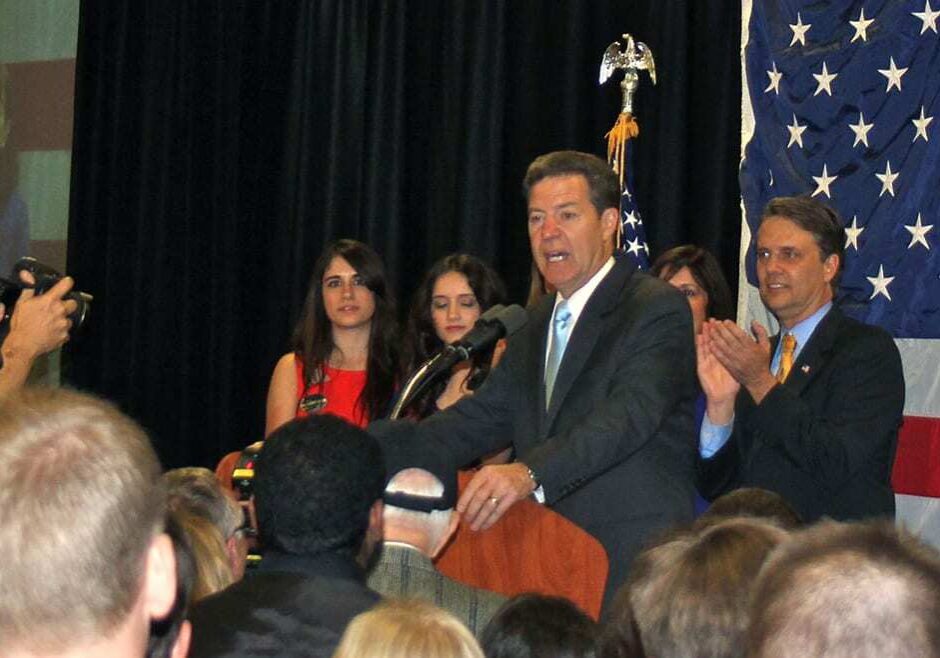
When talking to reporters on election night, Brownback gave no indication that he had changed his mind on Medicaid expansion.
“If you’re talking about Obamacare,” he said, “we’ll look at things another day for that.”
Tom Bell, chief executive of the 136-member Kansas Hospital Association, doesn’t expect an immediate change of heart. But now that the election is over, Bell said, he has reason to believe the Brownback administration and some legislative leaders will be more open to discussing expansion.
“Yes, we’ve had folks in the administration that have indicated that after the election this would be a different kind of discussion,” Bell said. “And we’re counting on that. We certainly plan to move forward.”
In Missouri, Sen. Ryan Silvey also intends to press ahead. The Kansas City Republican said “more and more people are coming to the realization” that expansion is needed to protect hospitals.
“It’s going to be damaging to our hospitals if we don’t do something,” Silvey said in late October.
Under the Affordable Care Act, disproportionate share hospital funds, which the federal government pays to health care providers to offset the costs of charity care, will be phased out starting Oct. 1, 2015. When the law was written, it was assumed hospitals would no longer need the disproportionate share hospital payments because millions of previously uninsured Americans would have either subsidized private coverage or Medicaid.
A study published in August by the nonpartisan Urban Institute said that not expanding Medicaid would cost Kansas and Missouri hospitals more than $9 billion in federal funding over a 10-year period. Losses would total $2.6 billion in Kansas and $6.8 billion in Missouri from 2013 to 2022, the report said.
The health reform law requires the federal government to shoulder all Medicaid expansion costs for three years. After that, the federal share will gradually decline until it reaches 90 percent, where it will remain.
About 300,000 low-income Missourians would gain coverage under expansion. In Kansas, expansion would extend coverage to an estimated 151,000 people with annual incomes up to 138 percent of poverty – $16,104 for individuals and $32,913 for a family of four.
Missouri lawmakers were close to striking a deal on Medicaid expansion last spring at the end of their regular session. Silvey has said the retirement of some the lawmakers who blocked the deal may help him gain approval of a compromise proposal in the upcoming session.
A Kansas plan
The Kansas Hospital Association has been working for months on an expansion plan that will be unique to the state, Bell said. Like plans crafted in states headed by Republican governors opposed to the ACA, the Kansas proposal likely will call for subsidizing the purchase of private insurance for those made eligible by expansion. And it will be tailored to work with KanCare, the state’s already privatized Medicaid system, he said.
“We have a private program right now,” he said. “It is being administered by private insurance companies. It just seems to us that we ought to build on that.”
Recognizing that the state’s growing budget problems loom as an obstacle to expansion, Bell said the KHA proposal will include a funding mechanism to lessen its cost to taxpayers. Funding options under consideration include raising a state assessment on hospitals. The state uses the assessment to bolster Medicaid rates paid to hospitals. That, in turn, triggers an increase in federal matching funds.
Expanding Medicaid eligibility would increase the amount generated by the assessment because of the higher federal match rate. But raising the assessment rate also is a possibility. Currently, hospitals pay assessments equal to 1.83 percent of their revenue. Federal law allows for assessments of up to 6 percent.
Good timing
A possible upside to the election results is that the Republican takeover of the U.S. Senate could motivate Obama administration officials to be more flexible when negotiating with states, Bell said. It could make them more open to Medicaid expansion proposals designed to appeal to conservatives that include elements such as work requirements and higher copays and deductibles.
Wyoming officials also appear to be banking on that. Just a few days after the election, Republican Gov. Matt Mead said he was moving forward with a Medicaid expansion plan tailored to “needs” of the Cowboy State.
“Some of the areas we’re looking at is people who are on the program, that they have some of their own, as it’s said, ‘skin in the game,’” Mead said in the Casper Star-Tribune. “In other words, they would pay a portion of the premium; they would pay a portion of the deductible. There would be a workforce development plan involved in it. And those types of things, I think (federal officials) are more open to than they were a year ago, and certainly more than two years ago.”
Reading these stories is free, but telling them is not. Start your monthly gift now to support Flatland’s community-focused reporting.
Related Stories
Kansas City Cooks as Site for National Anti-ICE Dinner Series
Celebrated chefs from throughout the metro collaborated for three nights on dinners that raised money for a local immigrant-rights nonprofit.
Nick’s Picks | Top Cop, Mission Mall, Lucas’ Travels and More …
Nick Haines also has the lowdown on information for the upcoming election, the arrival of fall and Kansas City's Day of the Dead celebration.
Nick’s Picks | I-70, Tax Break, School Petition, and More …
An Interstate 70 closure, a tax rebate for Jackson County property owners, a school closure petition, and more ...