
Historic Pickwick Plaza Gets Its Landmark Clock Back Just in Time for Grand Opening
July 20, 2017 | Kevin Collison | 4 min read
By Kevin Collison
The historic Pickwick Plaza in downtown Kansas City is back on the clock–literally–after a $65 million redevelopment project.
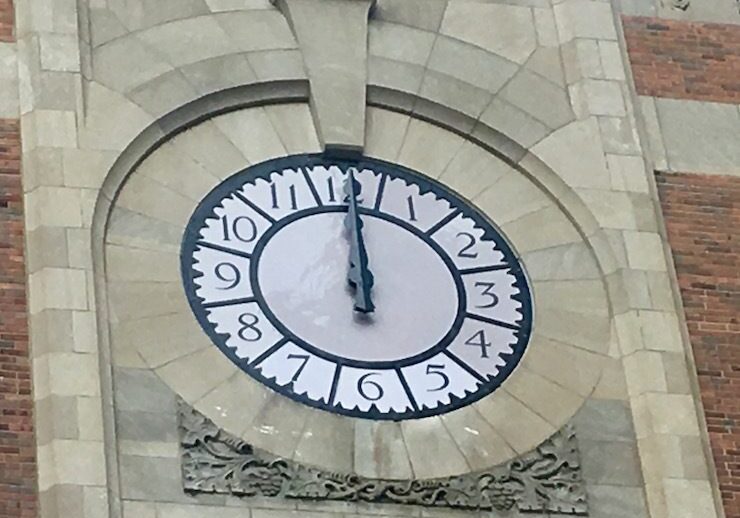
On Wednesday, workers were reinstalling the eight-foot diameter clock mounted seven stories above McGee Street, one of the final touches before the grand opening Friday of the 260-unit apartment development.
“That clock is symbolic of the long journey to bring that grand building back to life,” said developer Tom Smith of Overland Park. “I’m please to be part of this amazing building.”
Smith began pursuing the redevelopment of the historic complex at 933 McGee St. in 2009. The complex covers almost an entire city block northeast of 10th and McGee.
When it opened in 1930, it was one of the biggest downtown developments. The complex included an 11-story hotel, interstate bus terminal, garage and six-story office building all unified in the “streamline Gothic” style.
At its peak, the bus terminal handled 4,433 scheduled departures per month. Harry Truman used the hotel as a retreat during the 1930s to write his journal known as the “Pickwick Papers.”
But over the years, the buildings gradually were abandoned.
The Pickwick bus operation folded long ago, the office building was vacated more than 30 years ago, and the old hotel, which lived on for awhile as an elderly housing development, closed in 2009. Smith estimated the clock had been broken for 60 years.

Workers reinstalling the old clock at the historic Pickwick complex.
Clock restorer David Seay said the entire lower third of its aluminum face had been ruined by pigeon droppings when he first saw it last spring.
“We had to recast the bottom half of the face,” Seay said. “That stuff is nasty.”
Seay, who runs the A Regulator Time Co. of Manhattan, Kan., was taking a break from his repair job along with his helper Johnny Cox of Haren Laughlin construction, the contractor on the Pickwick project.
He said the clock was manufactured by Electric Time Co. of Medfield, Mass. It used a unique “impulse” system in which the clock’s four-foot hands didn’t move until 24 volts built up. Then they would click one minute. He replaced the original 24 volt impulse unit and its now digitally controlled for accuracy.
It cost about $20,000 to repair the clock. Besides replacing the impulse motor and aluminum face panels, the original manganese glass cover was broken and Seay had to find its replacement in St. Louis.

The two-level lobby of the historic Pickwick complex is among its amenities.
Smith, president of Gold Crown Properties, said the clock had to be repaired authentically to meet the preservation standards required to qualify for the state and federal historic tax credits that helped finance the Pickwick redevelopment.
The developer is relieved the clock will be ready for the grand opening of the apartment project, which is called East 9 at Pickwick Plaza on Friday. Mayor Sly James is scheduled to be among the speakers.
“We’ve been waiting anxiously for months for that clock to come,” Smith said.
The apartments are about 70 percent leased and Smith said has been averaging about 12 new leases each week. It’s part of a wave of new apartment developments in downtown and because its units are smaller on average, it appeals more to a millennial market.
In addition to the apartments, the Pickwick features grand two-story lobby, a fitness club and indoor pool. The architect for the redevelopment was Helix Architecture + Design.
The original architect of the complex was Wight & Wight, a Kansas City firm that also designed the First National Bank building, now the Central Library, and the original Nelson-Atkins Museum of Art building.

The Pickwick clock was mounted above the old bus terminal.

Johnny Cox (left) and David Seay take a break from their work reinstalling the Pickwick clock.
Reading these stories is free, but telling them is not. Start your monthly gift now to support Flatland’s community-focused reporting.
Related Stories
Nick’s Picks | Costco, Homicides, Rain and More …
Is Missouri's congressional map saga over? It seems so, but who knows if there will be another twist or turn. That story and more ...

Nick’s Picks | Obama Visits KC, Debates and Fall’s Arrival
Obama in KC With Election Day just six weeks away, some of the nation’s top political names are now rolling through Kansas City. Last week, Vice President JD Vance was in town. This week, it’s Barack Obama. The former president takes the stage Saturday at the Overland Park Convention Center for a leadership event hosted…

Preparations Aside, KC World Cup was Quiet for Hospitals, Police
Officials said months of planning will serve them well in the year's to come through improved collaboration.