
Harmony Project Helps Young Northeast KC Musicians to Thrive
May 19, 2023 | Martin Rosenberg | 8 min read
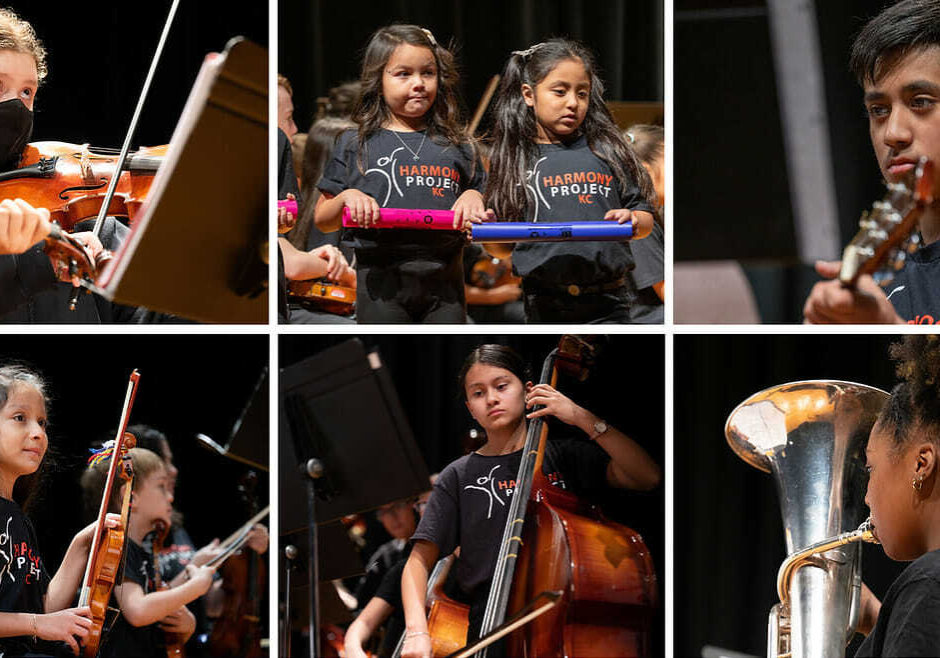
She sits in a chair, feet above the floor, swaying to the music she coaxes from her small violin. On her face, there’s the thinnest smile of self-satisfaction.

For her and her friends, gone, for the moment, are memories of fathers exhausted after mowing lawns across a vast swath of Johnson County…
… and of mothers tearfully talking by phone with loved ones left behind in desperate straits outside of Mexico City or in Guatemala…
… and of the crack of a drive-by gunshot in the middle of the night.
For the youth across Historic Northeast Kansas City lucky enough to be embraced by Harmony Project KC, prospects brighten on multiple fronts.
It starts with taking responsibility for an expensive instrument.
Then comes self-confidence.
Academics? A breeze.
Their parents get language tutoring for themselves — and then get mentored on navigating FAFSA college financial aid forms for their children.
Free Concert
Citlali, a buoyant Lincoln College Prep senior, is bound for Rockhurst University in the fall and is close to having tuition fully covered by scholarships and aid.
She is one of eight seniors at Harmony Project KC who are all going on to college, many of them the first in their families to do so. This is in a neighborhood with a 40% high school dropout rate, where 36% of families live below poverty levels and the streets are beset with one of the area’s highest crime rates.
The octet was accepted by 51 colleges this spring eager to tap into the disciplined, skilled, inspired and whip smart youth who have spent years honing their musical skills through one of the nation’s most innovative music training and nurturing programs.
Michael Stern, the music director of the Kansas City Symphony, is a fan.
If you have coffee with him and ask him about memorable chapters of his tenure in the city, which will end the conclusion of next season, it is not long before he is touting Harmony.
It is a rare, largely unknown Kansas City jewel.
The graduates and their younger colleagues, whose families hail from 29 countries, will give a free concert Saturday, May 20, at 10:30 a.m. at the Folly Theater accompanied by award-winning Jamaican American violist Jordan Bak.

‘Safe Haven’
Harmony is based in somewhat tight quarters at the eight-decade-old Northeast Community Center (NECC) at 544 Wabash Ave. in Kansas City.
Backers believe they have amply proved the worth of the concept behind the program and are out to expand it and its impact.
Michael Gordon, the principal flautist at the Kansas City Symphony, has been involved in Harmony since its inception.
“Service through music is incredibly important to me, using music as a platform to promote tangible change in the community,” he said.
Gordon, who started playing flute when he was 8 or 9 years old, said that for the youth coming through Harmony, many from challenging backgrounds: “Harmony is a safe haven, a sense of community with other kids, instilling incredible pride. It really transforms their lives.”
Carmen Eppright, a native of Peru, was recruited by Laura Shultz to help start Harmony in Kansas City in 2015 with 33 students.
Shultz, in turn, was encouraged by Stern to nurture the program. She is a former pediatric nurse and commercial photographer with a passion for nonprofits.
Participants troop to the Northeast Community Center three days a week — two weekdays after school and on Saturday.
Success Stories
Harmony started with 33 students in three grades and in eight years has grown more than 10-fold, Shultz said.
Three years ago, three high school seniors who completed Harmony became its first high school graduates.
One student this year has secured a full scholarship to Washington University. She intends to come back to Kansas City and work in immigration.
Here are this year’s graduates, listed by first name to protect their privacy, the schools they will attend and their areas of study:
- Anaely: UMKC, Psychology.
- Carely: UMKC, Undecided.
- Citlali: Rockhurst, Physical Therapy.
- Jaqueline: Washington University at St. Louis, Urban Studies and Spanish with Pre-Law.
- Rosa: UMKC, Psychology and Nursing.
- Roselyn: MCC Maple Woods, Veterinary Technician.
- Sophia: UMKC, Music and Computer Science.
- Marlon: UMKC, Business
Before Harmony, some had never been to a Royals game…
… until they were invited to play on an opening day.
Some had never heard of Yo-Yo Ma…
… until they got to play with him when he dropped by in 2018.
Many live in parts of the city that have poor populations and crime, and they need a safe place after school.
Harmony is that safe place, Shultz said.
Performing at the Kauffman Center
Inspirations
The NECC opened in Northeast Kansas City to support immigrant families. It was led by the late Charles Shangler, a former judge on the Missouri Court of Appeals, who years ago noted, “that mission continues in an even broader compass today with Harmony Project KC.”
Shultz said the roots of the effort and its inspiration go back to the now legendary El Sistema program kicked off in Venezuela in 1975 to divert poor youth from despair and crime.
A similar program has flowered in Los Angeles, where 3,500 students currently are at programs at 16 sites, according to Devon Sherwood, spokesperson for Harmony Project Los Angeles.

Here is how it works in Kansas City today, according to Gordon: “Before they pick up an instrument they learn to sing. The instrument then becomes a special thing. It transforms their lives.”
The miracle that happens at Harmony is not easily achieved, though.
“One pressure point is money,” Gordon said, “for instruments, for space.”
He continued: “Fantastic teachers don’t grow on trees. We are always recruiting, locally.”
Nina Kraus at Northwestern University three years ago studied the academic outcomes of students who have gone through the program and determined there was a measurable improvement in their academic performance.
In an email, she told Flatland that “sound connects us” and has a “biological impact on us.”
In a statement, Stern said, “Harmony Project KC is one of the most inspired, important, and transformational things to happen to the musical, cultural and educational landscape of Kansas City in a long time.”
Gordon said, “Music has the power to create social change and uplift young people.”
The youth, being young, would phrase that a bit differently.
Beautiful Music
Fourth grader Jazmine, who has been playing violin for two years, already has a plan to attend the University of Missouri-Kansas City and become a doctor.

For now, she most appreciates her engagement with the music.
“I like how you can go fast and long,” is how she put it.
Citlali loves to work out and plays soccer and volleyball. At Rockhurst, she wants to learn how to be a physical therapist.
She is 17 and started playing when she was 11.
“I started with a recorder. After workshopping with a cello, violin and viola I was most comfortable with a cello,” said the slight teen who could easily crawl into her cello case if she ever wanted to hide out.
But she is no recluse.
“I want to be out there. Cello is really out there. It is big and loud!”
After a musical pause, she hits one more note: “And I get to sit down!”
Martin Rosenberg is a Kansas City journalist and host of the Grid Talk podcast on the future of energy.
Reading these stories is free, but telling them is not. Start your monthly gift now to support Flatland’s community-focused reporting.

Related Stories
Nick’s Picks | Messi, Jail, Buses, and More …
World Cup Team(s) Arrive It’s starting to feel real. The first World Cup team has landed in Kansas City. Defending champions Argentina touched down at KCI airport on Sunday and will begin practicing today at Sporting KC’s training facility in Wyandotte County. Much of the attention, of course, is focused on Lionel Messi. The soccer…
World Cup ‘Statement Piece’ Evokes Best Version of Kansas City
Before I moved to Kansas City almost 56 years ago, I had been here only once — for a brief visit to the Kansas City Press Club when I was attending the University of Missouri School of Journalism. But because of that visit and the fact that I grew up in the Midwest (Woodstock, Illinois,…
KU Center Helps Women Gain Foothold After Incarceration
A flier from her probation officer was the turning point for Jodi Whitt, who had spent more than two decades in and out of the criminal justice system. The piece of paper introduced Whitt to the Technology Education Program offered by the University of Kansas’ Center for Digital Inclusion. Since 2019, Whitt has risen through…