
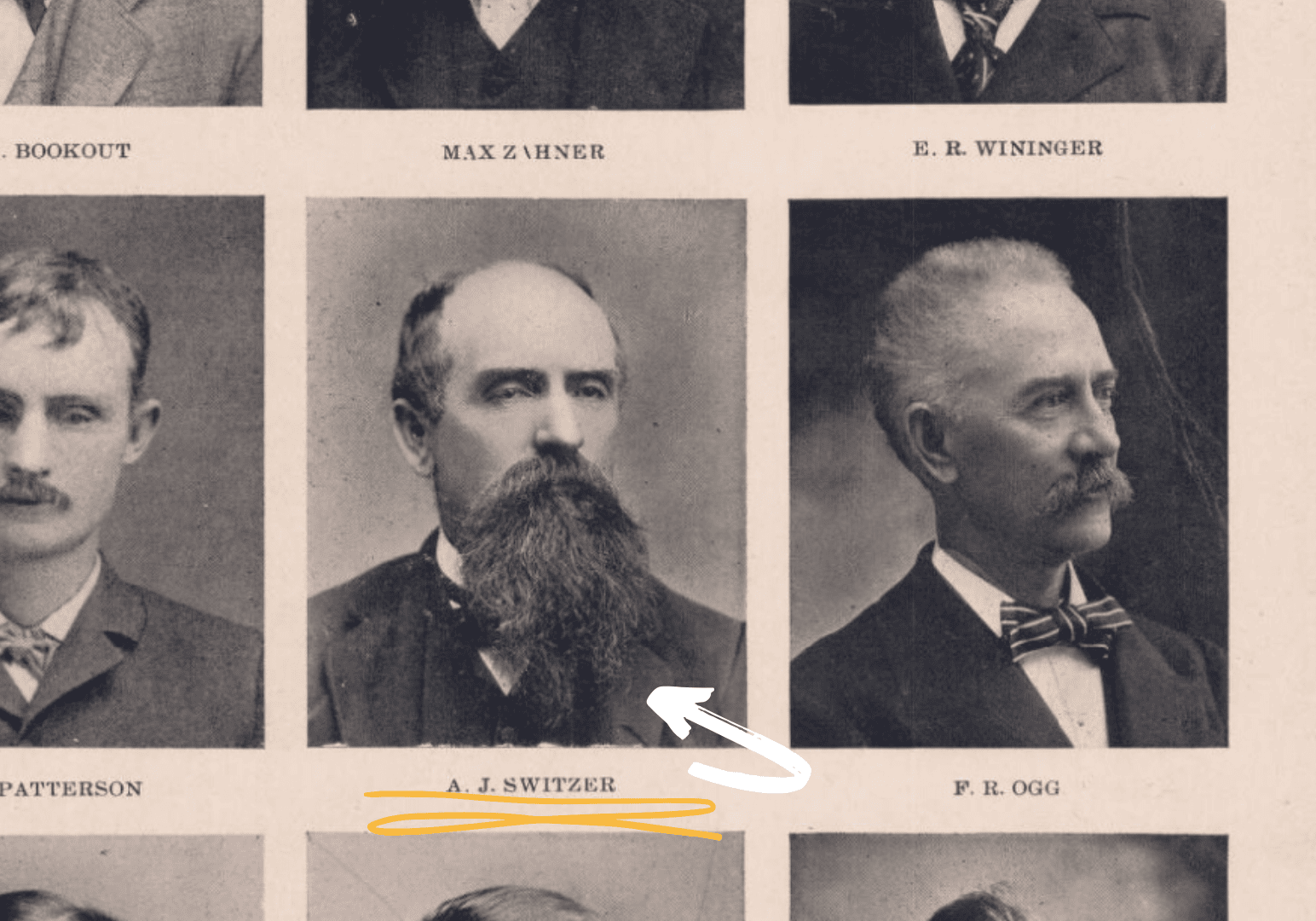
Sometimes recurring themes emerge from the cacophony of curiousKC questions from readers. In recent months, this has been among the most popular. How do you correctly say “Switzer Road”?
Let’s start with a quick trip down history lane.
The story begins with a man by the name of A.J. Switzer who was a “farmer and stockraiser,” according to the 1902 Atlas Map of Johnson County. The date next to his name in the Patrons Reference Directory suggests that the family settled in the Overland Park area in 1870.

“It is likely the street was named for him, or rather for his property, which the northern portion of the road ran directly along,” Andrew Gustafson said in an email. Gustafson is the curator of interpretation at the Johnson County Museum.
Today, Switzer is a larger road in the central and southern portions of the county, Gustafson explained. The intersection of 75th Street and Nieman Road would be right in the heart of section 23 on the map below, which was once the Switzer property.

Because he was a farmer, A.J. Switzer also may have been involved in the Shawnee Grange, an organization formed to educate and connect area farmers.
The Switzer family’s property was close to another well-known family, the Breyfogles, who settled in Johnson County in 1866. The Breyfogles were among the families responsible for the early development of what is now Overland Park. (Overland Park celebrates the 60th year anniversary of its incorporation this year.) The original Breyfogle homestead is at 7108 W. 86th St., built around 1890, according to the Johnson County Museum blog.
Here’s where it gets interesting.
Two streets were named after the Breyfogle family and noted in a 1922 Atlas Map. But, as luck would have it, those streets would later be renamed Switzer Road. That twist in the story brought us back to the original question about how to correctly pronounce the road.
“It is Sw-Eye-tzer – long i,” Gustafson said. “The office here all agrees on that.”
Reading these stories is free, but telling them is not. Start your monthly gift now to support Flatland’s community-focused reporting.
Related Stories
A Black Friday Romp Through the Metro’s Shoplifting History
Not long ago a woman walked into an Oak Park Mall bath and body store carrying two shopping bags. She lingered for two hours, examining the scented candles. Then the phone of Detective Byron Pierce of the Overland Park Police Department buzzed. The caller was an employee of the store. “Everything okay?” Pierce asked. No….
A Better Big Blue Battlefield in Kansas City | Part III
Editor’s note: This is the final installment of a three-part series on the restoration of the Big Blue Battlefield in Kansas City, Missouri. The engagement on the Big Blue Battlefield was pivotal in the larger Battle of Westport, an October 1864 clash that effectively ended organized Confederate military operations in Missouri. As the years receded,…
A Better Big Blue Battlefield in Kansas City | Part II
Editor’s note: This is the second installment of a three-part series on the restoration of the Big Blue Battlefield in Kansas City, Missouri. In the mid-19th century, overland trail teamsters driving wagons west sometimes followed a branch of the Santa Fe Trail out of Independence, using the shortcut to reach fields where the animals used…